

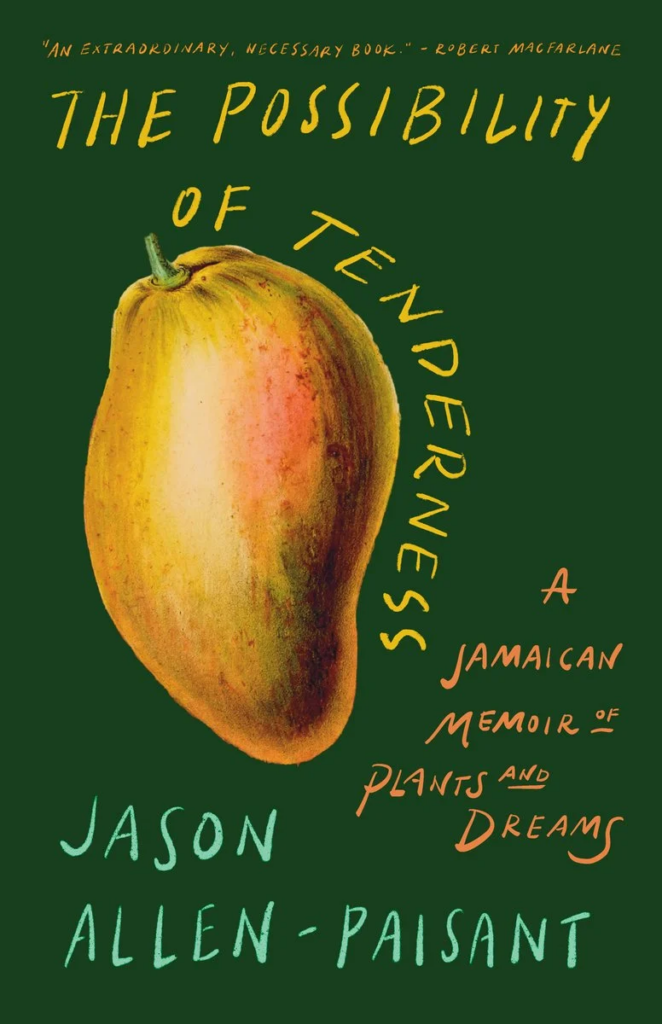
 In The Possibility of Tenderness: A Jamaican Memoir of Plants and Dreams (Milkweek Editions; Sept. 2025), author Jason Allen-Paisant tells an acquaintance what his book is about:
“I’m writing a book that narrates my childhood in rural Jamaica and my experience of walking with my grandmother. I talk about her way of walking, I say to him, about her relationship to plants, trees and the woodlands, as a stepping off point for a journey of recollection and discovery…The plants I speak about, the people I portrait, the stories I tell about the land, are my ways into describing a new form of living while Black in a country like Britain,” he writes.
His acquaintance sums up the book nicely. “It’s about Black people going into the countryside, but it’s also about the countryside seeing Black people…Everybody deserves to be seen.”
Allen-Paisant juxtaposes his childhood in Jamaica with his current middle-class life in Leeds, UK, to link his childhood experiences to his present life. He was raised by his grandmother until he was seven while his mother was at teacher’s college, then moved with his mother to a different town. His grandmother has long passed by the time he makes this trip, but his mother is renovating his grandmother’s house so she can live there. Allen-Paisant walks the same paths he and his grandmother walked when he was a child, identifying plants as a way of respect for them. He connects work in Jamaican grungs (garden plots) with the lack of ability to put his hands in dirt in Leeds, noting that English people are missing “the magic.”
He fits easily into his village again, reverting to the local patois and revisiting his childhood haunts. He connects with people from his past, and visits their grungs, where they plant medicinal plants and vegetables, particularly different varieties of yam. The text is scattered with photographs of the plants he sees.
But Allen-Paisant writes that he is “ashamed to say that [he] came from [Jamaica].” He wants to share photos of his trip with his “worldly” friends, but didn’t want to “[hurt] their image of me.” He visits the post office he used to play in as a child while his grandmother worked there, and finds it much smaller than he imagined. He is ashamed that he would have found this 3×4 meter building large as a child, but tells himself to get over it, remembering the 5-year-old boy he would have been at the time. But his shame means he has to justify his poor upbringing. He mentions twice that he is staying in a “nicer” hotel in downtown Kingston, and lists off the places he’s visited around the world: Canada, Britain, Paris, Martinique, the Bahamas.
We share Allen-Paisant’s awe in unearthing the old maps and deeds of his village’s history, as he explores the archives in Kingston to discover the chain of ownership of his village. He realizes that what he learned in school, that it was all sugar cane that was planted, was incorrect as coffee was a major crop. The slave holders were mostly Scottish and British people who had fled from the enclosures in England and now could lord it over the Jamaicans. Now the coffee growers are gone and the land has been reclaimed by the grungs and homes of the local people.
Allen-Paisant makes the connection between the plants he sees in Jamaica and knows the names and uses of, versus the plants he sees in Leeds and doesn’t know the first thing about. He laments his lack of familiarity with the plants and finds it odd that people walk without looking at or for specific plants. When he joins a Black person’s walking group for a day, he meets a (White) man who grows medicinal plants in his back garden and invites Allen-Paisant to come and visit. It’s a way of recreating a little bit of Jamaica in the UK.
He also refers glancingly to the perils of being a Black man in a dominantly white society in a public space on his own. How people perceive him and how they react. This mirrors his experience in Jamaica, where white people—and light-skinned Jamaicans—are treated differently than the locals. There are glimmers of this juxtaposition, as when Allen-Paisant talks about standing on a tree stump in the forest in Leeds, a Black man in black clothes, and how he must seem to passersby.
I did enjoy the explorations of his childhood home, and the descriptions of different grungs. Especially the one of the medicine man, who uses his plants to treat various illnesses. I was also intrigued by his excavation of the colonial history of Coffee Grove, including his visit to a plantation owner’s home which is now a museum.
This book digs deep into the connections Allen-Paisant’s Jamaican community has to the land, and what that land offers in return: food, medicine, well-being, community. It makes his middle class life in Leeds difficult to reconcile with his poor childhood. In fact, when he does go back to Leeds at the end of the book, he notes that he rarely walks in the woods anymore. This is a heartfelt ode to All-Paisant’s Jamaican childhood and how he perceives it looking back from midlife.
 Sarah Boon, PhD, has written for the LA Review of Books, the Times Literary Supplement, Science, Nature, Undark, and other outlets. Her first book is “Meltdown: The Making and Breaking of a Field Scientist,” and she’s at work on her next book. She lives on southern Vancouver Island (Quw’utsun lands) with her husband and dog.