

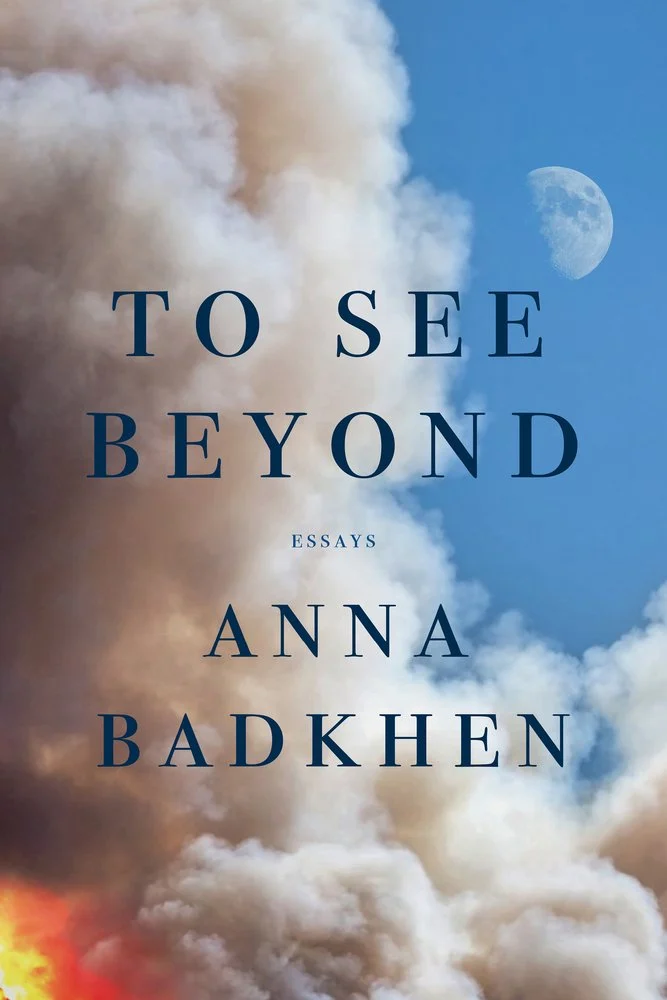
 As much as I love essays as a form, I often find collections of them uneven. Written under different pressures and moods, the variation between collected essays strikes me as baked in. So, it has been a while since a book of essays astounded me on every level — from the quality of individual sentences, to the range of subjects, to the author’s expert sensitivity. Anna Badkhen’s essay collection, To See Beyond (Bellevue Literary Press, April 2026), pulled me along like a hooked fish that gives in to being reeled, not reluctantly, but drawn by some unknown, compelling force.
Badkhen writes from no fixed shore. It’s a book of essays that examines what it means to be human during global crises, including climate change, war, displacement, and migration. Her narrative stance is, by turns, expat, immigrant, migrant, as well as war correspondent, literary scholar, and from what can only be described as her unique vantage point, which leans both emotionally expansive and somewhat erudite.
Her subject categories blur and overlap as she traverses a wide range of topics, often featuring other migrants, immigrants, and expats. She shifts between climate change to existential crisis, from the political to the deeply private, moving between subjects with the ease of a child doing flips in water, weightless, unconcerned with the surface. To See Beyond inhabits instability not as a problem to be solved but as a vantage point, a way of seeing that only the unmoored can manage. In Badkhen’s collection, we experience the vastness of her prose as if translating between languages—an argument, in itself, for why each subject matters.
Born in Soviet Russia and coming of age during the post-communist era, when Leningrad reverted to St. Petersburg, Badkhen, as our translator, brings an elegiac quality to things lost, things slightly out of reach. In her preface she writes:
“I love to stand, after sundown, outside my friends’ hearths, just beyond that circle of calm domestic light. The world behind me has quieted into sleep, and the golden halo of lamp or candle or cooking fire holds my loved ones as if in an ark. From where I stand, outside, I like to imagine that my friends are safe, even if they aren’t, and warm, even if they aren’t.”
In many ways this reveals the project of the book: to look at the precariousness of the modern world and find deep and lasting connections in the relationships we forge both because of and in spite of the hazards we encounter. The imagined world and the actual one, in a Badkhen essay, must find their uneasy equilibrium.
Badkhen often manages her artful balances by threading literature and literary reading through essays about war and war-torn countries, about climate change, about immigration and migration. Perhaps I’m showing my rather nerdy heart to admit how I admired how these literary references interlaced with actual circumstances enhanced my understanding of both. She writes about the war in central Mali while calling on Soviet folklorist Vladimir Propp, sharing, as if by personal incantation: “The story begins when the hero absents herself from home.”
This insight is slantly mirrored in a later essay, “The Book of Conjuring,” where Badkhen recounts a teenage friendship through the reading of a Yiyun Li novel, describing both the book and her own narration through their limitations: “The problem with a first-person narrative is that we get only the narrator’s point of view.” In both, Badkhen is drawn to the edges of what a story can contain, the hero who cannot know what she left behind, the narrator who cannot see beyond herself. This is her translational dilemma, and Badkhen wears it honestly: to write is always to hint at what falls away.
Badkhen writes in the tradition of Montaigne, not the Montaigne of the academy but the original one, for whom the essay, as a form, is both restless and reaching, the self its instrument of inquiry. Badkhen’s essays illuminate literature through the personal, offering stories that function, if not quite as archetypes, then as parables of the modern world: the displacement, the longing, the difficulty of belonging anywhere completely.
Her most ambitious essay, “The Sermon on Mount Gurugu,” brings all of these forces to bear at once, weaving the impossible plights of migrants against the backdrop of environmental ruin, such as the Rohingya people clearing forest wood for shelter as they flee Myanmar, or the mostly Black migrants squatting in caves on Mount Gurugu, a 2,953-foot mountain in Morocco from which these hopefuls can see Spain, which is to say the potential for a better life. Drawing on Ávila Laurel’s novel of these specific migrants’ plights, Badkhen artfully pulls apart the ongoing struggle of people in conflict with the natural world. It comes to a head in the Laurel novel when migrants hunt and eat Barbary macaques, a protected monkey that lives on Mount Gurugu, for which police imprison these migrants:
“…living in a makeshift camp pits migrants not merely against the natural world but also against the structures charged with protecting it: Environmental concerns — or their pretense — become yet another cause for the sedentary to persecute the migrant.”
The migrant’s plight and the environmental plight become a single knot, a loop with no logical conclusion or humanitarian end. So too, the real migrant and the migrant in literature become enmeshed, showing how the tale remains true and complicated in either scenario. Badkhen never hews far from what is intensely human. That is her anchor, even as everything else shifts, as she weaves her own migratory experience into the larger context:
“I am a migrant. I moved to the United States from Russia because I was looking for a better life for me and my children; this makes me an economic migrant. Who, me? I often forget. I don’t fit the stereotype. But the stereotype is contagious; it has infected me, too, dislocated my sense of reality.”
Given the difficulty and complexity of her subjects, it would be easy to assume the book is bleak, when it is, in fact, infused with hope and wonder, not the easy kind, but the kind that has been earned through clear-eyed witness. Many of her shorter, flash-length essays open into astonishment precisely because she has not looked away from the difficult truth. In her micro-essay “How to Fly Kites,” Badkhen arrives at an image of wonder so physical and so precise it stops the breath: arms raised, hands open, as if tethering a kite to the pure light above. And in “Shortcut,” she reminds us: “Inspiration . . . comes from the struggles along the winding and difficult path.” The close attentiveness of her essays allows the worst parts of human nature to commingle with the most wondrous parts—and this makes the wondrous, when it arrives, feel true.
Badkhen’s language rewards attention. She gifts us prose that does exactly what it needs to do—supple, precise, at times quietly dazzling. On these many levels, To See Beyond rewards not only careful reading, but multiple readings. “All of us are here because, over millennia of acts of God and wars and disease, our ancestors trusted the hours,” Badkhen reminds us. “In a way, all of us—you and me, too, reader—are souvenirs, carried into the world by the hopes of survivors.”
 Renée K. Nicholson is a writer, scholar, and narrative medicine leader whose work spans poetry, creative nonfiction, fiction, and academic articles. She is the author of six books, including Fierce and Delicate: Essays on Dance and Illness, Postscripts, and Feverdream. Her debut novel is forthcoming in 2027. Her writing has appeared in The Gettysburg Review, Bellevue Literary Review, AWP Writer’s Chronicle, and Synapsis: A Health Humanities Journal, where she is a contributing writer. She currently serves as series editor for the Connective Tissue imprint at WVU Press and is a member of the National Book Critics Circle.