

Fact: Eddy Crane did not come home after work to his wife and two daughters on September 10, 1987.
Fact: Kate Crane was twelve years old.
Subsequently: Kate has to figure out how to live after these facts.
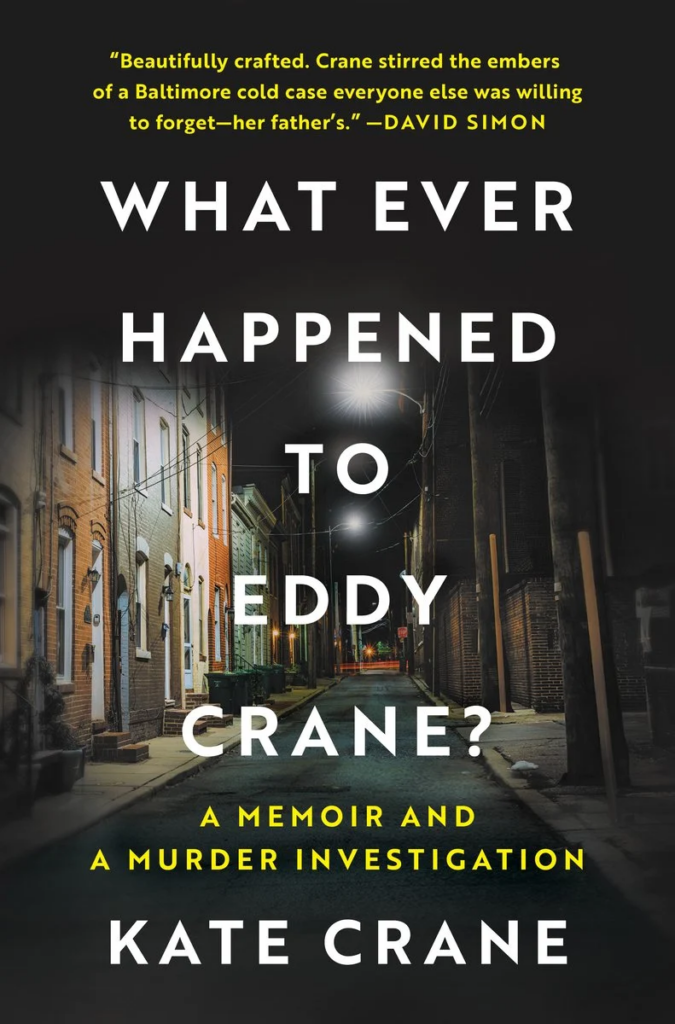
Perhaps the first thing to note about What Ever Happened to Eddy Crane? A Memoir and A Murder Investigation by Kate Crane (HarperCollins Publishers/Hanover Square Press; April 2026) is that the title is the central question of the book.
Perhaps the second thing to note is that the only way for Kate to know whatever happened to Eddy Crane was to write about it. She frames her approach for us in the preface:
“For twenty years I tried to outrun 1987. First through amnesia, then through a deliberate forgetting. But everywhere I went, everything I did, every conversation I had, it was in the room…
I constructed a narrative. It was safe—I rehearsed it often. I could look you in the eye right now and rattle off that story in fifty words or less without blinking or taking a breath. And your blood might run cold, yes, because there are no soft words for the facts of that night, or, at least, what facts I’ve been able to gather. Me? That narrative would not stir me an inch. Which was always the point.
I first became a writer by exsanguinating this story of vitality and meaning. I needed the fundamental story of my life to be bloodless.
I buried it. It refused to stay down. Twenty years after September 10, 1987, I came to a crossroads and a choice: Die by silence, or survive by telling. I chose to live.”
The book is journalism and it is also memoir: how do you live when your whole life is a search for an answer to a question that may have no answer? It is well-written and well-crafted; I thought this book was a beautiful combination of elegy and manifesto. Crane shows us the confused and scared little girl, the lost young adult, and the grown up who takes charge. We watch her evolve out of an unbelievable situation that not many can relate to.
Though Crane’s story is unique, it may sound familiar: the disappearance of Eddy Crane was followed closely by David Simon, journalist and later screenwriter of the television series The Wire and Homicide, who incorporated parts of it into the shows. In the most heartrending scenes of the book, Crane experiences the loss of her father again and again when she reads about him in the newspaper and sees episodes on TV that describe the events her family experienced. As someone who watched The Wire in 2022, long after it aired (2002-2008), I am surprised to learn this fictional show was inspired by, if not based on fact. In the book, Crane corresponds with and meets Simon to help her fill in the gaps in her history. Crane’s story’s connection to that popular show makes her story more impactful, more personal to a reader who also has a connection to the show.
Crane’s approach to navigating the aftermath of her father’s disappearance should be familiar to anyone who writes. The writing process is how we make sense of our experience for ourselves, and the writing product is how we help others make sense of our experience and perhaps their own experiences too. Crane takes us with her as she struggles to live with the hole left by her disappeared father.
We want to see her find the answer to the question. Crane, passing the twenty year anniversary of her father’s disappearance, picks up where the police investigation went cold. We want to see her heal her wound, even though the retired sergeant who worked the case in the 1980s advises her, “‘You lost your father,” he said, “and not much was done about it. And that’s the case 60 percent of the time. Whatever comes of this, you know you’re not going to get those twenty years without your father back.’”
This is the double-edged sword of anyone who writes about loss. The wound is never fully healed. We can never get back what was lost, but we can create new ways to move forward, scars and all.
Crane writes, “I’d sought family generally and fathers specifically in ways both subtle and overt. Across the board I was looking for dads I was never going to find. Taking on this quest was a sort of remedy: I’d traded anguish and paralysis for guilt, anxiety, and a sense of agency.”
That’s all someone who wants answers can do: take action. We have no control over the outcome, and we want to feel like we have control over something, anything. So the only thing we can do is act. Kate became the investigator and the reporter, because that was the only way she could free herself from the burden of the unanswered question, even though the pursuit came with its own costs.
Organized in three parts (Baltimore, New York, Baltimore), the book takes us from the distant past of Crane’s childhood, to the recent past in which she searches for the intersection of memory and fact, and into the story present where she arrives full circle, back to where she began, with as complete a picture as she can have. I won’t spoil the ending for readers – that’s a journey we each have to take for ourselves. What’s most poignant for me is that she had to, as she says, “chase herself through hell” to answer for herself, “What Ever Happened to Eddy Crane?” Perhaps that’s what writing our own endings sometimes feels like.
 Amy Goldmacher is a fatherless daughter, a writer, and a book coach. She is the winner of the 2022 AWP Kurt Brown Prize in Creative Nonfiction, and her experimental glossary-form memoir, Terms & Conditions, will be published by Stanchion Books in Fall 2026. She can be found on social media at @solidgoldmacher and at amygoldmacher.com.