
 If “cooking for oneself reveals man at his weirdest,” as Laurie Colwin wrote in her classic Home Cooking: A Writer in the Kitchen, the act of cooking, whether for oneself or for others, offers a whole world of character revelation.
In writing, as in life, food gestures towards longing and emotion. Yet I’m sometimes surprised in creative writing when characters never eat, never prepare food, never so much as reach for a cup of coffee. Where are their appetites? I wonder. Where are their bodies? All too often I’m left to guess what characters hunger for when they hunger, and the manner in which they consume it when they finally get what they want. I know that I can’t always expect characters to eat or cook their way out of their problems, but I do sometimes wonder why food, literary shorthand for almost anything in the realm of human longing, isn’t used more.
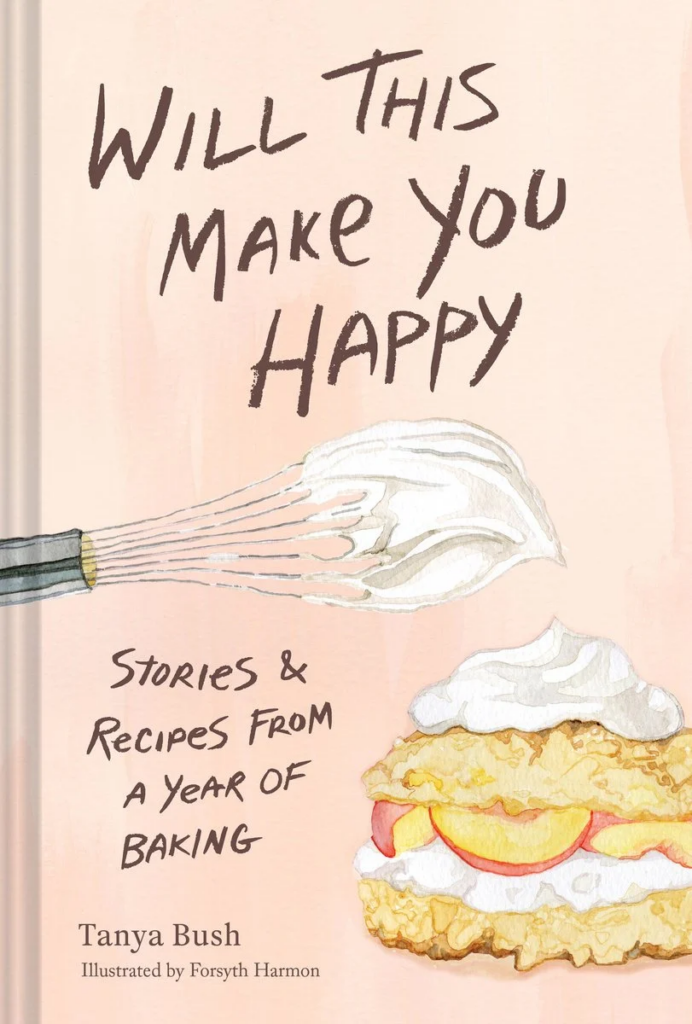
Luckily, I never had to wonder any of this while reading Tanya Bush’s phenomenal new Will This Make You Happy: Stories & Recipes From a Year of Baking (Chronicle Books; March 2026), a book that is all about the good stuff: life, lust and, most of all, baking. “Baking, like life, is complicated,” Bush, a baker by trade, writes early on; over the course of her book, we observe many ways in which these two things complicate and illuminate each other.
Will This Make You Happy is fundamentally a coming-of-age story in which Bush, who describes herself at the start as “desperate… twenty-three, depressed, unemployed, and adrift” becomes a professional baker, and in the process learns to take responsibility for herself and her desires. What sets Will This Make you Happy apart is its form as a narrative cookbook: a hybrid of personal writing and recipes. While it’s more common lately to include personal narratives in cookbooks, often in recipe lead-ins or in a long introductory chapter, Will This Make You Happy fully integrates the life story and the food story. The narrative action takes place over one very bumpy year and is divided into four seasons. Each season, in turn, has a few chapters of personal narrative and then several recipes, usually for desserts from the preceding narrative.
The book begins in the winter of the pandemic when Bush, having recently lost her job and rapidly sinking into depression, takes up baking to fill the time and busy her hands. After a few misses, when readers who bake will be whispering, repeatedly, to just stop opening the oven door, she finally has a win. This is simple, but revelatory: a banana bread that causes “that stomach-swooping, hands-tingling elation… I feel a sense of disorienting possibility, like I am slowly waking up from a nap when I hadn’t ever known I was asleep.” She sees there may be a path here for her, but culinary school is too expensive. Still, Bush learns what she can online, builds skills, and practices daily.
“Soon,” she writes, “I believe that pastry cream is the answer to the gaping void within us all” — and there are plenty of voids in Bush’s life. Bush’s partner, known in the book as The Boyfriend, tries to be supportive, but the couple is struggling. His well-intentioned gift of The Science of Baking feels like criticism; his sole descriptor for her desserts, no matter how technical or labor-intensive, is “tasty!” Still, he sees her passion; one night, he takes Bush to a restaurant where she can watch the pastry station. Entranced by the chef’s work, the “easy, dancerly pleasure” of her movements and the stellar products of her labor, Bush makes a plan.
Soon, Bush secures herself an internship at an agriturismo in Italy, sure it will turn her into the baker she dreams of being. Instead, she is excluded from anything hands-on . It’s painful to read, but it’s also an education about the kind of baker Bush does not want to be: one like her supervisor, who “is more interested in rigor than in pleasure.” She wants to make imperfect, delicious things that make people happy. “I will take pleasure in watching them be devoured,” she writes. “I will devour them myself.” She returns home, and in summer lands a job doing pastry production. She is busy, productive, learning constantly; in many ways, she finally has what she wanted. But just as things settle down, someone new comes along: someone who not only likes what Bush makes, but devours her desserts with abandon, complicating everything.
Will This Make You Happy is a book that you can read through, like a more typical memoir, and also cook your way through. I expected that one part, either the memoir or the recipes, would be stronger, but neither feels shorted. The memoir is a beautiful coming-of-age story, and the recipes are fun and approachable; they read clearly and felt well-tested.
The orange-almond cake, brown butter hazelnut chocolate chunk cookies and cinnamon-swirl banana bread I made (twice) for this review all turned out great, and it was fun to have a tangible, sensory experience linking back to the story. But what’s very special is the way that life and cooking inform and illuminate each other throughout this book. Will This Make You Happy says much about desires and appetites. Bush could have stopped with the idea that going after what you want is the important thing, but she goes deeper than that. Much of the learning is in how those desires move outward into the experiences, the enjoyment, of others.
If you love Laurie Colwin’s Home Cooking and More Home Cooking, My Berlin Kitchen: Adventures in Love and Life by Luisa Weiss or The Sweet Life in Paris by David Lebovitz, I’d imagine that Will This Make You Happy: Stories & Recipes From a Year of Baking will make you as happy as it made me.
Melissa Oliveira
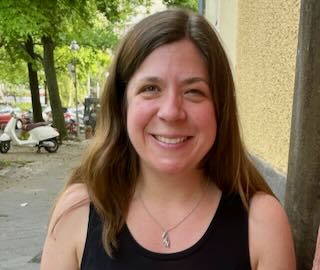
ReviewerMelissa Oliveira’s essays, poems and stories are published in Ploughshares Solos, AGNI, Post Road, BOAAT Journal, The Normal School and others. Her work was listed as a Best American Essays Notable, nominated for the Best of the Net Anthology and has received honorable mention in Glimmer Train’s Short Story Award for New Writers. She is a regular book reviewer for Hippocampus Magazine, and her reviews have also appeared in The Kenyon Review Online, Brevity, and more. She is a graduate of the University of Colorado (MA) and the University of Connecticut (BA). She lives in Berlin, Germany.