

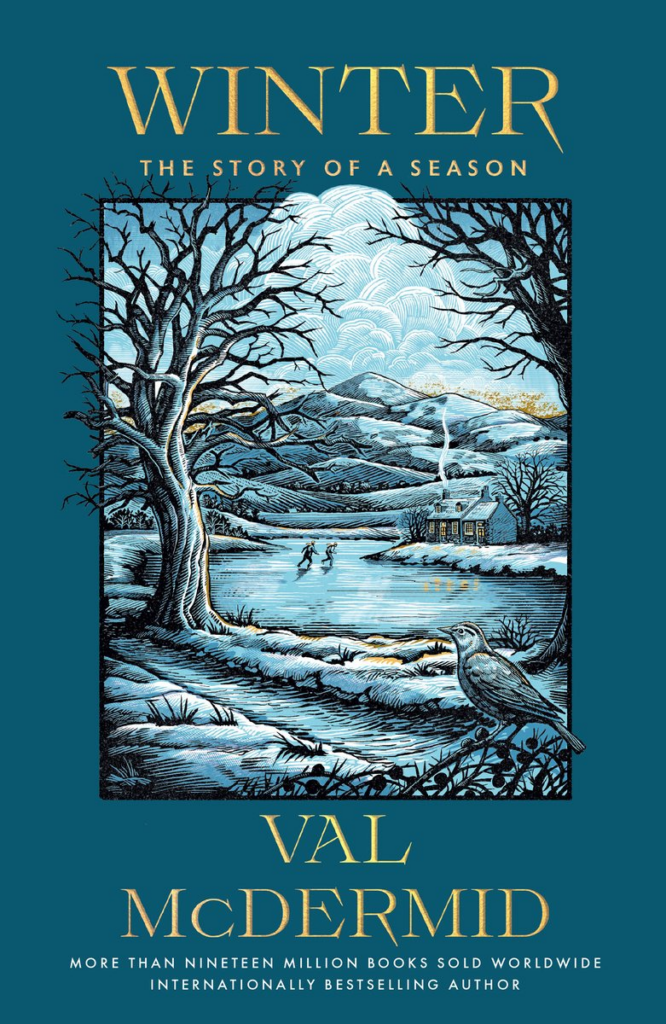
 At sixteen years old, I decided I was going to attend college somewhere with snow. Having grown up in subtropical Hong Kong and amidst year-round evergreens in Seattle, I wanted to experience a proper winter. My initial fascination, and subsequent frustration, with blizzards and knee-high snow eventually gave way to a quiet appreciation, and I was curious to review Winter: The Story of a Season (Atlantic Monthly Press; Jan. 2026) for a new perspective.
Winter is a beautifully meandering journey through childhood, local history, and a writer’s life. Although centered in Scotland, our glimpses of the season go wherever Val McDermid’s travels, memories, and daily life takes us. She evokes the intangible allure of the season with deceptive simplicity, almost making me want to give my childhood goal of building a snowman another go. In Winter, she takes readers across the full span of a Scottish winter, from staring out at leaves falling off trees to the various festivals dotted across the season, the winter solstice, and the new year.
A Scottish winter, of course, is notorious for its brutality and bleakness. Yet, as a crime writer of tartan noir, McDermid calls it her “chosen season of creativity.” The darkness of the season nurtures the brutal murders and shadowed alleys of her genre, but it’s only one side to the “Caledonian antisyzygy” of Scotland’s winters, where “stern, forbidding Presbyterianism” and “the dancing, musical, wildness of the Gaels” come together to shape her love for the season.
It’s the dancing, musical wildness — the human responses of art, warmth, and whimsy — that shine across the book. There’s the folk club at the Elbow Room pub McDermid frequented as a teenager, where singers taught her about music and murder ballads, alongside harder truths about homelessness and the battle for survival in Scotland’s freezing winters.
Then there’s the rummage, a philosophy of soup-making passed down from McDermid’s mother. There’s no recipe — just stock, vegetables, and whatever else feels missing, simmered for a few hours to make a hearty, rich soup to stave off the winter chill.
My favorite is the Loony Dook, the newest of the local traditions in the book. On New Year’s Day, revellers brave freezing temperatures to plunge into the North Sea and ring in the New Year. The tradition started in Edinburgh and has since spread across the East Neuk of Fife, down to East Sands in St Andrews where I coincidentally spent a year studying for a Masters in Global History.
That New Year, I had simply decided to take a walk along East Sands and the Fife Coastal Path. Imagine my surprise when I came upon people of all ages, from high school students in bikinis to elderly folk in brightly colored bathing suits running down the beach and throwing themselves into the ocean!
McDermid’s tales of winter reach far and wide. Some scenes, like the sleeper train car to London and falling face-first off a sled as it hurtled downhill, are familiar to a broad range of readers. Others, like Guy Fawkes Night and the lasting legacy of Robert Burns and the Burns Club, are much less so to those unfamiliar with British — and more specifically, Scottish — history and folklore. Yet, McDermid’s focus on the human relationships at the core of these stories, and at the core of our own relationships to the season, ground the tales in something familiar across cultural backgrounds.
The beauty of Winter is in its deceptive simplicity, and I would be remiss in passing over the printmaking illustrations that amplify the evocative minimalism of McDermid’s prose. Philip Harris’s stills, sometimes of tranquil landscapes and sometimes of birds and rushing creeks mid-action, “[offer] a glimpse of nature in a beautifully bleak state,” in his own words.
Winter is truly an exquisite book to read, hold, and experience. You’ll find in it a companion through the dreary winter months that will encourage you to see the skeletal trees and blankets of snow through a different, maybe not-so-dreary light.
 Charmaine Lam is a historian and writer currently pursuing a PhD in global history at NYU. Her work explores themes of migration, diaspora and hybrid identities. In previous lives, she has worked in museum programming, higher education access and multimedia journalism.