
Words have substance, texture, definition. The word “word” is given distinction by Merriam Webster’s Collegiate Dictionary – yes, the bulky print version – as being both a noun in the form of something that is said, as in “I just can’t think of the word right now,” and a verb meaning expressing something, as in “Benjamin, we have to word the declaration just right.”
But the word “word” can denote dire consequences: “Don’t move until I give the word,” “He sent word that he was captured,” “They had words and parted forever,” “Hey, put in a good word for me, or else I’ll be homeless.” In other words, the word “word” can substitute for, well, other words, minus the details. And let’s not forget Henry Higgins who worked his British tail off trying to transform Eliza Doolittle into a sophisticate so she could move in and around high society. Using words pronounced just so, he trained Eliza and achieved his linguistic breakthrough. Ultimately, a more colorful speech pattern emerged at the upscale Ascot races when Eliza belted out “Come on, Dover. Move yer bloomin’ arse!” Needless to say, Eliza’s rhetoric got her special attention.
Like a rock thrown into the literary pool, words cause the waters to ripple; they have power and weight, which is why writers ache and moan and starve and revise, revise, revise to make certain they use just the right words in a scene, in dialogue, in verse. A simple switch can transform sentences from passive to active, upping the ante on verbs allows plots to take flight, and an adjective here and there can produce multi-dimensional characters or paint a poetic picture. As if being a writer isn’t tough enough, along come those darn words that forces us to work even harder.
Words can affect us, cut like a knife, or perhaps even change our lives, our philosophies, our paths. Just consider some of the great literature which has played an instrumental part in altering history or altering minds. Some examples include Uncle Tom’s Cabin by Harriet Beecher Stowe that changed the way people viewed slavery, Moby Dick by Herman Melville, a story rich with symbolism and detail, 1984 by George Orwell that continues to elicit the fear of “Big Brother,” and Diary of a Young Girl by Anne Frank about the personal toll of the Holocaust that still serves as a cautionary tale to this day. William Shakespeare’s sonnets and plays continue to be performed, studied, and analyzed many hundreds of years later, and the Harry Potter series created such a stir among young and not-so-young readers.
I never realized the strength words possess until I became a freelance writer more than a dozen years ago. I started writing for newspapers in that inverted pyramid style, and transitioned to the more creative magazine market where I was assigned articles in my area of expertise – arts and entertainment. I knew the players, the lingo, the backstory. I wrote to inform and solicit interest with an event, a painting, a stage play. I learned how to incorporate humor in my articles while still sticking to the story’s focus and the magazine’s style. Once I was happy with what I wrote, I sent it off to the editor who sometimes tweaked it here and there, and then sent me a check. By then I was onto the next interview, the next story. Several months later that first story would appear in print. I’d glance at the copy and file it away.
Within a year, my arts-related stories started to take more of a backseat. Sure I was still writing about sculptors and actors, but I began being assigned more and more stories focused on health, home decor, pets, business, and food. The latter was a particular challenge because words like “drizzle” and “flamande” snuck into my writing. I had to make sure my readers were salivating from reading my descriptions as I had been when I saw the food up close and personal. Writing food articles started to make me more aware of my audience and I began taking a second, third, and fourth look at the words I was using to describe a certain appetizer or entree.
Then there were the letters to the editor after my stories came out in print. Most were complimentary saying this or that article covered all the bases and intrigued them to visit a theater or restaurant I had written about. A few were critical, saying that perhaps I had overlooked an important part of the story. One organization criticized me for including homeopathy in a health-related story; another was angry that it wasn’t asked to participate in the story and could offer some important information. My personal essays got feedback, too. Readers wrote that they could relate to a story’s expression of loss or fear. I began to sense the power of words, but still didn’t fully understand they’re full impact. But I would soon
A national publication – with readers also in Canada and Japan – had assigned me a story about fiber artists who lived in the tiny Mexican village of Agustin Gonzales – a town nestled in the central Mexican highlands. Here, 100 families existed by farming the land, using their hands to plant, weed, and grow corn and beans. They ate simple meals – drying and grinding the corn to make tortillas, making homemade cheese from the goats that scampered about them on the dusty paths. Most of the villagers hadn’t gone beyond a sixth-grade education.
A Canadian woman, who was associated with an organization dedicated to the empowerment of women, traveled to this village and noticed the elegant crocheting and embroidery work created by the Agustin women. She felt that if the women in the village could produce this type of artistry, then they could also create rugs. For the next three winters, she went to Agustin Gonzales and taught these women the art of rug hooking. The villagers listened and learned. They created rugs depicting what they saw around them – mountains, cactus, cows, horses, burros, flowers, a church, ducks, rabbits, chickens, roosters and fish. Another organization member also became involved and helped the villagers market their folk art rugs. A Texas shop owner became enamored with the rugs’ simplicity and attention to detail and bought 25 of them. Local outlets in Mexico displayed and/or sold these rugs whose costs ranged from $18 to several hundred. Much like the food that comes from what is around them, the village women used sweatshirts and T-shirt material plus other recycled woolen goods to create their rugs.
As I researched the story and conducted phone interviews, I became captivated by the village women’s determination to survive and support their families. That sense of respect and awe must have been incorporated in the story as I wrote it, although I was oblivious of that at the time.
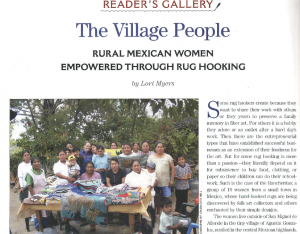
Visit Rug Hook Magazine's website to read Lori's story.
The story was published and, like all other articles, my focus shifted to other assignments, query letters, and writing fiction. Soon my editor phoned and so did the woman I had interviewed. The response to the story was like an earthquake. Materials were donated from as far away as Oregon and Canada; offers from exhibition venues were received; retail shops wanted to sell the whimsical folk-art-style rugs, and private buyers purchased rugs for children’s rooms. They had all read or heard about the article that chronicled the life of Agustin Gonzales and the creativity of its wives and daughters.
As a result of the article’s popularity, sales of the rugs increased. One villager was able to pay for her sister’s chemotherapy, American fiber artists began “vacationing” in or near the town to exchange artistic techniques and toil in the fields alongside the villagers. The village women’s self-esteem and self-sufficiency grew. For the first time in their lives they had to learn how to organize finances and keep track of what got sold. Mothers proved to their families that creating rugs can pay well. Families felt more secure.
And much of it was because of the article – filled with information and facts and story and words. Words.
I remember sitting in my cluttered home-office and thinking about all that came about from the magazine story on the rug hookers of Agustin Gonzalez. I remember re-reading the article I had written and finding deeper meaning. I cried with the realization that words can, every once in awhile, make a difference; that each letter, each syllable holds energy and punch; that word choices and their placement within a written work can resonate and grab someone’s soul, energize their spirit, and, yes, change a life.
The word “word” has proven its versatility in more ways than one for this writer. Sure it’s a noun, it’s a verb, and can have multiple connotations. And maybe, just maybe, if Eliza Doolittle hadn’t put her verbal acrobatics on display, she wouldn’t have found the love of her life…who finally realized that her word choices were her most interesting feature.
 Lori M. Myers is an award-winning writer of creative nonfiction, fiction, essays, and plays. Her work has been seen in more than 40 national and regional publications. She has a masters in creative writing from Wilkes University, is part of the writing faculty at York College of Pennsylvania, and teaches writing workshops. Website: www.lorimmyers.com
Beautifully written reflections, Lori, on the power of words. We never know what our words might do to lift another’s spirit, to spark ideas or help someone to see something differently, to inspire action . . . I have a feeling, Lori, that with the many fantastic articles you’ve written over the years on so many wonderful subjects, there are many people out there carrying around dog eared copies of YOUR words that they treasure in ways you may never know. What a blessing that you were able to learn of the impact of your words on the women of Agustin Gonzales! Thank you so much for sharing this inspiring story – a reminder to all of us to choose every word with wisdom and care. Big hugs to you, Lori!
Lovely and insightful, as always, Lori!
Words have power. And yours changed lives. I especially love that you were so moved after the fact when you reread your article through new eyes and saw what others saw. Nicely done and beautifully illustrated.
I agree with all the Words that precede these; you continue to be a joy and a talent that I’m honored to know. Your Words remind me, in my current theatrical endeavor, that each time I urge, plead, cajole, and beg actors to use the Words a playwright has written, because they were painstakingly chosen for good reasons, I am doing right by that playwright, that actor and the audiences that will take in those Words.
These comments are so moving. Thanks everyone for sharing!
As a fellow lover of words, I wanted to jump out of my chair and shout, “Yes! Yes! Yes!” to the message and the choice of words Lori used to illustrate a vital point. What a victory for the villagers who were given an opportunity to grow their livelihood after publication of Lori’s article. I, too, know the responsibility of using words wisely, and the humbling gift that results when what we say deeply touches another soul.
It’s time for me to go back to my manuscripts and bring them into the light.
Thank you, Lori.
Keep dancing on your keyboard!
Lori, I’m so fascinated by how you’ve incorporated your knowledge and inner spirit into this piece. You have captured the essense of what writers, those who take the time to think about what they’re doing, can create an audience that is a giving audience to some far away place in Mexico. The power of words that writers possess can fuel a nation, mobilize an army, care for the sick, and bring power to the powerless. Keep on writing. The world needs more writers like you.
The spoken, sung or written word carries much power indeed. Your words succinctly capture what can happen to readers when the words are used to inform and enlighten. The reader in this case then acted on the inspiration and look what happened. Lives were transformed and at least part of the world is a better place. May we all choose words to make the world a better place, whether we speak, sing or write them. Thank you, Lori. Love your writing! It has never been anything but inspiring, thoughtful, well-written, engaging and often with just the right touch of humor when appropriate. Loved this!
very nice lori. words organized can be captivating. i look forward to more of your writings.
Lori, what Tom said…my hero!
I keep track of situations that give me a sudden, unanticipated feeling that I might cry, because it seems like a very honest way to get to know yourself. And I just had one now. The story of the rug-hooking women was engaging enough, but then there was the line “one of the villagers was able to pay for her sister’s chemotherapy [because of money earned through rug sales].” Why cry? Heroism. Selflessness. Generosity. These are traits I value, and it affects me when I see people exhibit them. “Doing what you — and maybe *only* you — can do to make someone else’s life better” is pretty close to my definition of heroism. From the Canadian woman who had an empowering vision, to the village woman who used her new power to save a life, to Lori Myers who knew how to use the power of words to tell the story and create the feeling, each was a hero in her own way. Thanks Lori!
A creative endeavor that touches people so deeply that they are inspired to a new thought, understanding or action is the essence of art, I believe. And most often the artist is unaware, just as you were, of the effect her creation will have on those who encounter it. This is the process by which artists and art change the world. And your article demonstrates the truth in Bulwer-Lytton’s famous quote, “The pen is mightier than the sword.” How wonderful that you were given the gift of seeing the power of your creation!
Thank you for your kind “words.” I loved your first sentence. That says it all in a nutshell. So very true.
As a proposal writer for a non-profit agency that relies on “words” for existence, I thoroughly appreciated the article and your perspective, Lori. I was moved by the description of “The Village People” and the outcomes of the story. On a final note, a word written or spoken can never be taken back. We see the result of hurtful and harmful words on a daily basis.
As a proposal writer for a non-profit agency that relies on “words” for existence, I thoroughly appreciated the article and your perspective, Lori. I was moved by the description of “The Village People” and the outcomes of the story. On a final note, a word written or spoken can never be taken back. We see the result of hurtful and harmful words on a daily basis.