Reviewed by Melissa Oliveira

 About a decade ago, I heard poet Mary Ruefle say something in her conversation on the Between the Covers podcast that has stayed with me in the years since. “I would rather wonder than know,” she said, “and it makes it more and more difficult to be alive on earth in these times when your inclination is to wonder rather than know.” She goes on to talk about how, before answers were immediately available on our smartphones, one had to sit with unanswered questions, and how the immediate answer to any question ends a period of wondering.
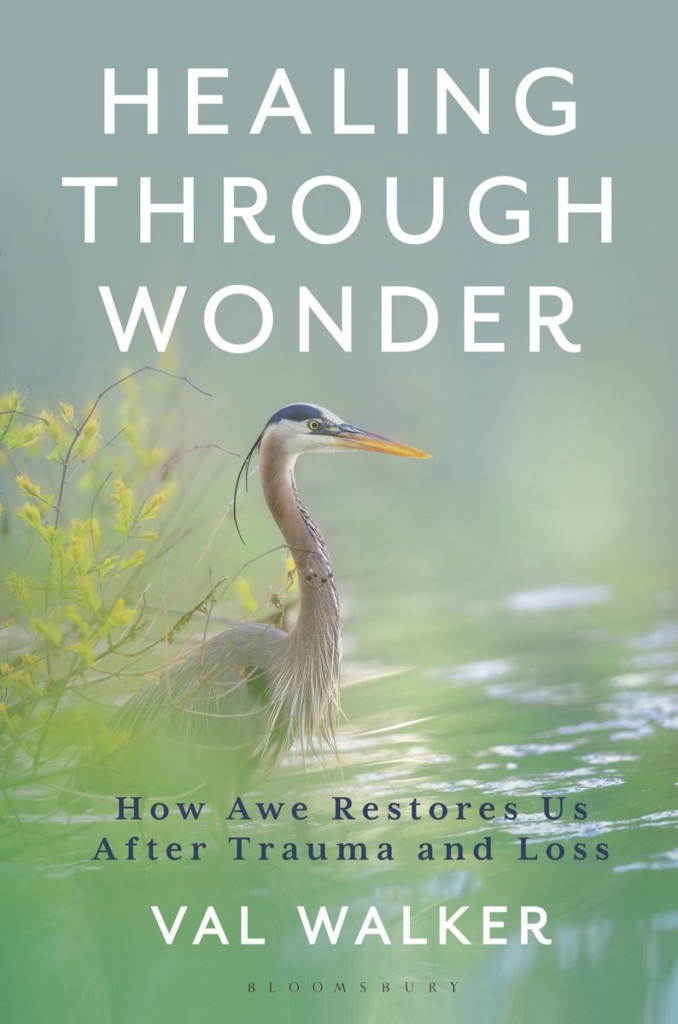
The statement felt rich with personal meaning. I could recall similar times in my own life, either with friends in rural New England or on long Colorado hikes with no hope of a signal, and just having to sit with ambiguity. Since we couldn’t immediately ease the discomfort of not knowing, sometimes that cleared the way for guessing, weird free-association, play, and wonder. It’s not difficult for me to recognize some relationship here between the frustration of unanswered questions and creativity, and seeking wonder seems to be an important part of this. What was unclear to me before reading Healing Through Wonder: How Awe Restores Us Through Trauma and Loss (Bloomsbury, 2026) was the direct relationship between wonder and healing.
Walker’s book makes an argument for wonder because it can actually help survivors of many life circumstances, ranging from substance addiction to domestic violence to other varieties of abuse, heal their trauma and build resilience in the face of other hardship. Walker, creator of the Healing Through Wonder Project, has firsthand experience of how wonder can heal, both in her own personal struggles and in her extensive work as a rehabilitation counselor. “Although I’ve found many books in praise of awe and wonder over the past few years,” Walker writes, “I’ve yet to see a book written about the healing power of awe that specifically pertains to survivors of trauma and loss.” Healing Through Wonder, which Walker describes as “part memoir and part guide”, approaches this subject in three parts.
Part 1 is the section that reads most like memoir and is Walker’s own personal history of trauma and wonder. Part 2’s perspective widens to include stories from four other “survivors of loss, addiction and trauma.” These stories come from participants in the Healing Through Wonder Project which, in collaboration with The Sun Will Rise Foundation (which helps people who are bereaved due to substance use) focuses on sharing these stories. Part 3 is more of a field guide to wonder: some comments on the current work on wonder and awe, where and how to access wonder, and the chemical processes by which it heals our brains. An extensive Appendix lists books, music, and film that are related to, or could spark, wonder.
Walker’s own story is harrowing. As a young person, Walker is drawn to New Age spirituality, astrology, and the like; through this set of interests, she meets and falls in love with a much older man. Early on, he’s gentle and charming. Over time he grows abusive and, when she tries to leave him, he stalks her, then imprisons her. “He threatened me with a knife,” Walker writes, “and held me captive for a month. I had to quit my job, disconnect my phone, and give him sex. Finally, escaping while he slept one morning at 3:00 a.m., I ended up broke, homeless, and without a car.” She has no support except for her beloved grandmother, who sadly dies around the time Walker is trying to get back on her feet.
Wider society and close loved ones alike blame Walker, not her abuser, certain she should just “cut the victim crap.” She internalizes all of this, finally hitchhiking to a beautiful riverbank with the intent to end her life with wine and Valium. But then a great blue heron hovers nearby for a moment, finally landing a mere few feet from Walker. “We became entranced,” she writes, “eye-to-eye, soul-to-soul, holding each other in rapt attention.” This encounter does not, of course, solve everything in her life. But this experience of wonder is the catalyst she needs, enough for her to feel connected to the living world again. Over years, drawing on that wonder and connection, she builds a new and purposeful life: going back to school, doing a Master’s, becoming an educator and a rehabilitation counselor.
Walker is a keen observer of the field of counseling, and her early experiences of being undervalued, pathologized, and stigmatized as someone seeking help from practitioners in that field inform this book and set it apart. “What people didn’t understand about traumatic stress,” she writes, “is that it stuck around like shreds of shrapnel in our neuromuscular system, our reflexes, and biochemistry. Little was known at that time about the neurological damage of trauma.” She digs into all of this here.
That said, if it is pure memoir you seek, the memoir section is just about a third of the book, and the stories from others are more profile than memoir. More integration between the disparate parts could have carried this fully into memoir territory, but it’s important to remember the intent is really different here. The memoir serves to inform us, like the profiles and all the science, about how wonder shrinks the self, quieting the negative chatter accompanying trauma.
Thus, “We are better able to attune to one another in the moment,” and even fleeting experiences of awe and wonder can calm us down, improve a sense of well-being and urge us to behave in ways that are more prosocial. It’s an interesting, unique, and valuable take on wonder, dragging it out of the realm of the strictly private and into our interpersonal relationships.
I think readers who enjoyed What My Bones Know by Stephanie Foo or the wonderful Awe by Dacher Keltner will also want to read Val Walker’s Healing Through Wonder: How Awe Restores Us Through Trauma and Loss. A capacity for wonder, with all of its childlike connotations, is a chronically undervalued quality, but connection to wonder may be necessary for healing, and not something to grow out of. Cynicism is cold company for the long haul, after all, so it is heartening to read that there’s actually resilience and strength to be found in wonder.
Melissa Oliveira
ReviewerMelissa Oliveira’s essays, poems and stories are published in Ploughshares Solos, AGNI, Post Road, BOAAT Journal, The Normal School and others. Her work was listed as a Best American Essays Notable, nominated for the Best of the Net Anthology and has received honorable mention in Glimmer Train’s Short Story Award for New Writers. She is a regular book reviewer for Hippocampus Magazine, and her reviews have also appeared in The Kenyon Review Online, Brevity, and more. She is a graduate of the University of Colorado (MA) and the University of Connecticut (BA). She lives in Berlin, Germany.