
Reviewed by Renée Reese

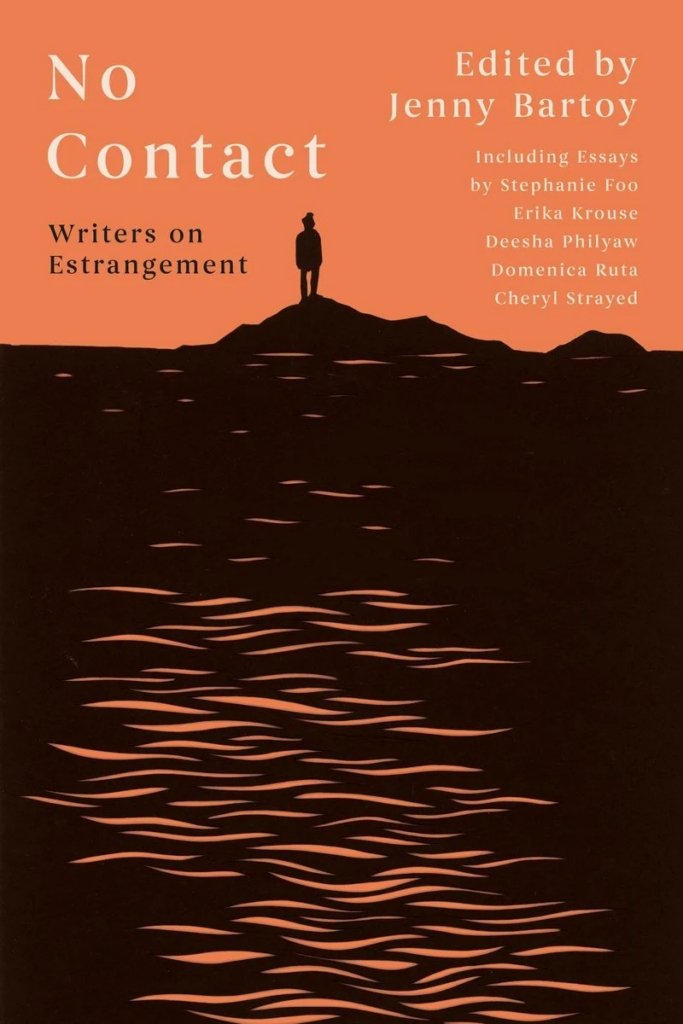 I’ve been in group therapy, officially, twice in my life. I count reading No Contact: Writers on Estrangement (Catapult; April 2026) as an unofficial third round.
It is an ambitious anthology, a collection of 32 nonfiction stories of estrangement in the form of essays, flash, and poems, including a piece from Cheryl Strayed. In her introduction, editor Jenny Bartoy tells the reader her goal for creating this work. “By sharing these brave voices with you, I hope to spark compassionate thought and deepen the conversation around estrangement.” She delivers on that goal and then some.
I’m close to the topic at hand — I heard my own sister’s voice for the first time in 18 years only recently. I’m also no stranger to other complicated and painful family dynamics. I approached reading this anthology with a rawness, ready to understand and empathize with the writers before reading a single word. Still, I was surprised at the journey I went on, my own grief unseating me as I sat with their stories, my own echoing in their cries.
Estrangement is a sticky topic, one that requires deep nuance to fully appreciate. That’s exactly what this collection of stories provides. The choice to be estranged is often seen as flippant or selfish and made to be an indictment of our emotional health and capacity for forgiveness. Those of us who made the choice know, it isn’t much of a choice at all. Bartoy says “… one thing is certain, encompassing nearly all cases: No one wants to be estranged from family. By choice or circumstance, it is simply the only path forward—no matter how painful.”
This sentiment is echoed throughout the book. In Cassandra Lewis’s essay “Mother’s Day,” she says “…estrangement is rarely portrayed as the resolution for achieving survival. Instead, it is a temporary mistake or a problem to be solved through reunification.” In Emi Nietfeld’s essay, “A Leap of Logic,” she tells us “I believed, from so many movies and stories about dysfunctional families, that I could and should make things right. I was trying my hardest to heal us—even as I worried that it would cost me my life.”
Whether you made the choice to be estranged or were on the receiving end of that choice, there is often a residue of shame. I’ve felt it many times. It’s the very thing that, for years, led me to stumble when asked basic introductory questions like, “How many siblings do you have?” I found solace in some of the essays written from the point of view of writers who didn’t make the choice to be estranged. In “Weird Sister,” Nicole Graev Lipson says, “What’s hard to share is my belief there must be some strange, shameful rot at the core of me — for surely no truly good person has this happen to them.”
The diversity of narrative is the strength of the collection. It lets the reader know, any type of person can make this choice and it can happen to anyone too. The stories transcend race, class, and cultural background. These writers are estranged from mothers, brothers, sisters, sons, daughters, cousins, fathers, and sometimes, their whole family. We travel to Jamaica as Soni Brown cares for her estranged mother through her battle with dementia. We sit with a then 22-year-old Hannah Bae in South Korea as she navigates her parents’ abuse across continents. We read about Michelle Dowd’s time and escape from a California religious cult and subsequent shunning from everyone she’s ever known, including her own mother.
We head to England to witness Jamal Mahjoub wrestling with his estrangement from his brothers: “How can three souls, born to the same parents… and brought up in identical surroundings, find themselves so alienated from one another that they can no longer bear to see each other…?” Anna Qu details her trip back to China as she travels to her grandfather’s gravesite and reflects on her estrangement from her family.
Another point that this collection highlights is the systemic collapses and “collective failures,” as Lindsey Danis notes in her aptly titled essay, “Legacy of Estrangement.” We see multiple instances of someone not having adequate resources or assistance for mental illness or addiction. In many stories, we wonder if some outside help could’ve prevented a world of pain for the writer. In other stories, we see the rupture building as we watch familial issues climb atop life issues. There’s cancer, rape, abuse of all kinds, and poverty. For some, it’s generational, an inherited dynamic that seemed unfortunately inevitable.
There are no easy endings in this book. There was nothing tied up neatly in the bow of reunification or an emotional climax of forgiveness. What the anthology does offer is portraits and meditations of rigorous self-examination. There’s gut-wrenching honesty, that doesn’t feel one-sided or unfair, but authentic and necessary.
At times, reading this collection felt like unzipping my skin and exposing myself to mirrors of some of my deepest pain. But there were a few moments of levity that made me smile, and sonnets that made me pause in awe. There were also pieces so well-written, I felt like I was in a nonfiction masterclass. Each piece of this anthology offered something and I have some standout favorites: Deesha Philyaw’s short and mighty essay “Whiting,” Gabriela Denise Frank’s lipogram “Estr ngment,” that completely omits the letter “a” throughout the text, Nietfeld’s “A Leap of Logic,” and Bae’s “The Cost of A Mother.”
In some stories we find the writer discovering their own sense of peace, community, and comfort, like noam keim, estranged from their mother and learning their mother tongue, or Mattilda Bernstein Sycamore, reconnecting with long-lost cousins, or Nietfeld simply noticing, “In creating distance, I’ve found peace. Estrangement is a quiet space where I can think.” The peace the book offered me was this — I am not alone. Not even close to being alone. There is no shame here.
Each story is different, but these writers are in conversation with each other and with all of us who carry our own stories of estrangement. Frank says,“The process of letting go doesn’t occur just once — you never stop concocting the potion, nor pouring it through — you let go over, then over, then over.” Let each story wash over you and offer you peace, wisdom, permission, or validation, and make the most of your own letting go. Over, and over, and over.
 Renée Reese is a lawyer, creative nonfiction writer, and New York native. She is an alum of the Kenyon Review Residential Writers Workshop, and her work has appeared in Huffpost. She runs The Creative Year publication on Substack, which chronicles her journey as an artist. When she’s not reading or writing, you can find her dancing, painting, or in a New York City coffee shop, daydreaming about her next project.
Thank you for reading us with so much love and care, Renée!