
Reviewed by Lindsay Bennett

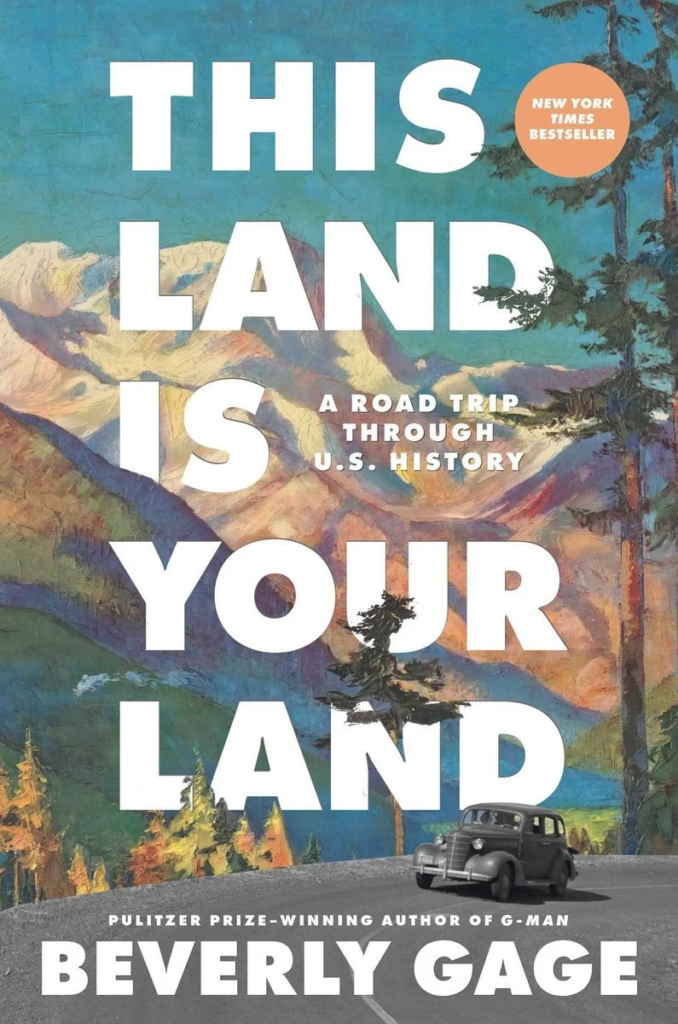 Inspired by America’s semiquincentennial (2026 marks the 250th anniversary of the signing of the Declaration of Independence), Pulitzer-prize winning author Beverly Gage gives us This Land is Your Land: A Road Trip Through U.S. History (Simon & Schuster; April 2026).
Guided by her perspective as a historian (Gage teaches American History at Yale) and fueled by her love of a good road trip, Gage sets out on a journey of epic proportions, visiting thirteen different destinations in pursuit of answering a question once posed by Benjamin Franklin, namely: Is the sun rising or setting over the republic? To that end, Gage — mostly alone, but occasionally with a travel companion in tow — traverses some of this country’s most storied places. Her objective is perhaps less to answer Franklin’s question, and more to explore why it remains one.
Far from a dry, academic text, This Land is Your Land strikes a conversational tone, like a friend who is telling you about her experiences and observations at various historic sites over dinner — that is, if your friend happened to be a top-of-her field historian. Gage brings readers along as she visits several predictable sites, like Philadelphia’s Liberty Bell, the Alamo in Texas, and Charleston, South Carolina (the first city to secede), along with destinations far less famous, but no less fascinating.
To that, she mixes in anecdotes about her own history, like visits she made to historic sites as a child, closing the distance between writer and reader. I was immediately brought back to my own childhood field trips to California’s Spanish Missions (and I can easily imagine a conversation with Gage about those). Gage offers tantalizing details of various characters in American history to whet the appetites of readers, as is the case in her Michigan chapter, which paints a picture of America’s labor movement — including a detailed and ultimately unflattering portrait of Henry Ford.
The chapter I found most enthralling, and which I think best captures the American paradox that Gage returns to again and again was, “Is This America?” which focuses on Mississippi and Alabama. During Gage’s visit to the region, she drives along most of the Civil Rights Trail, beginning in Alabama, driving west through Mississippi and Arkansas, then towards Memphis. She describes her trip, and weaves in highlights about significant events, as well as prominent civil rights icons, including Martin Luther King, Jr., John Lewis, Rosa Parks, and Medgar Evers.
Even as a reader well-versed in that part of American history, I was glad to learn some new things from Gage. Beyond the facts, though, what makes this chapter (and numerous others) stand out is Gage’s willingness to probe beyond the basics. She notes that much of the messaging along the Civil Rights Trail emphasizes America’s “progress,” then pauses to consider the tension between that message and the present-day reality in much of the region, which faces “unemployment, poverty, resegregation, pollution and population loss.” The “comforting narrative” of progress is called into question by Montgomery based lawyer and activist, Bryan Stevnson, whose perspective and work Gage highlights in this chapter.
Gage is not attempting to represent a comprehensive history of the United States in This Land is Your Land, nor does she deliver a one-to-one ratio of America’s best and worst. Instead, the author provides a thoughtfully curated exploration of some of America’s most poignant historic sites and a means of learning more of our past and, perhaps in the process, gaining a deeper understanding of our present. Gage is not promoting a “Great” America (though she shines a light on myriad high points in the nation’s history), but neither does she sanitize America’s most shameful chapters (Gage, for example, accurately describes the Manzanar War Relocation Center, where thousands of Japanese – most of them American citizens — were held during World War II as a prison, “not a ‘camp’”).
In the end, Gage reminds readers that, when trying to answer the central question (Is the sun rising or setting on America?), it often proves hard to know at any given moment. She acknowledges that America’s history is often deeply troubling and that many of the recent developments are “alarming.” Still, she remains grounded in the knowledge that the fear of decline or collapse that permeates virtually every era often inspires reflection and a redoubling of efforts to improve things. During her visit to the Lyndon Johnson Library and Museum in Austin, Texas, Gage observed a quote by LBJ, which described history as “the excitement of becoming — always becoming, trying, probing, falling, resting, and trying again.” I’m inclined to agree with Gage that Johnson’s words accurately frame “about the best we can do.”
This Land is Your Land is the perfect companion to anyone inclined to take a trip through some of America’s most interesting history.
 Lindsay has always been moved by people’s stories. For many years, in her capacity as a death penalty lawyer, Lindsay worked to tell her clients’ stories. Fueled by her love of great storytelling, Lindsay went back to school in her 40s, obtaining her master’s in creative writing and literature from Harvard Extension School, where she was awarded the Dean’s Prize for Outstanding Capstone Project. Lindsay’s work has been featured in Ms. Magazine, Herstry, and The Memoirist, among other publications. In all endeavors, Lindsay is guided by her belief in the transformative power of stories well told. She is working on her first book, a work of narrative nonfiction. Read more at www.lindsay-bennett.com.