


Introduction to the WAIS-IV
If the fifteenth floor of the McGill psychology building were a person, she’d be really into direct communication. You’d probably ruin your life for her. You’re here to have your intelligence tested in a space that isn’t big on subtlety. The lime green hallway is lined with too many laminated signs, all boasting black arrows pointing left. Clinic this way. You wait in a well-furnished room while a psychologist sets up across the hall.
It’s 9 a.m.on a Thursday morning. You didn’t mean to be here, but you’re single and newly celibate. It’s not like you had much else planned for spring break besides wanting to confirm you are, as you have long known, clinically depressed and anxious. When the clinic called you after seven months of waiting, you just had to. No question about it. You had a clinical interview here two days ago, and even though you checked enough boxes to be handed a label, the intelligence test was part of the packaged deal.
You look out the window, check your phone, pace around the room, check your phone again. You study the abstract painting beside the door. The minutes keep passing. You worry the assessment has already begun without your knowledge.
The WAIS-IV
The test really starts when you are ushered into a room — a blank space, mostly empty but still cramped. Inside: a white table, two chairs, unfilled shelves, assessment materials. The psychologist, you. The psychologist is not a psychologist but a young clinical Ph.D. candidate. You are her guinea pig. (This is why both the clinical interview and the intelligence test are free.) With her pimple patch and eyelash extensions, the psychologist looks like the type of person you could tell all your secrets to, which is exactly what you did two days ago. Now, she sits across from you and explains how the next three hours will go: You will complete a series of cognitive assessments. Some questions will be easy. Others won’t. You are not expected to know all the answers. You are allowed to ask for a break whenever you need.
Block Design
You begin by playing with blocks. The psychologist slides nine cubes your way, her pink nails clacking against the plastic. Each cube is the same, equal parts red and white, divided by a line of diagonal symmetry.[1]
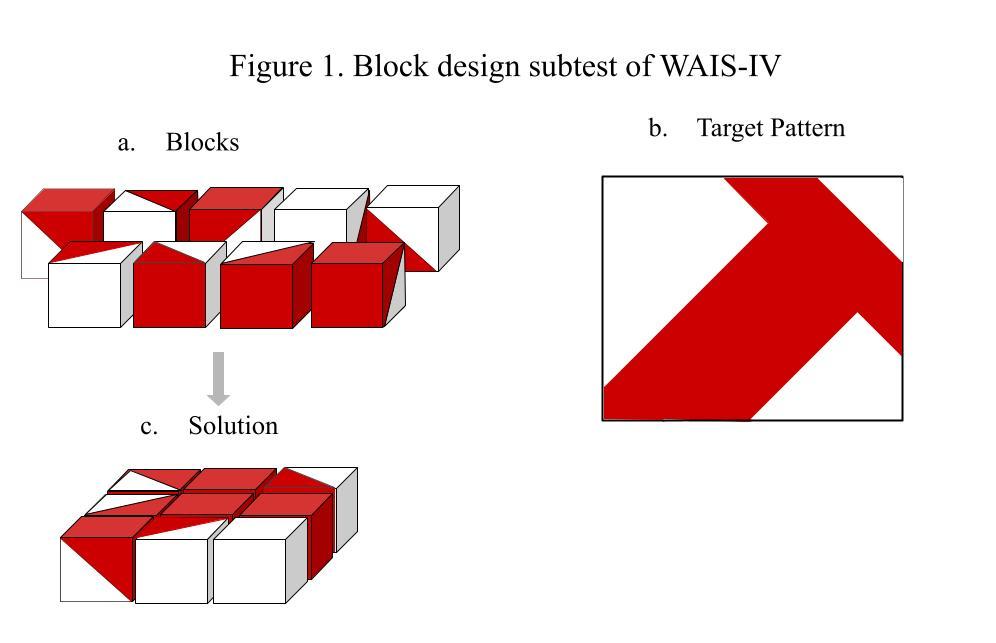
You scrutinize the cubes, confirming that they are, in fact, all the same as the psychologist opens her binder. She tells you to arrange the blocks to reproduce the target pattern on the page. It is your job, she says, stopwatch ready in hand, to work as quickly as possible while maintaining accuracy. The clock will not stop until you say finished. After, she will give you a new target pattern. The cycle will start over.
The stopwatch starts, and you forego expediency. The psychologist should expect this. As you articulated two days ago during the interview, being perceived as incompetent is the foundation of your social anxiety. According to your miscalibrated brain, to be seen as inept, inadequate, perhaps even stupid, is simply the worst ill imaginable. When given the choice between right and quick, you’d rather be right, so you taunt the clock after every completion, gingerly withdrawing your hands from your masterpiece, inspecting for any errors before declaring a resolute I’m done. She begins to stop the clock before you announce your finish.
The psychologist adds more blocks, making the patterns increasingly difficult to construct. You pretend these additional cubes are your reward for not screwing up. Like alcohol before socializing or lube before sex, a dose of external validation would make this all a lot easier. You want the psychologist to say “good job” each time you complete a pattern, to toss you a small morsel of praise before you re-scramble the blocks. You want her to give you this, this small token in return for all these patterns you’ve made and destroyed while sweating through your shirt. But she doesn’t. She just turns the page to a new pattern, says nothing. You suppose you both disappoint each other. Your meticulousness. Her silence.
You know she doesn’t really care about your performance and only wants you to work faster.
***
Two months ago, when you and M broke up the first time, M said you were continually disappointed by her. You said that’s the whole point. To love someone is to know they will disappoint you endlessly. You learn to accept them anyway.
M said nothing. You broke up again a month later.
***
Similarities
No blocks or stopwatch for the next task — just the sound of the psychologist’s soft voice, followed by your own. You stare at her, in her sweater vest, slick back bun, and chunky jewelry as she names two concepts. It’s up to you to identify a similarity between them:
Drum/piano. Musical instruments.
Tiger/horse. Animals—mammals, to be exact.
Nose/mouth. Facial features related to sensation.
Badge/crown. Metallic accessories.
Always/never. Absolutes.
Music/tide. Reduce to sine waves.
Friend/enemy. People you want to keep close.
Allow/restrict. Ummm. They both delineate permissible ways to exercise agency?
Acceptance/denial. Stages of grief.
When she asks you how a poem and a statue are the same, you retort that they both have attention to form. She asks you to say more, and you are surprised by the insufficiency of your answer. You want to say that a poem and statue actually have nothing in common. You know this because the night before M broke up with you (the second time), Li-Young Lee came to you in a dream. He sat you down at a table and told you, reaching tenderly for your hand, you have suffered each other to have each other a while. A statue could never say such a thing.
You want to explain this to the psychologist, to quote “Goodnight” and make it sound entirely rational, but your miscalibrated brain insists you are taking too long to answer, that you’re trying to be too honest, too thoughtful, that maybe you are unintelligent after all because clearly, this isn’t the answer she’s looking for. You try to concentrate on what a normal person would say, but all you offer is that a poem and a statue both require a chipping away, a tunneling. She scribbles something down in blue ink.
***
Much of this story is not yours to tell. But in those last days when you and M tried to be better to each other, you told her, rolling over to face her in bed, of your perverse desire to read her blue notebook. For months, you had wanted nothing more than to hold its leather cover, to curl your finger under its elastic, to crack it open and read each entry scribbled down in pencil. You wanted to know her every mood — absorb them through your skin to hold her feelings in you until you understood everything she didn’t say. You knew how crazy you sounded, even then, as you talked into the night — how intrusive, how absurd this impulse — but as you sit in this claustrophobic room now, you feel that same itch. Only this time, it’s not M you’re trying to understand. You need to read that blue ink. You need to know where it all went wrong.
***
Matrix Reasoning
Back to patterns. No blocks this time. The psychologist flips through the binder, revealing the first of many incomplete matrices. She draws your attention to the array’s empty quadrant, a blank box whose blankness is punctuated by a question mark. It’s up to you to complete the matrix by indicating the correct answer choice.
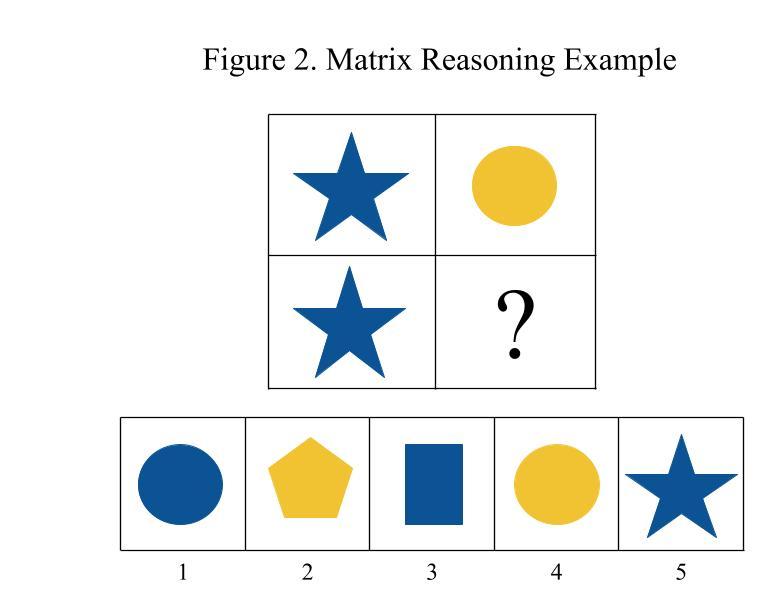
The psychologist glides her acrylic index across the option set, and your memory snags on the nail of this task. You remember this task from the Gifted and Talented (GATE) test. The assessment — intended to identify students with superior intellectual abilities — that you took and excelled at in third grade.
Even though your GATE experience is hardly relevant here, you want the psychologist to know you’ve done this before — and know you were good at it, too. You want her to know your life before this room, to know you used to be a high-achieving, award-winning, full-of-potential promising young person going big places to make a big impact. You want her to know that you are still those things, even though this intelligence test has convinced you otherwise. And yet, according to your miscalibrated brain, the only thing worse than answering incorrectly is failing to play by the rules entirely.
You consider the concept of the “good participant.” You learned about it in your Research Methods class, which you were required to take as an Honours Psychology Student. This so-called “good participant” does not want to “ruin” the experiment, so she tries to guess the experimenter’s hypotheses and modifies her behavior accordingly. All she wants is to be helpful. To be good. She is, at her core, a people-pleaser. The kick is that being a “good participant” isn’t good for anybody. Pretending to be better than you are leads to bias, unreliability, and false conclusions.
Even though this is not an experiment, there are no hypotheses, and authenticity would only be to your benefit here, you become the “good participant.” You make yourself into what you think the psychologist wants. You play dumb. You pretend you’ve never seen this task before. You pretend that you are someone who knows how to have her intelligence tested, pointing at your best guess as the binder’s pages turn and turn.
***
When you and M were together, the pattern went like this: Something would bother you, as it often did. A last-minute change of plans, an insensitive comment, a lapse in memory at an inopportune moment. Instead of being direct, you diluted, downplayed, denied your bad feelings to keep her feelings good. All you wanted was to please her. To give her what you thought she wanted, which was someone who took no energy to be with. Someone convenient, easy to love. As the months went on, you saw the pattern emerge. You still completed it each time until you were knee-deep in false negatives — strained by the erroneous conclusions you had led her to. If there was ever such a thing as “good partner,” it was you.
***
Information
When the psychologist asks if you want to take a quick break, you realize you do not know how long you have been in here. You do not know how the sun would spill through the room if it had windows. You do not know what questions lie ahead, how many more times you’ll say I’m sorry but I don’t know, how much longer you’ll shift awkwardly in your seat while thinking about stripping off your sweat-soaked shirt. There are no minutes. No seconds. No steady metric of anything.
But like “taking a break” instead of breaking up for good, you know a five-minute respite will not fix much. It will not restore your depleted ego. It will not make you feel better. The only way out of this room is to keep going. So you do.
***
In January, M asked you the same question. You had already broken up once and were on the fast track to another fracture. Sobbing on FaceTime, phone propped against your empty plastic food container, you were honest for the first time. You said you’d rather be broken up than be strung along at arm’s length. You said you can’t do this anymore. You said you’re done, you want your stuff back, and that you can’t stay friends. Then you called her, two days later, lying on the floor, taking it all back — wanting to be taken back. And so, you did.
***
This time, you don’t claw back your words. They settle into the stiff air as you prepare for what’s next. A series of questions, each inquiry designed to dig into the encyclopedic store of your brain. The psychologist doesn’t use those terms in her explanation, of course, but it’s true. You know what’s coming. You could recite the test questions forward, backward, and in alternating order, if you wanted to:
What is water made of?
What are the three types of blood cells?
Who was the president of the United States during the Civil War?
Where were the first Olympic Games held?
What is the capital of Italy?
Who wrote Alice in Wonderland?
The psychologist doesn’t know that you’ve lived this moment before, not as yourself but as her, on the other side of the table, rattling off these questions to some other undergraduate. Last semester, while collecting data for your Honours Psychology Thesis, you spent over one hundred hours in a tiny windowless room, not unlike this one, in the same building just eight floors below. Part of those many hours involved asking participants to complete this subtest of the WAIS-IV. Over the course of those four months, you watched approximately thirty young adults descend into mild panic as they, too, realized they knew little about the world, thinking themselves so uncultured that they were, perhaps, unintelligent.
You don’t disclose your familiarity with this part of the test, both in content and its many cultural biases. Like a “good participant,” you empty your brain onto the table. You have administered this test more times than you’d like to count, but like most people your age, you haven’t lived enough to know all the answers. You don’t know who wrote Sherlock Holmes or the size of Earth’s circumference, but you make sure to specify, smugly, that MLK Jr. was an integrationist, Gandhi was all about non-violence, and that the “correct” answer to “Who was Sacajawea?” will be, at best, revisionist history.
Symbol Search
You move onto something different. The psychologist hands you a pencil and a booklet, splayed open to rows and rows of symbols.
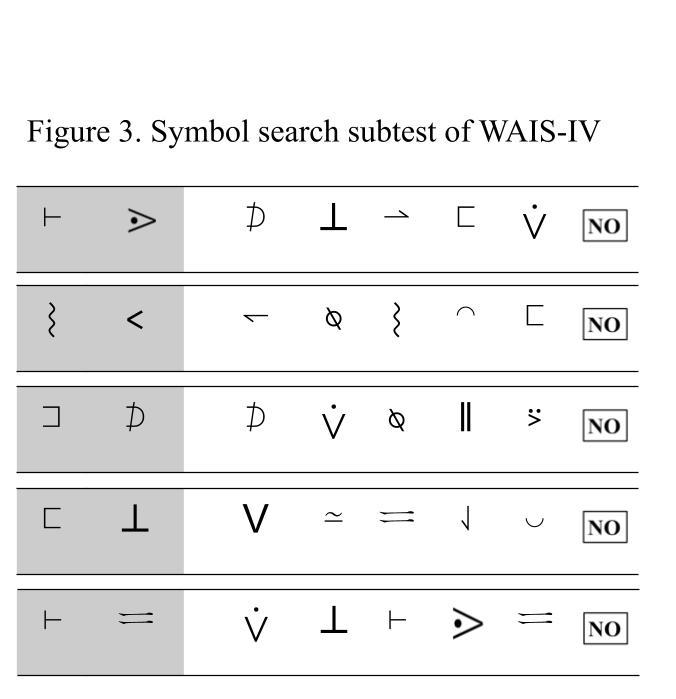
On the left of each row: two target symbols you’re supposed to search for.
On the right: the word no outlined by a box to indicate, after a faithful scan of the row, that the targets are nowhere to be found.
In between: a gamut of symbols that sometimes, but not always, match the targets.
At the command of her stopwatch, you scan row after row, searching for the perfect match. You fly through the first page, and the task becomes somewhat bearable — pleasant, even. For a moment, you pretend you are not you, a mentally ill nineteen-year-old with attachment issues, but a matchmaker. A finely calibrated dating app capable of scrutinizing every symbol, each curve and contour, until you find the target’s pair. When you must circle no at the end of a row, you contort your mouth in momentary disappointment for the lone, unmatched symbol. Then, you move on to the next.
***
In November, M compared your relationship to her roommate’s. Why can’t we just be like them? They do leisure activities together. Even though your apartment held Dollarama crafts from your first months, scraggly pipe cleaners you’d contorted into daffodils as Netflix leaked from her laptop, she knew you’d never been one for sitting around. By the fall, you were working two jobs and writing a thesis with a full-time course load. And though you knew, even then, that your chronic need to Tetris your life contributed to your misery, you couldn’t — and still can’t — comprehend the concept of “leisure time.”
Still, when she asked this of you, over the phone, it really did sound so lovely you could almost see it: slivers of any salvageable daylight creeping past her undrawn curtains, paper crafts strewn across the sheets, as she lay, lazily, next to a version of you a little less like yourself.
You know now she was the ⋗, and you were the v̇.
No matter how much you keeled, you could never match her shape.
***
Coding
The psychologist flips your booklet to a new section. New instructions. New task. She points to a legend at the top of the page, which designates a symbol for each digit one through nine. Your task, as she describes, is to transcribe the numeric to the symbolic.
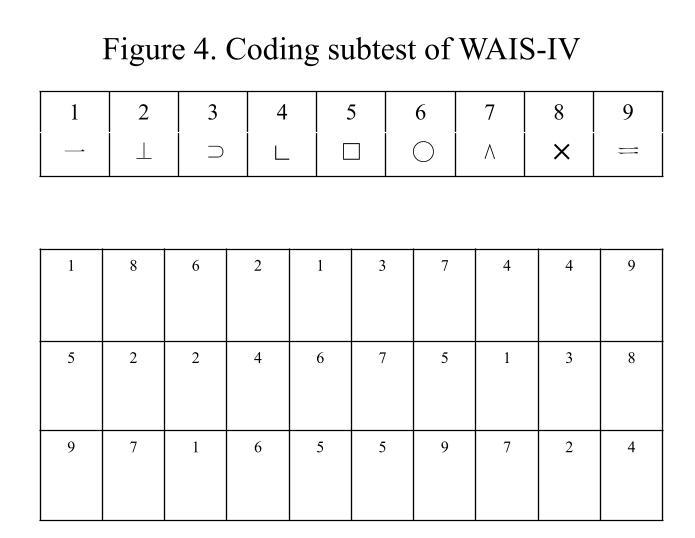
Following a brief practice run, you begin tearing through the boxes, scribbling down the correct counterpart beneath each number.
You see 1. You write:

.
You see 8. You write:

.
You see 6. You write:

.
You see 2. You write:

.
You see 1 again. You write:

.
You see 3. You write:

.
You see 7. You write:

.
You see 4. You write:

.
You see 4 again. You write:

.
You see 9. You write:

.
You see 5. You write:

Halfway down the first page, you smile at how easy this is. The simplest thing in the world. Impossible to screw up.
You see. You write. You see. You write. You see. You write. When you look up after two minutes, nearly three pages of perfect transcription completed, you want the psychologist to balloon her eyes, slack-jawed, and say, Oh my god. You’re a natural. A true transcription beast! How did you learn to do this?
To which you would proudly reply, I spent a year translating my heart. Here, let me show you.
Then, you would close the booklet, flip it face down, draw your own translation grid, and fill it in:
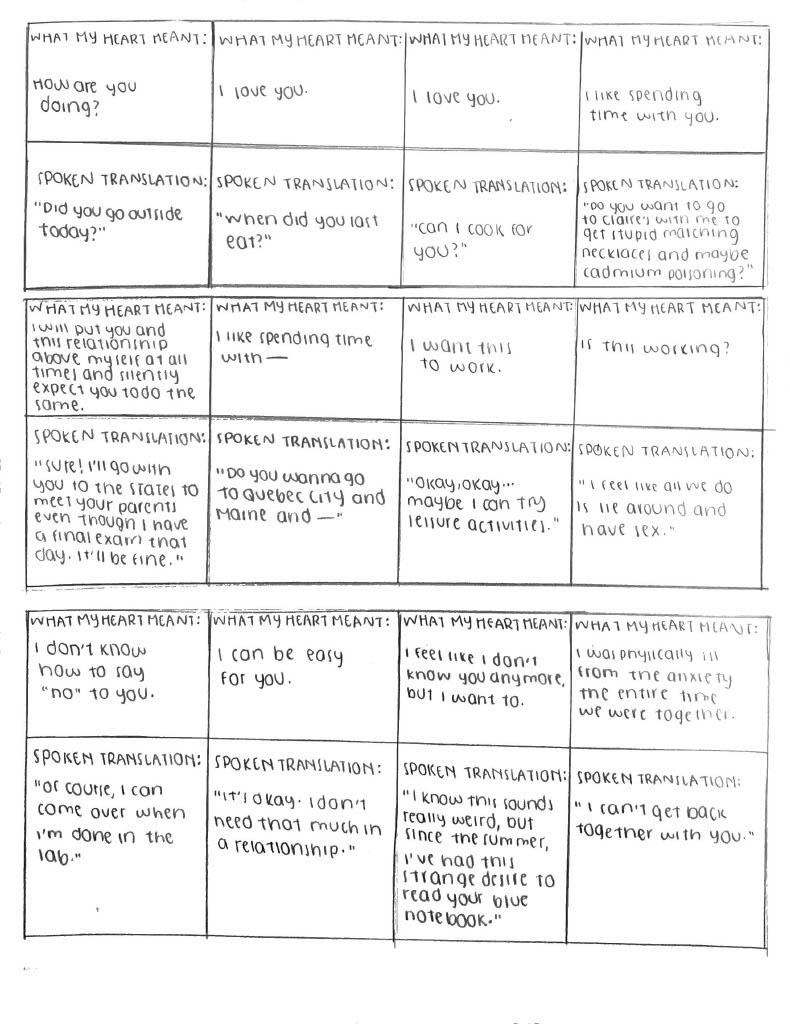
Afterwards, you would push the grid across the table, grinning. The psychologist wouldn’t call you dishonest or too much. She wouldn’t name the unrealistic expectations, the protest behavior, the overwhelming fear of abandonment, the textbook codependency. She wouldn’t say people pleasing is people-using,[2] or that you brought this on yourself. She wouldn’t talk about “good participants” or “good partners.” She wouldn’t even say, hey, look, I know you’re going through it. And you are actually — scientifically — dumb because you’re withdrawing from the breakup — all those neurotransmitters and such — but damn. You’re fucked up.
She would simply reply, babe, your heart is where your brain should be, and shred the booklet between her sharp nails.
Except she doesn’t do any of that. Only, let’s move on to something else.
Vocabulary
You begin the final task. Your last chance to prove yourself a “good participant.” The last push to salvage the score and satisfy your miscalibrated brain, to correct whatever image the psychologist has created of you, all recorded in her blue script.
She opens the binder for the last time. You stare down at a list of words, large print on glossy paper: Tranquil. Fortitude. Acute. Tirade. Ominous. Marr. Encumber. Succumb. Ameliorate.
She points to them, one by one, asking for their meanings. You like words, you tell yourself. You are good with words. You play along in this language game, using words to prop up the meanings of other words.
She points to audacious, and you think, when someone asks to kiss you one last time after breaking up with you for the second time in a month. She doesn’t ask you to define pushover, but you would say someone who says yes anyway.
You say audacious means gutsy, and she doesn’t ask for more.
She points to palliate, and you want to say when someone insists on taking “a break” instead of ending things for good, knowing nothing will change. But you only say, as you’ve said many times before, I think I know, but I don’t want to be wrong, so I’m not going to give you an answer. She notes your wordy non-response.
At compassion, you try not to cry. You mutter kindness, but she wants more. You have nothing left to give. The tears well quicker than the words come, and you think Shit. In this windowless room, this is where you’ll cry for the first time since you broke up. You’ll cry ugly tears — golf balls that slip past the gulfs of your eye bags and splatter below — because compassion is something you have for M but not yourself. Because you keeled and leisured and translated and still couldn’t make it work. You’ll cry because you saw the patterns and still shrank your vocabulary until yes was the only word you knew. Because you’ve moved from task to task without ever moving on, and you’re convinced you’ve failed them all because you can only think about her. Because you are certain there is something so fundamentally wrong with you that cannot be fixed.
But instead, you whisper slowly, wracking the depths of your miscalibrated brain, It’s forgiveness…Empathy—yes, I think that’s what they call it. She nods.
Conclusion
You realize, hours later, staring at the dying houseplant alone in your unlit living room, that you were supposed to say a poem and a statue are both works of art. It hits you — like the night you knew it was over with M. You laugh a hollowed laugh until you sob — hand pressed over mouth as if you could shove the noise back inside yourself. As if you could bury this knowledge so deep it disappeared.
But there is no return to ignorance. No correcting your mistakes. It didn’t matter how hard you spit poetics to tunnel around the truth. How long you lay in your bed, leisurely and statue-like. There was only ever one right answer.
And yet, you had been so, so stupid.[3]
[1] Figure 1 reconstructed from Figure 1 of The missing piece in block design tasks: Resolving performance differences elicited by designs with identical stimulus parameters | Attention, Perception, & Psychophysics.
[2] From The Dry Season by Melissa Febos.
[3] Initials have been changed for anonymity. Unless otherwise specified, examples from and representations of the WAIS-IV included in this essay are reconstructed from memory. Due to the stressful nature of this task, my tendency to dissociate, depression, grief, the otherwise unfortunate fallibility of human memory, and the lack of resources available for fact-checking, there is no guarantee examples and representations are perfect reproductions of the real test. Still, I’ve endeavored to capture the essence of each subtest and the test, mediated through my personal experience. Some subtests have been omitted from this essay for the sake of brevity. As with the test itself, I tried my best. It was all I could do.
 Jessica Kinuyo Bakar is from Northern California and lives in Tiohtià:ke/Montréal, where she studies creative writing at Concordia University. Her recent work has appeared or is forthcoming in Geist, The /tƐmz/ Review, and elsewhere. She is working on a nonfiction project on the 2023 Lāhainā fires and has received support from the Quebec Writers’ Federation and AWP.

Thank you for an amazing read!
<3
<3