
Somewhere along the way, I convinced myself that writing a book was for other people. I was thrilled to find some success writing short pieces, but a whole book with a spine and a cover and acknowledgements? Forget it. It was all too big, too scary, too much time. I didn’t belong in that world.
However, after years of enduring fertility treatments and not seeing any writing about the subject, I was called to write a book about infertility, pregnancy loss, marriage — all these big ideas that overwhelmed me the moment I sat down to work on my book. So, I wrote very little in this space of paralysis. This book, the one that I wished-existed-so-I-could-read-it during this hard time, loomed large in my life. But it was not coming into being.
My hazy memory can credit a fellow writer-friend for unlocking my frozen process with a tiny comment, “Just write islands.” Sit and just write a scene, a list, a few words that might get you to a shitty first draft, to borrow Anne Lamott’s phrase. This island metaphor is now the cornerstone of any long, creative work I approach. I could manage to sit down and write a little bit, especially since by the time I was really writing, I was a new mother with very little time because of my very little sidekick.
For a decade, I wrote islands, over a hundred of them, with no purpose other than to get into words these seemingly-inscrutable feelings I had about fertility treatments and pregnancy loss — and a new layer to that story, the ambivalence of motherhood. Sometimes I only found five minutes and every now and then I found an hour to sit with my thoughts and form them into sentences. But it all felt very slow. I joked my project made me feel like the poetically-famous mariner with an albatross dangling from my neck.
Years later, I had a mountain of islands — a mixed metaphor I hope you will forgive — that needed to come together. I took the islands on several trips, a variety of colored Post-it notes in hand, to try to organize this what-felt-like-a-mess into … maybe … a book(?). Book drafts deserve to be out in the world breathing fresh air, too! On those weekend trips, I sought a clear direction but found few paths. The albatross still hung from my neck: people asking how the book was going, my mind wanting to move on to a new writing topic but held back by a stack of papers festooned with Post-it notes.
It took a few attempts at making my book into a book-with-a capital-B for me to understand that I could organize the book any way I wanted, that these islands could hold together loosely in what I jokingly called an archipelago, a word whose own etymology transitioned from something specific to something more loose, more general. In the 1500s, it only meant the Aegean Sea that was filled with small islands. But then the word began to mean any sea that could hold many islands. And by the 1800s, the word meant the islands held together in the sea and not the sea itself. My book didn’t need to be a book with-a-capital-B, a singular idea of what the word should mean — my book could be an archipelago, a loose connection of islands that sits in a sea of my making.
Once I allowed myself to stop forcing some kind of specific organization on my book, I was able to push through the obstacles holding me back from publishing. A main concern was that a tender-hearted reader going through fertility treatments would pick up my book only to get to the end and discover I did have a baby. When I was going through treatments, I would have thrown that book across the room with the happy ending. Now that I was in charge of forming my archipelago, I didn’t need to follow a traditional plot structure, so I moved the ending to the beginning. I even called it the epilogue, putting that island exactly where I wanted the reader to find it. Because I can put the islands wherever I want in my archipelago. A reader could know from the first pages that the story ends with a baby, and if that reader didn’t feel safe reading such a book, they could put it down and maybe return to it when they felt safer in its presence.
I worried that readers might not understand the privilege that one must have to even endure the struggles I was about to share in the pages they held. Why not put an author’s note? And why not have a second author’s note about the ridiculous insurance disparity of the fertility world? The book could finally fall in place once I allowed it to loosen up but still be connected in one semi-cohesive story. Approaching my writing with this idea created space for me to put my book out into the world: an archipelago of my own making for anyone to explore.
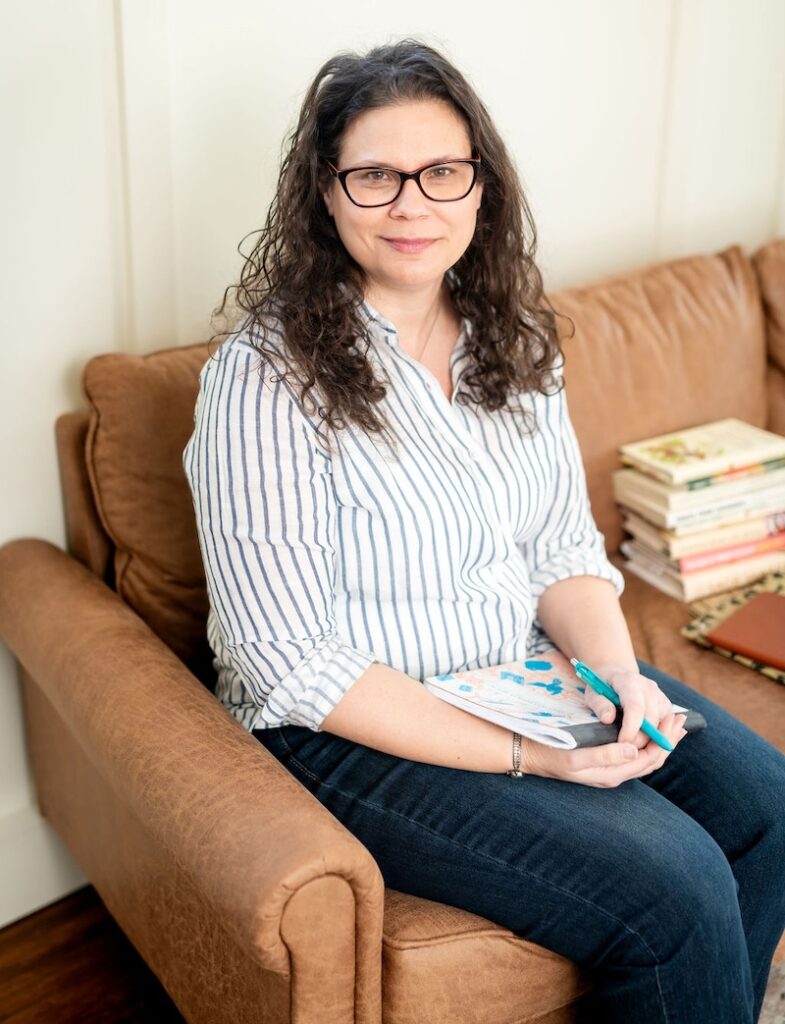 Colleen Lutz Clemens writes in Pennsylvania where she lives with her family and pups and teaches English at Kutztown University. She publishes widely in both academic and creative venues. Her creative work has appeared in collections such as Click: When We Knew We Were Feminists, Three Minus One: Stories of Parents’ Love and Loss and Biting the Bullet: Essays on the Courage of Women. She is the co-editor of three anthologies of narrative nonfiction including Philadelphia Reflections: Stories from the Delaware to the Schuylkill. She recently published her first memoir, E=mc2: A Story of Infertility, Miscarriage & Love. Readers can find her at colleenclemens.com and on Instagram at @colclemensauthor.