
Reviewed by Chanda Daniels

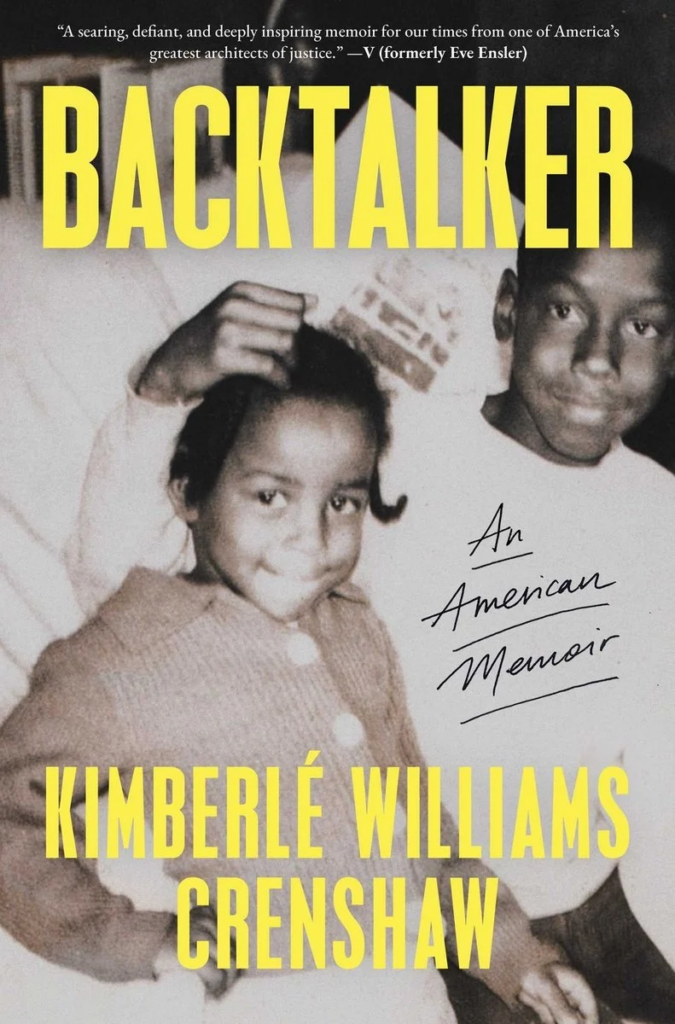 When Kimberlé Williams Crenshaw said, “Perhaps mom had been right that backtalking might get me somewhere,” I began to reflect on all the honest conversations that landed on less than enthusiastic ears and where we would be without them.
As a fellow Black woman with an aversion to hypocrisy and injustice, it was transformative to read the journey of the scholar who coined the terms “intersectionality” and “critical race theory” in her memoir, Back Talker: An American Memoir (Simon & Schuster; May 2026).
Before critical race theory and intersectionality became the center of debates on Fox News and within our current administration, they were concepts built through Williams Crenshaw’s lived experience. The memoir unfolds as a series of beautifully layered memories. As she details her upbringing, we witness her case study for intersectionality, one that shows these are not conceptual theories, but ideas shaped by navigating the systems meant to uphold these inequities and read as she brings them into the national conversation through what she calls ‘backtalking.’
She shows us this starkly from the opening, with an experience every Black girl experiences: the moment she realizes she doesn’t fit the idea of girlhood we’re told. What begins as a young girl’s pursuit to be chosen as the beautiful princess in her all-white class’s story time becomes the first crack in the facade of an equitable world, when she realizes she would never be picked for a role described as “beautiful and pure.”
The memoir moves through Willam Crenshaw’s early days in Canton, Ohio, a childhood grounded in a strong sense of identity instilled by her father, an educator, and her mother, a music teacher and third-generation ‘backtalker.’ Evenings at the dinner table with her older brother centered on community, civil rights, and Blackness.
Born in 1959, her life spans the death of Martin Luther King Jr., the Civil Rights Act, the desegregation of public schools, Justice Clarence Thomas’ confirmation, the Obama years, and into the present day, where her research carries renewed urgency as we face one of the greatest threats to a multiracial democracy since her childhood.
Written with clarity and precision built by Williams Crenshaw’s deep expertise on race and gender politics, and sharpened by the constant defense for the need for both to be discussed, the memoir is both grounded and resolute. The vignettes that form her perspective land with a familiarity that pulls you in. The fury when the Lorraine Hansberry play she poured into was replaced with a colorblind production of Blackboard Jungle. The expansion that comes as she leaves Ohio for Cornell. The sense that we are walking the halls of Harvard beside her as she strategizes how to secure more diversity in faculty and coursework.
In her post-grad years, Williams Crenshaw’s law school experience solidifies her understanding that the law, which she once believed to be a tool for liberation, often functions to fortify the racial status quo. Critical race theory emerges as a way to demand accountability, to insist that legal frameworks account for race, and to show that simply learning systems alone is not enough to ensure justice within them.
The subversive tension between Willams Crenshaw and those within the movement space is the most illuminating part of the memoir. Conversations often relegated to the margins are centered here in a way that feels rare. W.E.B. Du Bois wrote of double consciousness, but as Crenshaw depicts, and as many of us have lived, Black women carry a third perspective, one where gender and race doesn’t fit neatly in either box. Too often, there is pressure to choose one identity over the other, even when both carry consequences.
In these moments, the story challenges the reader to reflect on where they acquiesce when challenged. She recounts times when hope is laced with disappointment, when honesty is met with hostility rather than understanding. Through it all, Williams Crenshaw remains a backtalker. The work insists that in moments of dismay and regression, softening our edges is not the way to get somewhere. The answer, repeated throughout, is to continue speaking up for what you see and believe.
The story expands beyond her academic work to tell a full story of becoming, from joyful moments like singing in the car with her mother, to harrowing encounters with boyfriends and early advocacy wins, all culminating in her becoming the steadfast backtalker she is known to be. But her story is not without the inevitable grief, including death and depictions of gender-based and gun violence, realities too often intertwined with Black life.
The memoir itself feels like the next important act of backtalking.
In the context of where we are in America, today, Crenshaw’s concepts are the hottest debate, centered in censorship and rewriting history. She uses her writing to show that while you can try to ban words and manipulate history, the truth will be memorialized. When the goal is to erase and silence, this memoir is a triumph in standing in the place others aren’t willing to go, forcing her identity, and so many other Black women like mine, to be seen. A backtalker like her wouldn’t do anything less.
 Chanda is a writer focused on the intersection of politics, culture, and identity, and the author of the newsletter Ok So Hear Me Out…, where she examines these questions through a personal lens. Her work has been published in The New York Times and Courier News and she’s been featured in Vox and Washingtonian Magazine.