
Reviewed by Ben Winderman

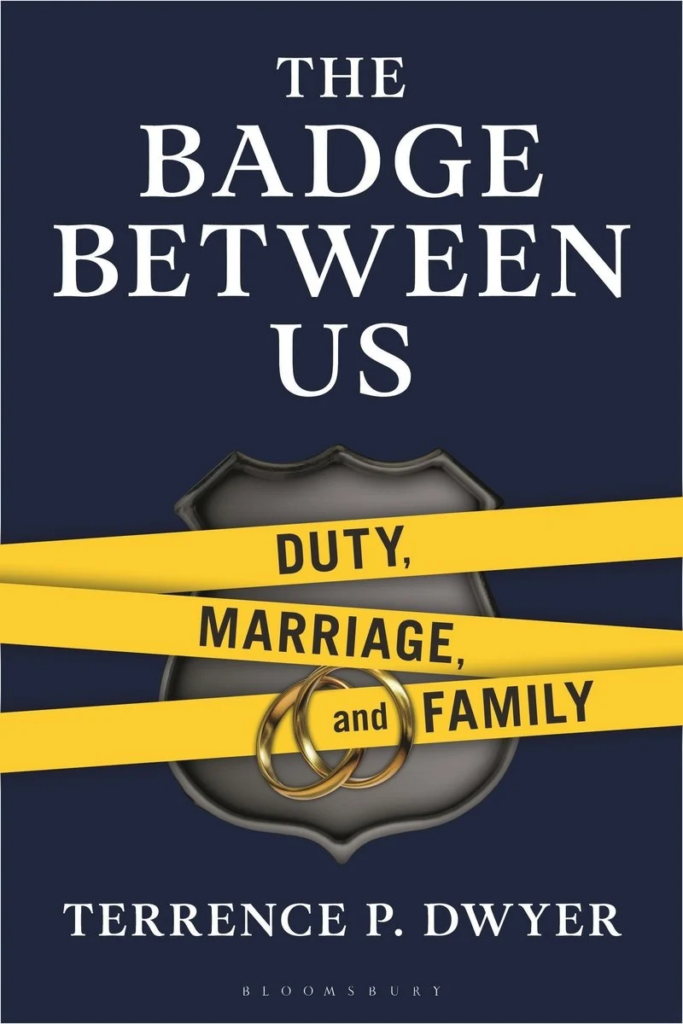 Terrence P. Dwyer’s The Badge Between Us: Duty, Marriage, and Family (Bloomsbury Academic; Feb. 2026) courageously confronts institutional problems embedded in the culture/career of policing. Dwyer, retired from the New York State Police after a 22-year career reports upon “the job’s” inherent hypocrisies, its underworld actors, its dysfunctional bureaucracy, and the inescapable injuries this work inflicts.
But wait! The Badge Between Us is the opposite of a boring commentary on corruption in the ranks; because Investigator Dwyer is also out to tell a love story focused on the relationship between him and his wife as he navigates the treacherous waters of his career.
Tug-boats are effective because their job is singular. What happens however, if they’re tasked with tugging two (or five) boats, in an array of locations, to safety, simultaneously. And there’s the tug. As Dwyer’s book progresses, we read him as a dependable, albeit imperiled tug-boat, trapped in the multiplicity of rescuing New York from crime, protecting his wife Joan from life with a cop, completing law school, navigating parenthood and partnership, and losing faith in the Catholic church. No wonder he developed night terrors. “We aren’t retirees,” an academy classmate of Dwyer explained, “as much as we’re survivors of the job.” Thank goodness Terry survived to retire, write, run, and recover. Thank goodness he wrote his story.
The Badge Between Us is an eclectic confluence of street and sweet; Dwyer’s intimate memoir wrapped in a true-crime classic. The book seduces the reader’s imagination with seedy scenes starring “roaches in bodega video poker machines,” mobsters with colorful names like Nicky “Cigars” Marangello, Richie “Shellackhead” Cantarella, and Joey “The Mook” D’Amico, and blotto cops crashing cars on the Verrazano Bridge.
But wait! The Badge Between Us also crafts poignant imagery of a cop’s oldest daughter (Siobhan) bringing a late-night piece of her high school graduation cake to her over-worked-on-the-edge dad, while he compulsively examined evidence in preparation his next morning’s federal court testimony in connection with a New York City Mafia case.
Generously, The Badge Between Us invites you to eat that graduation cake and peer over that edge. So, for several evenings this spring I sat at my dining room table doing just that, indulging in the deliciousness of Dwyer’s unfettered state of mind, while contemplating how serving your passions, by the forkful, can simultaneously confuse your soul.
I mostly read to contemplate and forget the unopened envelopes on my dining room table.
One of the more memorable sides of this book is that The Son of Sam, serial killer David Berkowitz, bookends this story. Berkowitz’s 1977 killing spree provides Dwyer with the motivation to become a cop and protect the public safety, but it’s one of the book’s final scenes, when Dwyer interviews the infamous Son of Sam, in prison, that showcases Dwyer’s masterful prose: “How could Berkowitz, the boogeyman of my youth, have found his faith in prison, while I struggled to hold on to mine?” The chapter, “Meeting Sam,” deepens Dwyer’s work from chasm to canyon. Here he writes with an atypical candor and vulnerability compared to previous pages, and in doing so reveals his own trepidations and regrets. Mentionable: If you’re a fan of the Netflix show Mindhunter, you’ll revel in “Meeting Sam.”
Now I must tug-boat us back towards the love story; the most patient part of this book. Terry and Joan’s marriage is never a scene but instead an ongoing thread, stitched to a stylish ending. Dwyer writes: “For twenty years, Joan lived with the badge between us. It existed as an invisible wall we stood on either side of… My self-absorption and focus on working investigations blinded me to her pain. Deep down she detested the job. She hated what it did to me, how it separated us, and how it changed me. She mourned the loss of the person she first met on Fordham’s campus.” As I cautioned, this part takes patience.
I love this book’s honesty — Dwyer acknowledges at different times what drew him to and kept him in this line of work. Even as he suffered the work’s strain upon his marriage and faith. “The question of why I didn’t leave was often asked of me,” Dwyer reflects, “and the answer always came back to a late evening on a Bronx apartment building’s rooftop many years earlier. Crouched behind a wall for cover with my gun out, and eighteen hours into a work day that lasted several hours more, I waited for a wanted murderer — a street thug desperately seeking entry into a Genovese crime family crew… I could feel bone deep this was where I belonged.”
One of the characteristics of Dwyer’s work that I enjoyed most was his descriptions of place. As a kid I was the only person in my family who wasn’t born in Brooklyn, but reading Badge made me feel like a late-night New Yorker. Mind you I sat safely in my suburban Pennsylvania home.
In fact, even Dwyer’s own children didn’t grasp the danger that their dad faced on the job every day. “Not sure. . . I guess. . . you know . . . just assumed you’d always be safe,’ said Siobhan after attending her dad’s Superintendent’s Commendation Award ceremony in Albany, NY.
Another favorite takeaway, in Dwyer’s words:
“Police work anesthetizes you. A disconnect from ordinary life gradually occurs. You no longer interact in public the same way as others; everyone is suspect; every event is a potential danger zone. Eating out becomes a shuffle to get a view of the door. You scan the exits in every room you enter. Sharp noises and the absence of noise equally alarm you. Over time you view the world only through the myopic lens of your work. Judgement of others is harsh. Workday events accumulate. You become numb to other people’s pain and your own. Unfeeling is the mental state late in your career.”
Our society has developed an acute awareness of police brutality, but reading The Badge Between Us helped this concerned citizen understand the complexity of such conditions. Dwyer would be the last to defend or excuse instances of excessive police force, particularly ones that target the most vulnerable members of our communities, however his work provides a primary source of education — 22 years of his toil, to become a voice behind the Badge.
But wait! (I know, last one.) After lengthy investigations of gang activity and the most gruesome of multiple homicides, Dwyer decides to retire. The description he offers of his final shift, walking the carpeted hallways of his station house in nice shoes, is one of the beautiful show-don’t-tell moments of this book.
Beyond what I’ve shared, this book is full of deep reflection and surprising realizations. I’ll leave those for your own discovery, perhaps at your dining room table, ignoring the bills.
 Ben Winderman is a writer and business owner from Bucks County, PA. He won the New Millenium Writings Nonfiction Award for his essay “Ladders,” and has published work in The Dying Goose and Hippocampus Magazine. He’s working on a full-length memoir entitled Going to the Dogs. Ben earned his MA from the Wilkes University Maslow Family Creative Writing Program. He has two grown children (Sam and Maggie) and one pit bull named Pablo.

Great review! I will add this to my reading list.
This book is filled with action, stress, personal risk and personal discovery. He seems to truly understand what his wife went through as he struggled his issues. That is common to so many relationships, but the sensitivity is often missing.
I do surprise myself with the awareness of how often I am drawn to a crime story or show. Yet, often they just display violence. This definitely appeals to me and I’m sure it’s that it’s the reviewer’s style, descriptive moments, and beautiful choice of words that enhanced the appeal.
Cuddoes to writer and reviewer for sparking and holding my interest.
Great reading material!
Thanks! Enjoy the book; it’s unique and engaging as you describe!
The review of The Badge Between Us had me at the reference to MINDHUNTER and the “eclectic confluence of street and sweet”
Can’t wait to get my hands on this book!!
Thank you!!
I’d read this book. Reminds me why I spent so many hours watching Castle, Blue Bloods, and Law and Order – I love a cop drama!
All good shows- Thanks Sammy!
I’d read this book, reminds me why I watched so many hours of Castle, Law and Order, and Blue bloods – I love a good cop drama!
Me too! Thanks!
I’d read this book! Reminds me why I spent so many hours watching Castle, Law and Order, and blue bloods – I love a good cop drama!
This review left me wanting to delve into this book and share the experience. Looks like a great choice for our next book club read!
I’d read this book. Reminds me why I spent so many hours watching Castle, Blue Bloods, and Law and Order – I love a cop drama!
That would be great! Sign me up! Thanks!
Excellent review that illustrates how a high-risk profession impacts all aspects of life. I am looking forward to reading the book.
Thank you!
Excellent review that illustrates how a high-risk profession impacts all aspects of life. I am looking forward to reading the book.
Thank you!!
Very engaging review, can’t wait to read the book.
Thanks, enjoy!
Great review Ben. Your description of the characters and storyline set the stage just enough to pique interest with out giving anything away.
Thanks so much George!
Once again a fabulous review by Ben Winderman. His deep dive into Dwyer’s book shows depth and understanding of the material! Looking forward to reading The Badge Between Us
Thanks so much Kym!