
Reviewed by Brian Lee Knopp

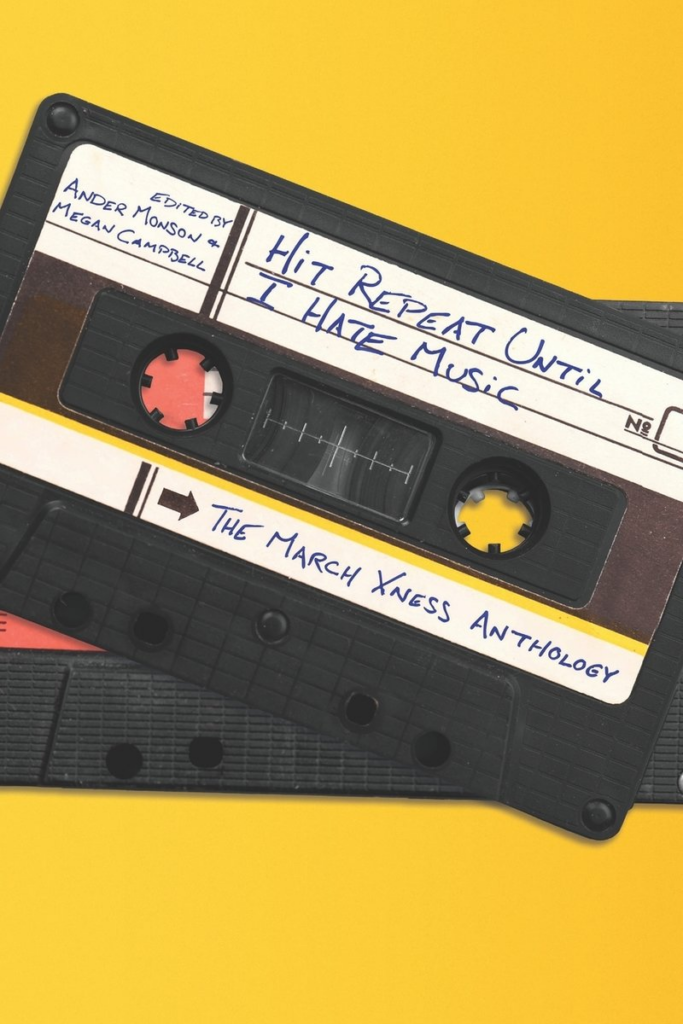 In 2016, writers Ander Monson and Megan Campbell created a music-themed tournament in which sixty-four songs and their corresponding essays were pitted against each other in successive brackets until there was a single winner. They started with March Sadness (Sad 90s Indie Songs), generating the essays themselves at first, then inviting others to participate in the competition.
Year by year, the tournament roared through March Fadness (One Hit Wonders of the 90s), March Shredness (Hair Metal bands), March Vladness (the Goth Bracket), March Badness (Bad Hits of the 70s and 80s), March Plaidness (Grunge), March Faxness (Cover Tunes), March Fadness redux (One Hit Wonders of the 80’s) and March Danceness (Dance Hits of the 90s). What Monson and Campbell admittedly “started as a joke” quickly became such a wildly popular contest that a lottery had to be implemented to manage the throngs of wannabe competitors.
Hit Repeat Until I Hate Music: The March Xness Anthology (Split/Lip; March 2026) is a collection of forty winning song essays from forty-two writers (as two of the essays are tandem written), with five essays per each of the book’s eight chapters that correspond to the eight themed tournaments listed above. The anthology’s title borrows from Laura C.J. Owen’s brilliant essay titled “Don’t Tell My Heart,” which is included in the March Fadness chapter:
Parts of me can be trusted, the song suggests: my eyes, my lips, my arms, my legs. But then, some parts of me just can’t bear to hear the truth: my brain, my ol’ achy breaky heart. Most of me is okay: parts of me aren’t. Do I contradict myself? Sings Billy Ray Cyrus: I contradict myself. I am large, I contain multitudes. MULLET-itudes if you will . . . . ‘Achy Breaky Heart’ always made me think of the online Awkward Yeti cartoons in which the sensible-but-neurotic Brain is in constant odd-couple conflict with the whimsical, vulnerable Heart. ‘I love this song,’ Heart instructs Brain, ‘Play it until I hate music.’
This anthology showcases the very best writing about the very best songs — and the very mad, sad, and bad songs — that make up the unique and irreplaceable soundtrack to our lives. The essays range in quality from the simply superb to the truly transcendent, even life altering. The essays are haunting, indelible; they are themselves unforgettable songs, dramatic prose performances with thousands of lyrics that convey and complement all the myriad emotions and experiences embedded in a song.
Reviewing this anthology was a challenge I had to accept because the essays promised to spotlight what is for me the crucial interrelationship between music and writing, the two intertwined influences that have ruled my life like a living caduceus. The essays delivered far beyond my expectations. I was delighted to discover how profoundly and satisfyingly immersive March Xness was; how convincingly and eloquently the essays proved that a single song can truly change the life of the listener . . . for better or worse.
I find that music, like other joys in life — love, luck, and laughter come readily to mind — seems to invite analyses in direct proportion to the very limitations inherent in doing so; that is to say, the more you try to explain intellectually, the less you appreciate or understand emotionally. A song’s appeal (or lack thereof) is essentially a mystery, working its magic (or poison) deeply within the shadows of the soul and often in the bewildering guise of mixed metaphors and multiple meanings: A song can be a burning spear thrust through your heart that helps you live; a song can be a worm crawling in your ear that turns into a butterfly or a badger, or a nightmarish hybrid of both. The key to the mystery seems to be context: where you were and what was going on in your life when The Song took hold of you. As Kathleen Rooney explains this approach in her essay on Terry Jacks’ “Seasons in the Sun” found in March Badness:
A rhetorical approach of which I am especially fond is to go super-deep in my analysis of something that could potentially be extremely shallow. It’s easy to dispense a quick opinion about a piece of art: “I like it,” or “I dislike it”; “that thing’s good,” or “that thing sucks.” Far harder, but more rewarding, is to dig way down into how a given piece operates and the circumstances surrounding said piece’s creation: the people, the time, and the place responsible for a work’s existence.”
All of the forty essays in this anthology provide such a contextual key by way of historical research and personal backstory. Each essay attempts to unlock the mystery of The Song residing within both the musician and the essayist. In so doing, the mystery of The Song can be unlocked within the reader, as well. It is precisely this poignant blend of criticism and memoir that makes these essays so compelling, and that makes March Xness so irresistible.
Out of solidarity with the more confessionary aspects of March Xness, I will admit my prejudice in favor of the March Badness essays. This subcollection was my favorite for several reasons, all of them shamelessly subjective. For starters, I found the March Badness essays to be as infectious as COVID, as funny as an orangutan with hiccups, and as addictive as popping bubble wrap.
On a deeper dive into my druthers, I found that reexamining my relationship with shitty songs from the 70s and 80s was effortless, almost reflexive and instinctual, like blinking at sudden loud noises or checking the coin returns of vending machines. My March Badness partisanship did not demand that I blowtorch my past to lay bare the smoldering incongruities of my psyche — a meditative self-immolation, if you will, required by and celebrated in the other themed tournaments I was drawn to like Goth and Grunge. Rather, with March Badness, I only had to remember . . . and then sit back and read with jaw dropped in awe of the dazzling, multilayered analyses that combined personal animus, cultural anthropology, and music history to decode the worst songs of all time:
Elena Passarello, on “Muskrat Love” by Captain and Tenille:
[Toni Tennille] says she first heard ‘Muskrat Love’ in the car on the way to a nightclub gig, about a year before she and Captain Daryl were discovered. Given the timeline, they probably heard the band America’s 1973 cover of Willis Alan Ramsey’s song. This was both the first recording re-named ‘Muskrat Love’ and the first to receive any real radio airplay. Weirdly, singer Lani Hall recorded a soporific take on the song, renamed ‘Sun Down,’ the year before, at the label that eventually signed Captain and Tennille. ‘Sun Down’ has the same tune as ‘Muskrat Love,’ but uses new lyrics that omit the Susie and Sam storyline, and I fully reject this heinous act of muskrat erasure.
Unlike Lani Hall, the band America weren’t about to remove the titular muskrats; their version keeps all of Ramsey’s rodent lyrics intact. This is unsurprising, since America’s first two albums made notable contributions to the canon of animalian soft rock. Remember that one song about the ‘alligator lizards in the air’ (how did they get up there? Did somebody toss them)? And that other song about the horse with no name, which features crackerjack naturalist observations like ‘there were plants and birds and rocks and things?’
Martin Seay, on Chuck Berry’s “My Ding-a-Ling,” Berry’s only number-one hit:
What’s most disturbing about Berry is the inescapable suggestion that these two major traits—virtuosic pied piper of America’s youth, and sexually compulsive predator—cannot be disentangled: that his genius cannot be easily extricated from his bad behavior, that the latter infests the former to its core. Part of the dangerous, faintly illicit thrill of Berry’s best music comes from the impression of these tendencies circling each other, sparks arcing through the gap between them, achieving an unstable equilibrium. And part of what makes ‘My Ding-a-Ling’ so awful comes from the impression of this equilibrium collapsing, just utterly showing its ass. . . . What’s upsetting about ‘My Ding-a-Ling’ . . . is the fact that it was rewarded so abundantly. Not even that, it’s the fact that it was rewarded so abundantly when it was the worst thing Berry ever recorded, while the best things Berry ever recorded are among the best things anybody ever recorded.
In closing, howsoever besotted I am with exquisite essays about terrible tunes, I found the most succinct and thoughtful summation of March Xness’ impact on writers and readers, alike, in Cameron Carr’s stunning essay (found in the March Fadness’ One Hit Wonders of the 80s chapter) titled “At The Crack of a Whip,” which explores the band Devo’s influences and legacy:
If writing about music is a competition, then the opponent is what is lost between the experience and the writing down. The best music writing—or maybe any writing—does more than tell what’s there: it gives shape to what is lost.
 Brian Lee Knopp is a retired North Carolina private investigator. In 2019, he published the revised 2nd edition of his 2009 memoir Mayhem in Mayberry: Misadventures of a P.I. in Southern Appalachia (Cosmic Pigbite Press). His most recent publication is Dreams I’m Never Gonna See: The Takeover of WDIZ Rock 100/FM and Other Essays (Cosmic Pigbite Press; 2024). A former professional sheep shearer with an MA in English literature from the University of Texas at Austin, Knopp has taught nonfiction writing for the UNCA-Great Smokies writing program, and his work has appeared in Hippocampus Magazine (2024 Pushcart Prize nomination), Stoneboat Journal, WNC Magazine, Now & Then: The Appalachian Magazine, The Great Smokies Review, and elsewhere. He lives in Asheville.

This review feels inspired, as if the book’s contents bled into the review. Gotta buy this one. As a writer riding that cusp with song, I can tell it’s going to inspire me too.