Interviewed by Rae Pagliarulo

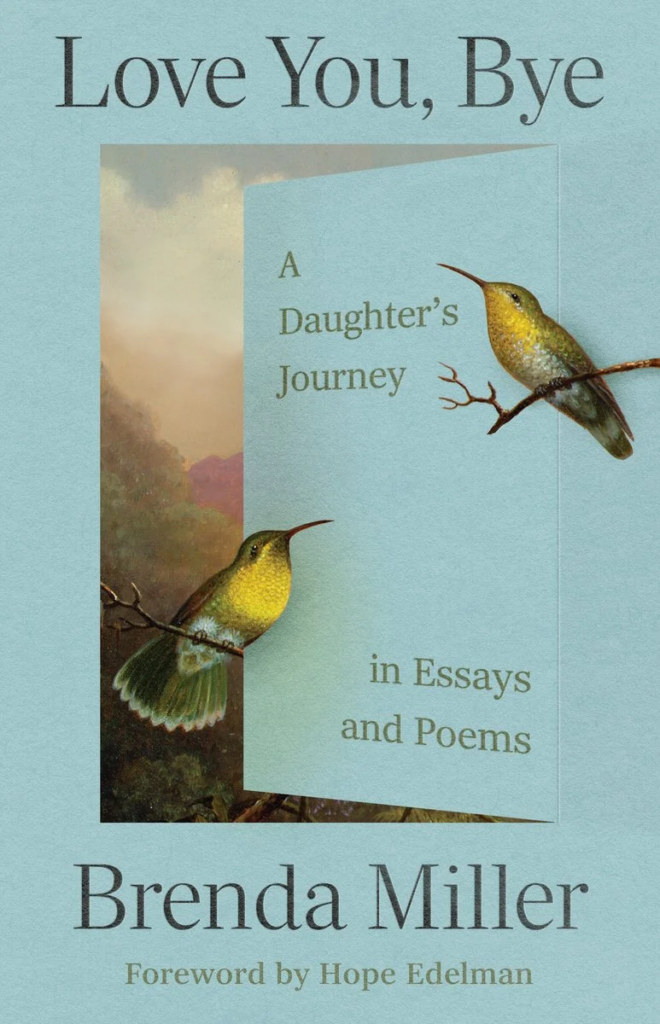
When Brenda Miller’s latest book, Love You, Bye: A Daughter’s Journey in Essays and Poems (Skinner House Books; April 2026) was released, I immediately knew that I wanted to cover it for Hippocampus Magazine. What I didn’t know was that I’d get so much more than an ARC of the book — Brenda agreed to chat with me about all things creative nonfiction over Zoom from her home in Washington, and for me, it was a dream come true.
Brenda has been setting the pace for discovery and experimental forms in creative nonfiction since she published the pivotal text on CNF, Tell It Slant, with her collaborator Suzanne Paola in 2001. In the decades since, she’s published more craft books (The Next Draft, A Braided Heart), co-written collections (The Pen and the Bell with Holly Hughes, Telephone with Julie Marie Wade), and her own poetry and essays (The Daughters of Elderly Women, An Earlier Life, Listening Against the Stone, Blessing of the Animals, and Season of the Body).
As far as I’m concerned, Brenda is one of the most prolific and influential voices in the genre, and I’m more than thrilled that I got to speak with her. Enjoy!
Rae Pagliarulo: Brenda, it’s so incredibly nice to meet you. I have to say, I hope you know how much it means to be able to talk to you. I reached out thinking I’d hear from a publicist and get an ARC of your new book, but to be able to have this conversation with you, and to do it on behalf of Hippocampus Magazine, where so many of us are just such huge fans of yours. In the time I was preparing for this interview, you kept coming up! Somebody mentioned “Swerve” to me one day, and then another day someone asked me about Tell It Slant, and then I woke up one day and saw that your essay “Typos” was in Short Reads! It was like your spirit was following me while I was researching.
Brenda Miller: Oh, that is so, so nice to hear. Of course, I follow Hippocampus, and you guys are doing an amazing job.
RP: Thank you! Now, let’s chat about this new book, Love You, Bye. My experience of reading this book was so interesting because it seems like we have so much in common! Like you, I had a real Fix-It Dad, and my Dad passed first, AND my parents also had birthdays that were just one year and one day apart!
BM: No way!
RP: So, how has the reception of this book been so far? I know you’ve been bopping around the Pacific Northwest for some tour stops.
BM: It’s been a little crazy! I retired almost two years ago from my jobs. I was working at Western University and Pacific Lutheran University’s low-res MFA. And it’s been really quiet around here, so I’ve been just writing a little novel and doing my thing. For some reason, this book really urged me to get out there in a way I don’t normally promote my work. It’s been really busy and very forward-facing, and so great. It’s speaking to a lot of people, and all of my events have been with dear friends and my former mentor, Terry Tempest Williams. It’s been pretty wonderful.
RP: Wow, that’s so nice! You said you’ve been out there more with this book, so do you think that’s a function of being retired and having the time to do more promotion, or does it have to do with the nature of the book you’ve written?
BM: I think it’s both. This is probably the most intimate book I’ve written. Now that it’s out, I don’t think I realized that while I was putting it together. But now I realize, wow, in a long career of writing very personal things, this still seems like the most intimate and authentic book. I think the themes of facing end-of-life challenges, and my work as a hospice volunteer, our world needs these stories now, we need to bring them more out into the open and be really real with one another. The book itself is really demanding that. I’ve taken inspiration from colleagues who have done book tours who told me, you really need to get out there! It’s exhausting already, but I’m enjoying it, too.
RP: How much more promotion is on the way?
BM: I just finished my Seattle launch. I did my local launch last weekend and interviewed Terry Tempest Williams in front of a crowd of 500 people. And then this weekend, I’m doing a yoga and poetry workshop at my yoga studio, which I’ve always wanted to do! Then trips to Nashville, Denver, a few places.
RP: That’s wonderful! So, let me pull it back a little and start from my first note. At this point, Tell It Slant is in its third edition, and it’s considered a really pivotal text for a lot of us in this genre. Still, to this day, it’s a text that when people are thinking, I want to write true stories, I want to learn more about creative nonfiction, they’re turning to this book actively. So I’m wondering, how does it feel to know that this thing you created is part of the beginning of so many people’s journeys? I mean, years ago when I thought, oh I have this diary full of thoughts, is this art? Someone said, it can be, and Brenda will tell you how.
BM: It’s quite an honor and a privilege to be in that position. When Suzanne [Paola] and I talked about writing the very first edition back in 200, there weren’t any textbooks, which was a kind of symptom or sign of the budding nature of creative nonfiction, especially in academic worlds. It wasn’t necessarily a full-fledged area of study yet. But people were hungry for it, right? So there were some anthologies, but no real instructional text. So we just said, let’s just write one and use our teaching notes on what we’ve been doing. I think because we both had such different strengths and perspectives, it just became a pretty comprehensive text at that time. And we had that wonderful anthology. Have you seen the first edition?
RP: I have it! So retro.
BM: So at some point, we heard through the grapevine that it was out of print. That’s when we decided to do the trade edition, and it was geared more towards anyone, not just students in the classroom. And then the third edition came about because things changed so quickly in the genre. I was using the book in my classes, and I realized oh, we’re missing a lot of stuff here, and a lot of the references are pretty dated. It was fun to put together a proposal for a third edition, and I was able to field test the new material with my students, who taught me a lot and gave me lots of good ideas. So, it feels like the third edition especially is a collaboration with all the creative nonfiction writers and teachers who have come up through the decades with us. It’s just pure joy that it has legs. Even now, there’s so many more textbooks, but it hangs in there as a good one.
RP: It’s just so interesting, because no one sets out to create something that’s going to be such a foundational text, that’s going to last generations. What a cool thing to just see a gap in the market and think…
BM: Exactly! I had never written a textbook but I had a lot of ideas. And what thrills me most is the way the ‘hermit crab essay’ has become just a word, a phrase people use as if it’s always been there.
RP: I know! Also, I’m going to a conference this weekend to teach a whole workshop on the hermit crab essay, so thanks for that. So much of what is in my presentation is pulled right from A Braided Heart, which is just so invaluable. So many wonderful anecdotal stories in there about how to let the hermit crab form influence the process of writing. I can be a little Type A and a control freak, and the more I’ve been reading about your approach to that form, it’s a constant reminder to me that letting go and having fun with things that might not turn out perfectly is kind of an integral part of it.
BM: Writing is a practice like any other art, and not everything makes it into the finished product, but guaranteed you’ll either come up with material you’ll use later, or you’ve oiled the gears and you’ve kept your writing mind going. Either one is a great outcome.
RP: Well, it’s like yoga that way. You go, and sometimes you have a crappy day where you’re crunchy and your down dog sucks, and then there are some days that you go, oh, I can feel how easy this is because I’ve had so many days of struggling. Now I just fly into Warrior Two!
BM: Yes! I do love my yoga studio, but there’s always a class where I’m like, when is this gonna be over? And then other classes where I think wait, already? We’re done?
RP: So true! Okay, so I read this in A Braided Heart, and I feel like it explains the experience of being a lit mag editor better than anything I’ve ever read. You were talking about when you get into a room to assess submissions and make decisions, and the quote is, “In this harsh, survival-of-the-fittest environment, almost every topic can seem old hat. It’s the voice that matters–voice and form. When we came across writers who mastered the art of signaling that their allegiance is firmly on the side of artifact over experience, that’s an author we’d be willing to follow anywhere.” Can you talk a bit more about that feeling?
BM: Oh, yeah. Well, especially with nonfiction, it’s when an author forgoes the summarizing intro into their story — what we call ‘clearing the throat’ or ‘getting on the runway,’ right? Just drop me in the situation, or give me an image, something very vivid that draws me in without the writer seeming to say, ‘Hey, hey, I want to tell you about this thing! You’ll be really interested, so just come over here with me! It’s my life story and it’s really important!’ Instead, when it’s good, I’m just floating on a river with somebody, and it usually happens in the present tense. When we’re just in the experience with someone. And a voice that is exploring it all along with us, rather than telling us about it.
I don’t know if that’s something a writer can intentionally do during the drafting process, but it might be something to think about in revision. Especially if you look at your first page and think, am I just telling you something, or am I really in it here? Am I really expressing something in the moment? And then you can always go back if you need to give more information or summary, but you’ve gotta let us be with you for a minute before we get to whatever it is you’re trying to tell us.
I think that often, even though I think the scholarly world around creative nonfiction has come an incredibly long way in the last 30 years or so, I do think a lot of creative nonfiction writers don’t really get the practice they need in scene work, right? In writing the scene, in writing dialogue, those in media res moments, where you drop the reader in.
RP: Wow. Why do you think that even with all the work that’s been done to legitimize the genre, writers are still leaning really hard on the emotional stuff? It’s wonderful, but it isn’t enough.
BM: I don’t know… I’m suspecting that people aren’t reading as much and as deeply as we used to do as students. You know, reading with an eye for very specific things like this. What is the writer doing in this sentence? Let’s just look at the first sentence and figure out why it works.
RP: Well, it’s the difference between reading as a reader and reading as a writer.
BM: Exactly. It could be that perhaps writers or students are being directed more to just write in one genre and category, too. Like, I started as a poet, so I’ve always been drawn to the image, a metaphor, a connection that I’m making — and not necessarily to the thing I want to tell you. Perhaps we need to be encouraging our writers to branch out, you know, try poetry, try fiction, and just see what you can bring from all those genres into what you see as your primary.

RP: So, what would you tell a budding writer? Somebody who’s coming into it with all the emotion? How do you help someone create enough distance so artifact does end up eventually trumping emotion?
BM: I think what we need to do is direct writers to the small rather than the large. The large is the big issues I’m dealing with, the big history I’ve had.
RP: Death, addiction, abandonment. All the big stuff.
BM: Which is really important, and your story to tell. But, when you want to translate it onto the page for others, start small. Start with a very, very small concrete memory, and see where that leads. Be open to the idea that you don’t know the story yet. You might know all the outlines in the story, but you don’t know all the meanings yet. You don’t know all the connections you can make through the writing.
There is a purpose to telling your big emotional story to others in certain venues, to maybe connect with others and help others. But if you’re turning it into literature, what’s the purpose of that? I think it’s more for you to understand more deeply and in a different way your story and what it means for others. This is where a writing teacher can help, where prompts can help. If you’re open to prompts, they’ll always lead you in unexpected directions.
I’m always writing from randomness, it’s the best way to surprise yourself. Going beyond where you think the ending is in a short piece, too. In a recent Substack post, I wrote about how I was writing the first essay in Love You, Bye, “Elijah,” and the whole time I was like, I don’t know why I’m writing this, but I’m just gonna write it and see. Why am I remembering this particular memory out of the million memories I have from childhood.
But at a certain place, the memory kind of stops. It comes to its own conclusion, and it could have been the conclusion to my essay, but instead I found myself writing, “Years later, now that my father is gone…” So now I’m bringing in the wiser adult narrator to look at the memory and think, why am I remembering this right at this moment? Oh, maybe it’s because I see my father and everyone else who’s gone as the ghost we invite into our lives and our home. It becomes about so much more. And it’s just a tiny little paragraph. If I ended the essay where the memory ended, it just would be an anecdote.
RP: I think a lot about beginnings and endings, especially in flash, because a lot of times I’ll read a submission and think, that could have ended two paragraphs ago, and you would have been just fine! There’s a tendency to over-explain, like, are you sure you got my point? So how can you tell if you’re going past the end to unearth more material versus going past it because you just don’t understand the story yet?
BM: My students have become very used to me cutting off their last paragraphs! Because those last paragraphs wrap it all up and say, ‘then I realized’ or whatever it is.
RP: I call it the Big Red Bow.
BM: Yes! So, ending on a strong image or some imagistic words, that’s a good sign. With “Elijah,” I just felt like there was something missing. It almost felt like rhythm. Like music. A good ending is like a coda that comes back around or something. I think you need to listen, you need to read your work out loud, to hear where the strong words are falling. Are they coming at the ends of paragraphs, at the end of sentences? These are all really technical things, and a beginning writer won’t want to think about this while drafting, because that will just rip you up.
RP: It sort of reminds me of that Sam Shepard quote: “The most authentic endings are the ones which are already revolving towards another beginning.”
BM: Absolutely. And sometimes if I’m having trouble ending an essay, I’ll go back to the beginning and remember where I started. Is there a way I can organically bring that beginning back in, even if it’s just an echo of a phrase? You’re kind of constantly doing this circular move. Then, when you put them all together in a book, it comes together. When I was interviewing Terry [Tempest Williams], she said, “I see this book as doing cartwheels.” So that’s kind of it. Your essays are doing cartwheels and moving forward.
RP: So, let’s talk about Love You, Bye, which has a lot of essays cartwheeling into each other, but I want to talk about the poems, too. It felt a little bit like you would write an essay, and then at the end, there was a voice in you that said, I’m not done talking about this, but prose can’t do it the way poetry can. I don’t know if you planned it that way?
BM: I was not seeing the poems and essays together at all. It was the editor who did that. So, originally, I was working on two different projects. A lot of times during the caretaking journey that I went through with my dad, you can only write a line or two. I’d walk over to the nursing home, and as I was walking home, certain images would stay with me from my visit, and I felt compelled to write them down. I wanted to remember what happened that day, because no one else was going to. So those little pieces became a little manuscript all on their own. Then, the essays about caring for my mom came later, so I also had a full essay manuscript. I had been thinking about the editor Mary Bernard, who I’ve worked with at Skinner House a few times, and as I was thinking about all this, Mary emails me out of the blue, asking if I had anything new she could look at.
RP: Well, thanks Universe!
BM: Yes! So I said, I’ve got a book of essays and I have a book of poetry. She said, just send them both. And she’s the one that came up with the idea of doing a hybrid collection.
RP: Wow.
BM: So you can imagine, it was more than just squishing the pieces together, right? That would have been easy. Let’s just shuffle the deck and put them all in. But now, every essay and every poem didn’t fit, and I really had to create a more cohesive collection. I did some of that work with Mary, and also with a developmental editor later. They were also the ones who decided to put the photos in, because I had shared a few as cover ideas.
RP: That was another question I had! I love images cut with text so much. The photo of your mother at the end of the essay called “Peaches”? My heart just went, oof. So beautiful. And it made me wonder — did you put them in for yourself, or for your parents, or for the readers?
BM: I think I did it for them — my parents — and for you, too. So much of this book is about the hard stuff at the end. And I wanted people to see them as the whole people they were. They were married almost 62 years, and they were devoted to each other to the end. I’m sure you noticed the essay by my mother in there, too.
RP: I love that you did that! And also — what an incredibly well written essay! She was really good.
BM: I only edited it a bit! I got the idea because of course, I have a whole bag of her writings, and I had just gotten done writing an essay about my mother’s handwriting. I thought, I wonder if they would go for having a piece of my mom’s in there? And they did. I couldn’t believe it. As I’ve been doing book events, I made a looping PowerPoint slideshow of all the pictures in the book. At one of the events, a friend caught a photo of me reading from the book with a big smile on my face, and right above me is my mom smiling down at me.
RP: Oh my god, I love it so much. Okay, to wrap up our discussion about Love You, Bye, I want to talk about the essay, “Singing at the Threshold.” It fully destroyed me. Like, made me go online immediately to see if they’re opening a Philly chapter. One of the things I found so remarkable about this essay is your description of the ‘work’ or the ‘labor’ of dying, as you put it. I wonder how your ability to see the labor of dying through both of your parents and through your hospice work has changed the way you look at things?
BM: Well, I have my own death plan, which everyone should have.
RP: Here here, sister.
BM: Along with my power of attorney, I’ve also got my ‘companions’ of death — two, maybe three women in my life who will be in charge of what’s happening towards the end. You know, I want there to be a window open, and I want the Threshold Singers, and I want to be in my own bed, you know? These are things we write down, but I’m also becoming a big advocate for medical aid in dying, and death with dignity, largely because of what I experienced with my father in the nursing home. I mean, people are living past their expiration dates. It sounds harsh, but that’s the truth. They’re living, but they’re not really living. It can be torture. So, the novel I’m actually writing takes place in the near future, where everyone can do it.
RP: BRENDA!
BM: Yup, and my main character is this woman whose job is to facilitate the end-of-life experience through the senses. So everyone gets a last taste, a last sound, a last smell, a last touch. And writing a novel is so much harder than writing an essay. I had to take a class! And in the class the teacher made me get these characters to do things, and have conflicts. I was like oh, they have to do stuff? Oh, and they have to talk?!
RP: That sounds amazing. Put me on the pre-order list, please.
BM: Done!
RP: So, it sounds like the process of getting Love You, Bye out into the world was very collaborative, and your voice was not the only one involved. Now that it’s out there, is there anything you wish you’d done differently? Or anything that you’re really glad you did?
BM: That’s a good question. Now it just seems like the book it’s supposed to be, so I don’t have any regrets. I mean, there are pieces that didn’t make it in, and pieces that aren’t quite as strong as others, and of course I did find a typo…
RP: We always do! All right, I’ve got one more question before we wrap up, although I could talk to you all day long. Considering how long you’ve been doing this and how long you’ve been teaching and writing and sharing in this genre, what would you say to those who are just starting now? Looking ahead?
BM: Gosh. Well, this is going to sound cliche, but I think it still is a golden age for creative nonfiction and the personal essay. We need very specific and personal stories more than ever, and we need new forms to keep developing and evolving. So learn from your predecessors, but create your own forms. Create new ways of expressing things that will attract people’s attention amidst the noise and craziness that we have going on. That’s the biggest challenge we face now, that I didn’t have back in the day. There’s so much coming at us, and we don’t even know what’s real anymore. So we need the realness, the authenticity. We need the young folks to be able to tell their stories. So yeah, create new frontiers.
RP: Hell yes. Are you an AWP person?
BM: Oh, not anymore.
RP: Well, this year [2026 in Baltimore], there was a feeling of like, creative nonfiction and flash just having a huge moment. There were more panels about it than I’ve ever seen. You could feel the growing interest and the possibility and the energy going into that. More presses are looking for it, more panels are talking about it.
BM: Good!
RP: I feel so lucky to work in this field, or I guess to volunteer in this field, because I do have a day job but this is all I really want to do. Just talk about writing with writers.
BM: Well, you’re good at it. This hour went by like nothing.
RP: What a freaking delight. Thank you for what you have done for a lot of us. Showing us what’s possible. Showing us how to do it. Opening doors to new discoveries. I am personally insanely grateful to you, because your work has done so much for me. This chat was such a pleasure for me.
BM: Thank you so much. And… love you, bye!
RP: Ahh! Love you, bye!
Rae Pagliarulo
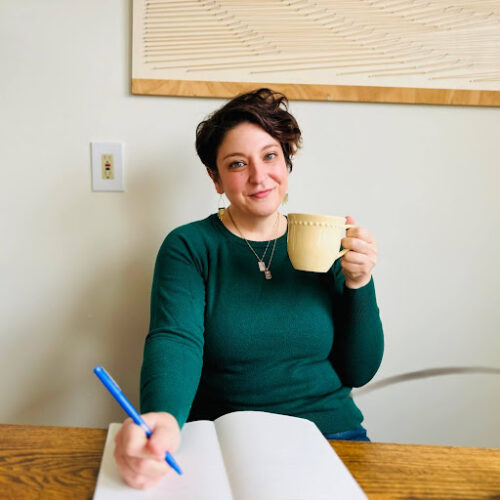
Associate EditorRae Pagliarulo (she/her) is the associate editor of Hippocampus Magazine and has published poems, articles, and essays with Short Reads, Cleaver Magazine, the Brevity Blog, and more. She is the co-editor of Getting to the Truth: The Craft and Practice of Creative Nonfiction (2021), and by day, she runs a consultancy called Ellipsis Strategies, helping Philadelphia nonprofits to achieve their missions through strategy and fundraising.
Role: As associate editor, Rae works closely with the publisher on overall strategic planning for the magazine, books, and events. She oversees and collaborates with section editors and works with contributing writers to our articles section.