Reviewed by Brian Watson

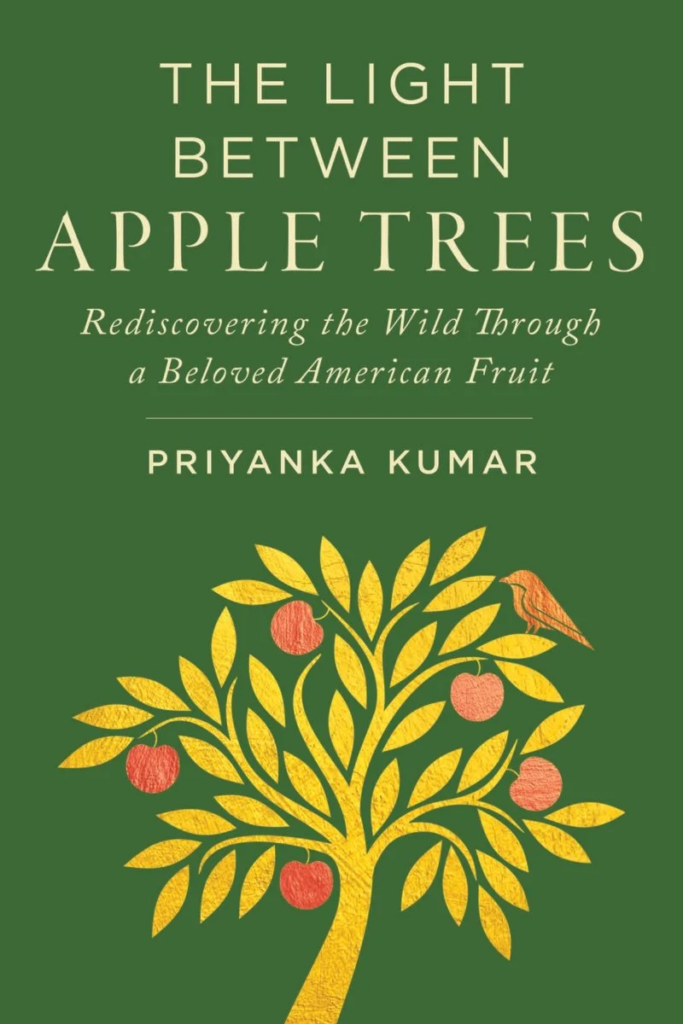 Although I was disappointed to learn that I am not America’s beloved fruit, Priyanka Kumar’s hybrid memoir, The Light Between Apple Trees: Rediscovering the Wild Through a Beloved American Fruit (Island Press; Sept. 2025), part botany and zoology, part ecology and climate, and part loving portrait of the author’s life, felt like it was written expressly for me.
I might not have made a career out of my honors major in Biology, but those classes formed the foundation for my years as a macro floral photographer, as I researched the scientific names of the flowers I found, including Malus domestica, apple trees. And for Ms. Kumar to go into exquisite detail on the evolutionary history of apples, noting the contributions from both Malus sieversii (a wild species of apple found in Kazakhstan) and Malus sylvestris (a European species of crabapple) brought my inner, oft-neglected, scientist great delight.
Ms. Kumar brackets this book, in the preface and near its conclusion, with a memory of her childhood in the Himalayas, running through an orchard with her father, delighting in the trees and their fruit. In that latter, more realized, recollection, she writes, “I experienced an awakening: I saw that the earth herself had opened her great green arms and lumbered over to give me an apple-scented kiss.”
The evident warmth of this memory formed, for this reader, the true light between the apple trees of this incredible memoir within its one-year narrative that explores the state of once prolific apple orchards in New Mexico. I learned that apples arrived there in waves, dating back to Spanish colonialist explorations and reaching a peak more than a century ago as settlers arrived with trees from the East Coast.
But it isn’t wholly nostalgia that fuels Ms. Kumar, because her observations and orchard visits plainly chart the damage that both consolidated farming and climate change have wreaked on her state (and elsewhere in North America). Americans so loved apples that there were more than a hundred varieties at the beginning of the twentieth century. Orchards, including Thomas Jefferson’s at Monticello, were home to multiple varieties, a strategy that made as much botanical sense then as it does now — a wide selection of varieties not only improves pollination but also helps orchardists recognize strains of resistance to disease and climatic stress.
Is there a parallel there for writers to consider? Surely writers can appreciate Ms. Kumar’s observational attention, so vividly written — when she writes, “We rested on a thick log, listening as a flock of Steller’s jays with pointed black crests scolded a poor robin, who at last took the loud hints and fluttered away,” I can see and hear those vituperous bullies, the same birds that often decry our yard work here in Washington State — but we can also examine how orchardists devote themselves. By planting our words on the page in a variety of ways and genres, we can winnow what doesn’t thrive and strengthen the work that does.
Another point of adoration for Ms. Kumar’s writing lies in the perfection with which she places external references and clarifications. When speaking of bumblebees, she quotes Emily Dickinson: “The lovely flowers embarrass me. They make me regret I am not a bee.” When reviewing the associations apples have had within different cultures, my eyes shone to read, “Sappho compares a bride to a ripe apple blushing on a tree, just out of a picker’s reach.” She is also appreciatively straightforward when pointing out the failures of some of the United States’ apple pioneers. Of Jefferson, she writes, “He epitomizes an inherent contradiction at the heart of the country’s birth: a cry for liberty from men who stood on the backs of enslaved workers.”
But the author is at her most poetic when her love of how fruit brings people together comes to the fore. She describes orchardists plotting their land decades, if not centuries, ago, saying, “It is a true act of generosity to share beauty with those whom you will never know.” And in response to an orchardist who shared some ripe bounty, she writes, “The real gift of being human is that we are compassionate and loving beings — these qualities feed our creativity and capacity to navigate challenges.”
Perhaps her truest thesis statement for this enchanting book is distilled in this one sentence: “In tears, I realized that picking and sharing was a way of being, a container that held the secret sauce of those days when we lived not so much as neighbors, but as one big, juicy family.” If ever there existed a summary of the hope for a better, more communal future, it is here within these pages.

Brian Watson
ReviewerBrian Watson’s essays on queerness and Japan have been published in The Audacity’s Emerging Writer series and TriQuarterly, among other places. An excerpt from Crying in a Foreign Language, their memoir’s manuscript, appeared in Stone Canoe in the September 2025 issue. They were named a finalist in the 2025 Pacific Northwest Writer’s Association’s Unpublished Book contest, and in the 2024 Iron Horse Literary Review long-form essay contest. They also won an honorable mention in the 2024 Writer’s Digest Annual Writing Competition. They share Out of Japan, their Substack newsletter, with more than 600 subscribers. In 2011, their published translation of a Japanese short story, “Midnight Encounters,” by Tei’ichi Hirai, was nominated for a Science Fiction and Translation Fantasy Award.