

The doctor sat on the edge of the hospital bed and said, “Glen, you have a tumor in your brain.”
“Phew!” I thought to myself, sighing with relief. “He’ll be okay because a tumor in his brain is not a brain tumor, and that’s not as bad. He’ll be fine. We’ll be fine.”
Later, when we sat together in his hospital room at St. Joe’s in Denver, eating dinner off the hospital trays, he turned to me, his eyes wide and filled with fear. “I have a brain tumor, Jo. A brain tumor.”
In a calm and soothing voice, I said, “Oh no, honey bunny. You don’t have a brain tumor. You have a tumor in your brain. It’s not the same.” Glen looked at me like I was insane. “Really,” I insisted. “It’s not the same thing.” I continued eating my boiled broccoli and picked at my overdone steak, so sure of myself, so content in my conviction as I ate. Everything was going to be fine, I said to him with my eyes. Glen got quiet, looked at me for a long time, nodded, then looked away.
We finished our dinner, I put our trays in the hall, and we turned and looked out the window of our fourth floor hospital room, down at the parking lot. A while later, both of us still looking out the window, I whispered — barely audible, and choked — “It is the same thing, isn’t it?” Glen didn’t look at me, didn’t say a word, just reached out his hand. I took it and we both pressed our foreheads to the glass. Scooted closer together so that the entire sides of our bodies were touching.
***
The next night, Glen said to me, “You need to go home Jo. I can’t have you here. I need this night to myself, without you.” I don’t remember how I got from Glen’s hospital room to my car, but I must have, because then I was driving through unfamiliar streets in an unfamiliar neighborhood. Then I was on a busy highway, steady and numb. Music from the radio. Blinkers, brake look, look, look, and merge, merge now, then drive. Drive home.
Before I left the hospital that night, Glen said to me, “Don’t call me. I can’t hear your voice.” So when I got home, I put my pajamas on, sat on the couch, warm cup of tea in my hands, and called Glen. He picked up on the first ring and said, “Jo.” When I heard him say my name, I doubled over, my teacup tipping, warm water pouring out, the cup falling then, smashing on the floor.
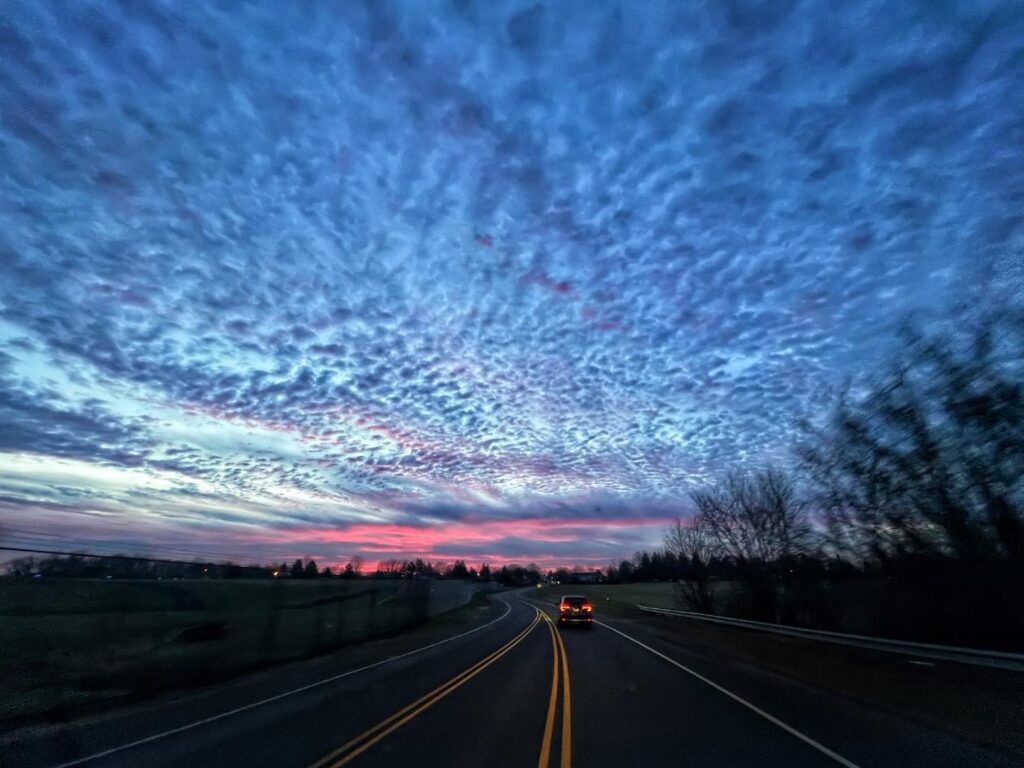
At 5 a.m. the next morning, I drove back to the hospital to find him. Driving down that old growth highway, before the world was awake, I saw the bluest, darkest, most beautiful sky. The blackest blue, more blue than blue, cresting the top of the hill. In my body, it was the sky sweeping through, settling into and around my breaking heart. It was this that pressed me on. Gave me my first inkling that whatever happened next, it would be this darkest blue, becoming light, that would hold me — hold us both — as we shattered and broke apart. “Drive,” I said to myself, my eye on that sky. “Keep driving, on to him.”
***
“I wait for the sound of your car,” Glen said to me, a few months after his diagnosis. “When you arrive and open the door of your car and it makes that popping sound, I think — I should fix her door, but I never do, because when I hear it pop, it means you’re home.”
We were good together, Glen and me. After twenty years of building a life, my favorite part of each day, right up until the end, was feeling the contentment of him, next to me. His skin touching mine.
It was also fun, really fun, being with him. Loud fun, falling off the couch fun. Fun that was sitting down, right there on the ground in the middle of a night walk fun, because we were laughing so hard. Fun that was more quiet, too, not so loud, more inside the fun, like we were falling asleep one night and I noticed I was smiling. I said to Glen, “Glenny, I’m smiling.”
“You are?” he asked. “You’re smiling right now? Why?”
“Because it’s fun, falling asleep next to you.” He mumbled, half asleep by now, “You’re so weird. I love you, but really, you are.”
“I know,” I said, still smiling. I snuggled in close, he did too, and a little while later I whispered, “Are you smiling yet?”
“UGH! Go to bed.” Then it was quiet, both of us listening to the other one breathe. Many minutes later, Glen whispered, “Oh my god…I’m smiling.” That kind of fun.
***
Glen was the gardener in the family, but after he got sick, it became my job to weed, water, and gently cut leaves of chard, kale, lettuce, parsley, and cilantro, never collecting more than we could eat in one day.
I’d had my eye on a bunch of celery he’d planted, waiting for it to be ready to eat. The day it was, instead of getting the scissors as I had always done to cut one, two, maybe three stalks of celery for our lunch, I grabbed the entire bunch in my hands and pulled the whole plant out. I couldn’t, for a second or two, remember where I was. Why were there roots and dirt hanging from this plant I held in my hands? Why was this plant now gone from its place?
I brought the whole bunch into the house with all of the dirt, all of the roots, hanging from my hands. “I made a mistake,” I said as Glen came over to see what vegetables we’d be eating that day. “I made a mistake,” I said again, and then once more. Then I sat down on the kitchen floor and I cried, not long, maybe a few minutes, as Glen knelt beside me, held me, didn’t say a word, let the crying run its course.
Once the course was run, we stood up, cleaned the bunch of celery of its dirt, and got on with our lives — eating lots of celery as we did.
That’s kinda how it went after we found out Glen was dying: regular regular regular. Not regular. Regular regular. Not regular. The shock of it, a constant falling and, in the falling, we were grabbing for branches. We’d grab on, hold on for a second or two, suspended in that quiet frame of finding. But then the branch would snap and we were falling again.
Both of us at the border place: the inside and the underneath. Meadow then forest. Stream then bank of stream. Ocean. Shore. That force of nature border place. That fault line is where we were and where we stayed, for a long time: Find it, feel it, know it, fall. Find it, feel it, know it, fall.
***
I can’t remember if I was in the room with him when he fell that first time. I must have been, because I think I remember seeing him fall? But what I remember more is the sound of his body hitting the floor. I can’t remember how I got to him after he fell, but I remember kneeling down beside him. I remember that he was crumpled there, in a way that frightened me. I remember that we were alone. That no one else was in the house with us that day, and I remember, will always remember, the terror on his face. The sound he made, which was the sound of an animal, in fear and in pain, and his eyes. I will never forget his eyes. The helplessness in them of not being able to catch his own weight, crashing to the ground.
I remember getting as close to him as I could and wriggling my hands underneath his body. I remember pressing my body against the wall, pulling him to the wall with me and lifting him into a sitting position. Leaning against the wall and maneuvering him so he was sitting in between my legs, his back against my chest. Wrapping my arms around his waist and nuzzling into him, murmuring, whispering, “It’s okay, I got you.” Him nuzzling back, murmuring, whispering, “Jo.”
Getting my hands underneath his knees and bending his legs so that his feet were flat on the floor. Inching my way up the wall as I held his body as close to me as I could. Pushing down with my legs, into the earth, as I lifted him up, holding him against my body. “Press, Glenny,” I said. “Press your feet into the floor and straighten your legs.” He pressed enough so that I could get him to a standing position.
Turning his body to me, his cheek resting on my shoulder so that his face was buried in my neck. The dampness on my skin as he cried. I wanted to cry. too, but I knew that if I did, I wouldn’t be able to keep him standing — that my strength would give way, my focus, so I did not cry then and instead I held on.
***
I was at a pizza place for a work meeting when all of a sudden and out of the blue, my body split in two: I was sitting at the table eating pizza with everyone, but also I was not sitting at the table eating pizza with everyone. I was floating above and also tethered below. Tethered to the eating, the pizza, the table and the people. Floating because Glen was dying and I was splitting, and the only thing I could do was rudely, inappropriately, and loudly interrupt the meeting.
I said, “His skin, when I touch his skin. His body, when I touch his body. His eyes, when I look into his eyes. I can’t keep my hands off him right now because at a point that is coming too soon, I will lose him. There is a marker now, a marker of time, and so my hands, they are on him almost constantly, because his skin on my skin. The shape of his arm, his hand, his foot, the breadth of his back. His face.”
I said it all quickly and in a rush. Then I looked down at myself; looked back up at them. Said to this group of people I worked with: “I don’t know where my body went. I…I can’t find it.” My face crumpled then, and I began to cry.
A woman I work with stood up from the table and came to me. I stood up, too. She held onto my shoulders and looked me right in the eyes. Said, “Your body is right here. It’s right here. I have it. I’m holding it, in my hands. Keep looking at me until you can find it for yourself; your body.”
She held onto me then, held tightly on, so that in my wild eyed and bewildered state, I could do the work I needed to do, which was to believe her. Believe that my body had not disappeared; that it was still right there, with the others in the pizza place that night.
***
Glen was standing at the kitchen counter, silently struggling to tell me something. I searched his face, trying to understand what he needed. His eyes locked on mine, and then he shifted his gaze to a specific place on the counter. Looked back at me, then at the same place on the counter. Me, the counter, always to the same place on the counter. It took me a minute or two, but then I got it: “That’s where the butter used to be. Butter? Do you want the butter?” He gave me a huge smile and said, “Butter!”
I had moved the butter and forgot I had moved the butter. Forgot to put it back in its usual spot on the counter so he could easily find it, spread it on his toast, with his favorite jam. I vowed, in that moment, never to do that again, to move the butter or anything else and not put it back in its rightful place.
Around that same period of time, we were watching TV one night and I was holding my wrist because I’d hurt it somehow. Glen looked at me holding my wrist and said, “Do you want a push?” I was intrigued. A push? Was he playing? Being coy? Was he going to push me over, onto the couch, as I sat there, holding my wrist? “Yeah,” I said, curious and game. “I wanna push. I’m ready to be toppled.” Glen looked at me strangely, then gently took my arm, placed it on his lap, and began to massage my wrist.
I wanted to cry, I wanted to laugh, but I didn’t do either, and instead I closed my eyes and let Glen push me. Then I puzzled my body into his and together we watched the rest of the TV show with Glen holding my wrist. “Remember this,” I said to myself. “Remember his skin. Remember, remember. Push.”
***
There came a time when Glen could no longer feel my touch on the right side of his body. When I had my hand on his right shoulder one day, he looked at me and said, “Are you touching me?”
“Yes,” I said.
“I can’t feel it. I can see you, but I can’t feel you, touching me.”
“I’m touching you,” I said. Then I put my hand on his left side so he could feel me there. He looked at me and started to cry.
At the same time he stopped being able to feel on his right side, he also stopped being able to see the right side of things. This meant that when Glen looked at a plate of food, he did not see the right side of the plate. When we were watching TV, he could not see the right side of the screen. When he looked at my face, he could not see the right side of my face; only the left side. When I came up to him on his right side one day, by accident and without thinking, he jumped.
He began to lose other capacities, too, like one morning we were having our bagels, lox, cream cheese, and eggs for Sunday breakfast and Glen kept trying to use his fork to eat his bagel. I said, “Just use your hand sweetie, to pick up the bagel.”
“Okay,” he said.
Then he tried to pick up the bagel with his fork again. I moved the fork away gently, placed the bagel in his hand. He tried to spread the cream cheese on his bagel with the knife, but he couldn’t figure it out. Couldn’t figure out how to hold the butter knife, or how to put the knife into the tub of cream cheese; how to get the cream cheese on the butter knife. He looked at me, baffled and confused. I took the knife from him and spread the cream cheese on his bagel. He tried again to eat the bagel with his fork; the eggs with his fingers. “Use your hand sweetie,” I said again, “to pick up the bagel. The fork is for your eggs.”
“Okay,” he said again, as he struggled to spear his fork into his bagel.
Soon after this, Glen was trying to split wood for the wood stove with the wrong side of the ax — the part of the ax that isn’t sharp. I yelled, “Stop!” He looked at me and smiled, lifted the ax over his head, and swung it down with the wrong side again. “Glen!” I yelled, hurrying toward him. “Stop! Stop!” I got to him before he could raise the ax over his head again and got it out of his hands, and after I did, he sat down on the ground and started to cry. “Why are you yelling at me?” he wept. I got down on the ground with him, feeling sick to my stomach, knowing it was me who had made him cry. “Oh honey. I’m sorry. I’m sorry I yelled.”
“You yelled at me,” he said softly, still crying. “Don’t yell at me, it hurts my head.” He melted into me, and I let him. “I’m sorry sweetie, I’m sorry,” I said, stroking his back in circles until he stopped crying.
***
A few days after he swung the ax the wrong way, he climbed up on the roof to clean the solar panels of all the snow that had fallen the night before. I quickly climbed up after him, and when he looked over and saw me, crouched down by the edge, I took the opening and said, “Glenny. Come to me. Come down off the roof.”
“I got it, I got it, don’t worry, don’t worry, you always worry.” He was enjoying this work that he knew so well, enjoying the cold air on his skin. He continued to clean the solar panels of snow on the roof of his shop, walking along with the huge and heavy broom he used. “Please Glen, come to me. Please stop.”
He laughed. “I’m fine! I need to clean the snow off the solar panels. I’m almost done.” He turned away from me and kept working. I didn’t know if I should go to him then, because if I went to him, it might break his concentration, and his concentration was keeping him steady and firm. So I stayed where I was and said the only thing I knew would get him to stop: “I need you, Glen.” He turned to me immediately, and I reached out my hand. “Are you okay?” he asked, worried. “Come to me, and I will be.” He made his way to me, took my hand, and we both climbed down from the roof.
Once we were inside, he forgot about being on the roof, and he forgot about the snow. I made him a cup of coffee and settled him on the couch. Then I kissed him: on his forehead, his cheeks, his lips, his eyelids, the tip of his nose, his lips again as he held my hand, let himself be kissed. Then I went into the bathroom, sat down on the floor, and cried because that was the moment I knew that Glen could not be alone anymore. I knew this was coming when he stuck his bare hands in the oven one day, to pull out a hot dish of lasagna, and it was only by luck that I had been standing right next to him when he did, pushing his hands away before they touched and burned. Cried because my eyes: they were not enough anymore to keep him safe. My body next to his body: it was not enough. My heart pressed to his. This would not save him.
When I climbed down from the roof that day and came out of the bathroom after splashing cold water on my face, I called Glen’s brother, then I called a few friends. I set up a schedule so that someone would be in the house with him when I couldn’t be there to keep him safe.
***
When Glen would forget, I’d remind him. When he slumped in fatigue, I’d put my arm beneath his, and together we’d straighten. When his face would scrunch up in pain, I’d ask if he’d taken his medicine for the headaches. When he raged in frustration at not being able to do what he used to be able to do, I’d sit next to him and wait. Notice my breath, my hands, my feet. When he turned to me in tears, I’d touch my forehead to his forehead, put my hand on his cheeks. Together, we would cry.
This is when I began to bump and to trip. Drop blueberries on the floor and splatter the juice. Forget my wallet, my phone, my snack bag. Turn right instead of left. Drive myself to the grocery store when what I needed was a hammer. I remember Glen weeping one morning, saying to me: “I miss my brain.” I held him then, held him so tight, then spilled the glass of water I had in my hand right on his lap.
One night, when Glen was close to his death, he called me to him. We sat on the floor facing each other, knees touching, holding hands. “Jo.” He said, “Jo.” He’d lost the ability to see out of his right eye, so he covered that eye with his hand so he could see me more fully. He looked at me and he looked at me. He told me what it felt like to die. He said he could feel himself letting go; that he could feel the leaving. When I asked what that was like, he said that it was easy, and that it was calm. He said it was like riding a wave. “It’s nice. I don’t mind. I’m not scared.” His face got worried then and his eyes filled with tears. “Are you mad at me, Jo, that I’m dying?”
“Oh my love,” I said, “of course not. You are dying as you lived, which is gently, beautifully, kindly, and with care. I will miss you so much, and yes, I am mad you are dying, but no, I am not mad at you.” He nodded, and then the conversation was over and he forgot, once again, who I was.
The next morning, he looked at me and said: “You can let me go.” Before I could answer, he looked past me and said, “Coffee. Coffee.” I got Glen what would be the last cup of coffee he would ever have. As I handed him the cup, I leaned in to give him a kiss. He put his hand on my cheek, again looked right at me, and said, “Thanks guys. I read you so much.”
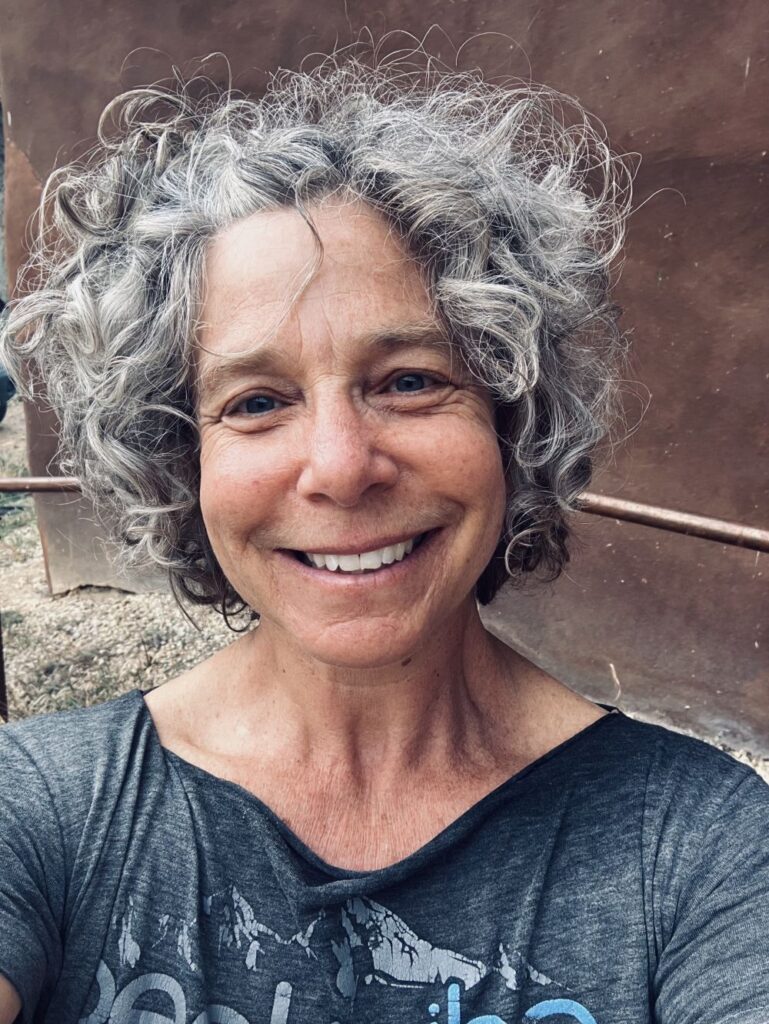 Joanna is a dance maker and writer. In 2026 she was invited to perform a durational and improvisational dance work at The Denver Art Museum. In 2025 she was selected as a runner-up for The Editor’s Prize in Nonfiction by The Missouri Review and received The Letter Review Prize for Books. She is working on her first book: No Anguish in This House: A Memoir of Dancing and Dying. She lives off grid, in a straw-bale home, in a small mountain town (pop. 272), in Jamestown, Colorado.
Hi Joanna, so lovely to meet you here. You gave so much of yourself in this little story. First, I am sorry for your huge loss. Your piece is deeply moving and VERY beautiful. We live, we die, and some us also dance (I just loved discovering that you too have lived the life of a dancer).. and we are richer for what we share in the moments between. So thank you for doing this. And hello from New Jersey. xo
Incredible deep love beautiful breathtaking. Thank you
Wow.
Damn…as someone who has been through a similar experience, I recognised so much. I felt this deep in my heart. Thank you so much for sharing.
Heartbreaking and gorgeous. Thank you.
Dear Joanna, this essay is breathtaking.
Absolutely beautiful.