
We barely park the car, barely slam the doors shut, barely get our names out before Rachael is already folding into herself on the hospital wall, howling this deep animal sound that pulls every coat and badge and student in sight toward her like a magnet. Suddenly we’re swallowed by the blue commotion of the high-risk birth room, the place they save for babies like Bree, babies with their futures written in shaky handwriting. Bodies sweep in, gloves snap, lights flare, and someone says she’s ten centimeters and then Rachael screams again, a sound that flattens the whole damn world.
And here I am, in this bright square room, wondering if the moment I meet my daughter is the moment she leaves. Wondering if this is the crack in my life I’ve been unknowingly walking toward. Bree, our soon-to-be second child, has a rare genetic condition called Trisomy 13, meaning that tucked away in every cell of her body is a third copy of her thirteenth chromosome, like a cosmic typo. Google had given us a life expectancy of seven to ten days; of course, that was if she actually made it to birth.
I look down at the tattoo on my left wrist. Three words in a font I chose because it looked spiritual. Be here now. But now, in maybe the only room my daughter will ever be in, I stand in the corner where they tell me to stand, like some pathetic puddle of worry, having trouble being anywhere “here” or “now.” I try and will this moment to be filled with beauty and holiness and meaning. Maybe this is all I get with her, right? Instead, I’m a tight little fist of nerves, hands pressed together like I’m begging someone to give me a sign. I look back down at the tattoo on my wrist. Fuck you Ram Dass.
I try to cry because crying feels like something people do in moments like this, but grief is rusted shut. The world of medicine took a tight wrench to my emotions over these past nine months.
I count bodies to stay upright. Eleven. No, twelve. A student joins, bright-eyed beneath her mask, ready to learn from my daughter like she’s a rare species pulled from a shipwreck. Bree as specimen. Bree as opportunity.
Machines hiss and chirp. Cords coil like snakes. Rachael’s feet blur in the silver stirrups. I try grounding myself the way people in therapy blogs say you should. Think of my older daughter Shyla, think of a song, think of some future where this is all fine, where we take Bree home and the sky is clear and nothing hurts, and she isn’t about to try and take her first breath but her lungs don’t work or her heart stops beating or her kidneys fail or —.
Time gets slippery. Five minutes, ten, a year? It folds and unfolds like some restless animal pacing the room beside me. When Shyla was born, I held Rachael’s hand. I had a place and a role. Now I hear Rachael, but I can’t see her. She’s somewhere beyond the crowd, beyond the bright moving arms. My loving Rachael, her fears for our daughter and the intensity of her physical pain are being mangled together in the blender of this moment.
A doctor appears at my elbow like a ghost. Maybe he was always there. Or just materialized from the stress. He asks how I’m doing with that puppet-jaw movement masked faces have, and I answer because I’m Canadian and polite, even though everything in me screams leave me the fuck alone. He keeps talking, trying to perform comfort, but all he’s doing is blocking my view of my daughter’s only shot at life.
Then, through all the sound and light, I see something purplish and wet lifted skyward. A cry. A burst of existence.
Bree.
My daughter, held high in the arms of a gowned doctor, is alive.
Relief hits me first before the chaos returns with twice the force. They let Rachael hold her for a heartbeat, a flash, then she’s gone again, whisked to a machine, to a table, to a swarm. Someone shoves scissors in my hand and I cut something I barely see, asking if it’ll hurt her, my voice small as dust. Everyone moves like a pit crew, like a ritual, like they’re dancing for her survival. Somewhere in all of it, I feel the rip in my life widening, the universe pulling threads loose.
And then Bree is gone down the hall, swallowed by the white coats, the door flapping open and shut, and open and shut, and open and shut, until finally it seals, and just Rachael and I are left in the sudden vacuum.
“She’s here,” I say, stupidly.
“Where is she?” Rachael asks.
“Here in the world. Just… not here here.”
Rachael looks a bit out of it, in a post-delivery haze, drugged up on her own endorphins.
The room grows thick. Relief and terror mix like paint in water.
A nurse eventually returns with some gentle, rehearsed speech about stability, monitoring, not yet, soon. Do you want a picture of her, I think she asks, understanding by the ghostly look on my face that I need proof of her existence, like this wasn’t all some fever dream I cooked up. I pass my phone over and she brings back a foggy photo: Bree inside an isolette, tubes and tape everywhere. A tiny astronaut kept alive by machines.
This is the moment I thought might break me. Because maybe this is birth or maybe this is the afterlife or maybe this is the road I’ve been traveling without knowing it.
***
19:00
Shift change smells of iodine and someone’s dinner fries. The nurse peels off her gloves and they drop into the bin with a soft slap. “My shift’s ending,” she says into the nowhere of humming machines and glowing monitors that blink and blink around my daughter’s plastic cocoon.
I try to remember when I arrived but memory gets washed out in the fluorescent haze.
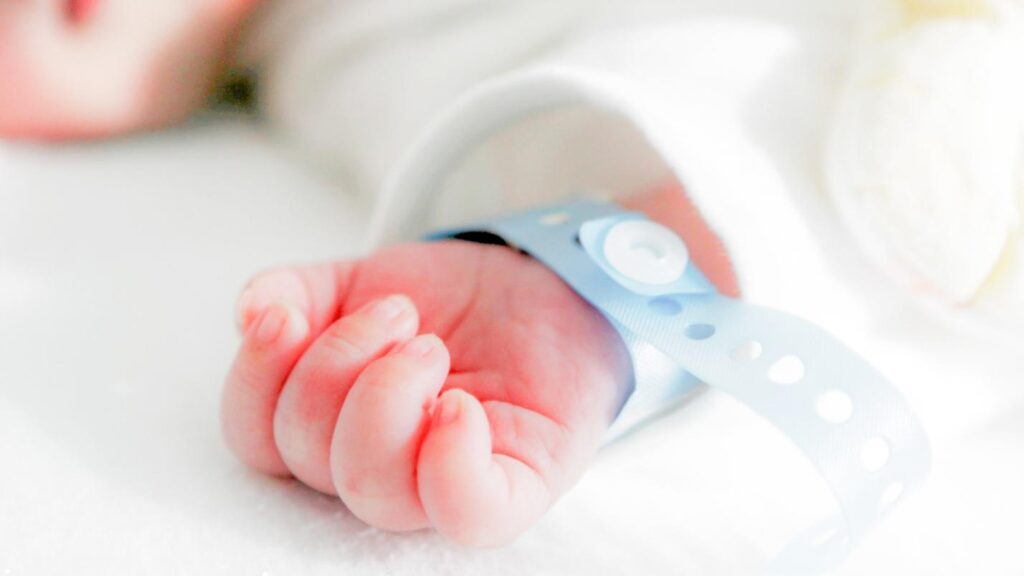
Inside the isolette is my Bree, only three days on this planet, her hand no bigger than my thumb. Three white sensors dot her chest. An IV board straps her wrist to foam. The sound of the nurse’s footsteps fades down the NICU hallway.
Rachael left an hour ago. She needed to pump, to sleep, to reset. I watched her trace the side of the isolette over and over with her finger, as if she was rubbing Bree’s hair behind the glass barrier. She didn’t want to leave Bree, but I told her I’d keep watch, as if my watching could change anything.
19:30
Bree sleeps inside the plastic bubble. I take in the beauty of her hand with an extra digit, two pinky fingers fused together. I’m happy this is her only noticeable malformation, no cleft lip, no major features that an outsider might point to as a reason for her not to exist. If she’s cute, she’ll survive, right? The world will fight harder for her if she at least looks like she belongs. People forgive beauty more than they forgive difference. I hate that I think this, but I do.
The three white sensors on her chest are like snow that forgot to melt. One for her heart, one for her breathing, one for her oxygen levels. The holy trinity of survival.
Her chest rises and falls so slightly you’d miss it if you blinked. Yet it feels like the hinge the entire world spins on.
Outside our glass-walled room, the sky erupts in purple and peach, like colours burning themselves out. I can’t tell if the sun is setting or rising. Time leaks out of its container here. All that remains are numbers on the monitor and the rise and fall of my daughter’s chest.
Someone told me once that hospital time is different. Days blend into nights until you stop believing in clocks and start believing in shift changes instead.
20:00
A new nurse comes in and introduces herself. I miss her name instantly, but she writes it on the whiteboard at the back of the room with a little smiley face next to it. Jenny. She says Bree is cute, but I don’t even think she actually saw her.
“So what are our goals for today, Dad?”
To invent a miracle. To delete an extra chromosome. To rewrite biology and fate and statistics.
“Probably get some rest”, I say.
20:30
I Google: “What does a seizure look like in a newborn?”
Google shows me a purple baby, limbs rigid, eyes rolled back. I close the tab before I can read more and turn every twitch of Bree’s fingers into an emergency.
The internet is a graveyard of worst-case scenarios, but my thumb keeps wandering back to the search bar like some part of me wants to see the future even when the future is unbearable.
20:45
I Google: “Trisomy 13 life expectancy.” I already know the answer after doing this hundreds of times since her prenatal diagnosis.
Google says: seven days is the median survival. Maybe if I search again, at a different hour, in a different browser, the algorithm will take pity and show me something else.
22:00
The ward is Level 4 NICU, the highest level of intensive care. Germs die at the door. Everything blue and lime-yellow like someone designed the place to look harmless. Cheerful colours without promises. Nothing natural here. Air that tastes of plastic, light that never sleeps, time that does not move forward but sideways.
A father passes our glass room bouncing a huge baby who screams in that righteous healthy way. Something ugly twists in me, then shame follows right behind it.
00:40
I Google: “How to parent a child who will die before you.”
Google shows me a forum of fathers who bought tiny coffins that are white with satin linings. Some had teddy bears painted on the side. I close the tab, but not before I see the thread titled: “How to plan a funeral when your baby is still breathing.”
I put the phone down. Pick it up again.
01:45
I try to count the nightshift medical students in the room as they walk in. Some walk in a little too wide-eyed with excitement. The one leading the group asks how I’m doing. I barely answer before the resident takes over with his steady voice.
“This is Bree, day of life three, full Trisomy 13. Dysmorphisms classic for T13. Echo pending. Parents are opting in to full code over comfort care. Palliative is involved. Social work following.”
He doesn’t look at me. They nod, scribble, and peer at Bree. A few ask questions. I sit three feet away, invisible, holding the stuffed giraffe we brought from home.
02:05
I Google: “What year is it?”
Google shows me the calendar. 2021. But that doesn’t feel real. The pandemic has warped time, and Bree’s diagnosis has warped it further. I still don’t know if I’m living in the before or the after. Before was nine months ago, the moment when Rachael tap-tapped on my office door with some news. After is supposed to be when Bree dies. But we are suspended in some middle space, in the waiting room of grief.
02:31
The janitor’s floor polisher echoes through the halls. My chair reclines but not enough. The fluorescent lights flatten everything into the same chalky plane. You’d never know it’s the middle of the night. Time is a loop of caffeine and the mix of Purell and plastic smells.
I hover over Bree. I am a ghost, weightless and detached, watching the monitors more than I am watching my daughter. I’ve memorised the nicknames. Desats. Bradies. Things that sound cute until they try to steal your child. We had a whole orientation on what to do if she crashed. They made me practice CPR on a lifeless doll until my arms shook and all I could think was whether crushed ribs were better or worse than suffocation for a child this small.
04:03
The nurse said she’d check vitals at four. Where is she.
04:06
“She’s doing great”, the nurse says, removing the stethoscope from her ears. I can’t tell if she’s the same nurse from before or a mirror image. Everyone looks similar behind the masks. Bright eyes and blond hair and cheerful voices turned up too high.
I look back at Bree, still sleeping, with tubes dangling from all parts of her body. When she leaves, I lean close to the plastic bubble, mouth near the plastic port, beard scraping the edge. I whisper: “Hi Bree. It’s Dad.” She doesn’t respond. Her chest is still rising, then falling.
07:03
New nurse, new gloves, new name scratched on the whiteboard. The last nurse said goodbye an hour ago, hopes she sees us again, but not here. I laughed, even though it wasn’t funny, when I really wanted to ask her if it was normal that Bree was sleeping so much.
The new nurse introduces herself. I forgot her name again. Rachael will be back soon. Shyla is probably getting ready for school with her grandmother back at our house, probably brushing her teeth or looking at the butterfly drawing she taped to the fridge for Bree, asking when she can meet her baby sister.
08:34
I Google: “How do you measure meaning in a life that is so short?”
Google shows me a list of philosophical, psychological, and spiritual traditions, all suggesting different qualitative ways to derive meaning. I don’t buy any of it. It’s easy to believe in that stuff when your daughter isn’t right in front of you, curled inside her plastic bubble with a rare and life-limiting genetic condition.
09:12
Rachael texts that she’s in the parking lot. Our shift change smells like burnt coffee and sweat. I look at Bree before I leave and wonder if this will be the last time I do so. My stomach drops like I’m on a rollercoaster. A pair of sneakers squeaks down the hall towards our room.
Bree’s vital stats glow above her. The monitor keeps perfect time, but the shift never ends, the sentence never ends, so I touch the glass one more time, feeling the cold against my palm, trying to memorise the feel of her presence before it becomes memory instead of possibility.
***
Bree is four years old now.
Her bedroom is lit up mostly by the sun peering through the skylight. We lie together in her bed, protected by the pink guard rails lining the sides. Her floral-patterned pieces of tape, the ones that hold her nasal prongs to her nose, frame her face. Rachael must have bought some new ones for her.
Bree rolls side to side, murmuring grunts as she chews on her favourite toy, a plush moose with various rings and textures surrounding its soft body. I get my mouth close to her ear, let her feel the prickly stems of my beard graze across her face so she knows who it is, and start to sing her favourite song, “Mr. Golden Sun.”
She freezes, listens as the words travel through her ear and nestle into her brain. And then a smile so wide it looks like it hurts. I count the beats before the grin fades: one-Mississippi, two-Mississippi, three. Still here. I’ve got a few of these tricks. Known triggers that never fail to make her happy.
I blow a strand of hair off her forehead and fix the back tubing of her nasal prongs, which she has gotten all tangled. It loops over the side of the bed, connected to her concentrator that’s providing half a litre of constant low-flow oxygen. The feeding pump on the edge of the bed starts its mechanical beep, letting me know the formula is finished. I silence the alarm with one thumb while the other hand stays locked in hers.
I calculate the next tasks: change the diaper, prep her next set of medications, get some water ready to flush her G-tube, rinse her feeding bag. Instead, I stay hunkered down on the mattress, watch her body move back and forth as she wrestles her moose, and let the to-do list stall. Thirty seconds becomes a minute. The monitor in the corner, smaller than the large screens in the hospital, is sounding off its alarm. I watch the red wave go up, down, up, and know it’s just a bad sensor reading because of all of Bree’s movements. For a moment, I just watch it, the way surfers sit beyond the break line, admiring the shape of a wave they don’t need to ride. I hold down the power button until it turns off completely.
“Sun,” I say, one word, offering the next lyric.
She kicks her legs and sprays her arms outward, her cue for an encore. I start the chorus again, slower, a cappella. Outside, the real sun is still awake, shining down on us. Even so, in here we have our own orbit. I start to tickle her hand and make odd clicks with my tongue. This is our language. She doesn’t know I’m her dad. Doesn’t know my name or my fear or my struggle. She knows who I am, though, in a way that I’ll never know.
For a brief moment, I go back to myself in the NICU chair, counting the beats between her breaths — and then I’m back. The sun through the skylight. Her hand in mine.
The flowered tape on her cheek lifts like a page turned down; I leave it crooked, the door ajar, her story still open.
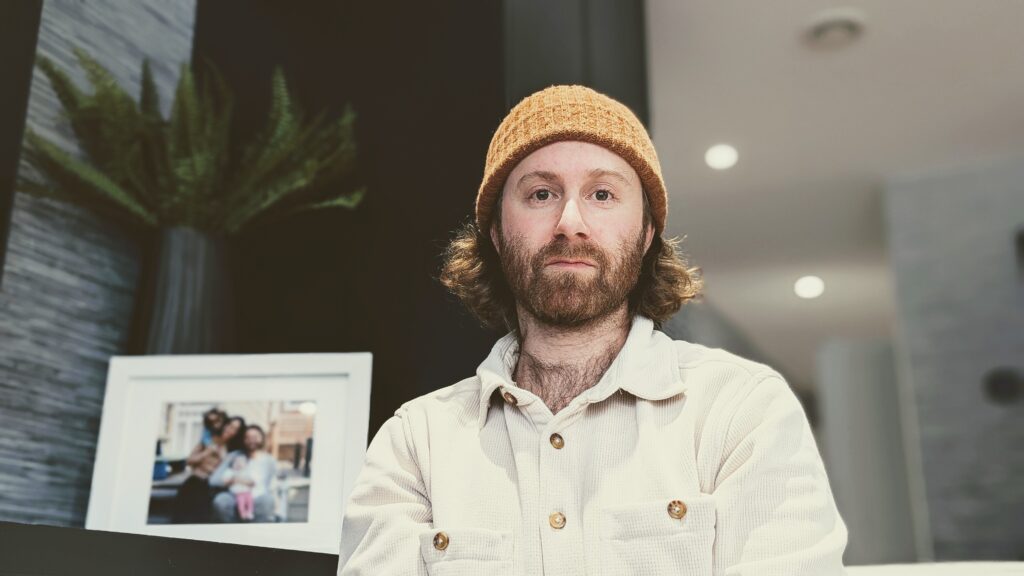 Robin Koczerginski is a Canadian writer whose work explores parenthood, disability, and the ways we avoid what we love most. His writing has appeared in The Globe and Mail. He lives in Toronto with his family and is at work on his first book.