

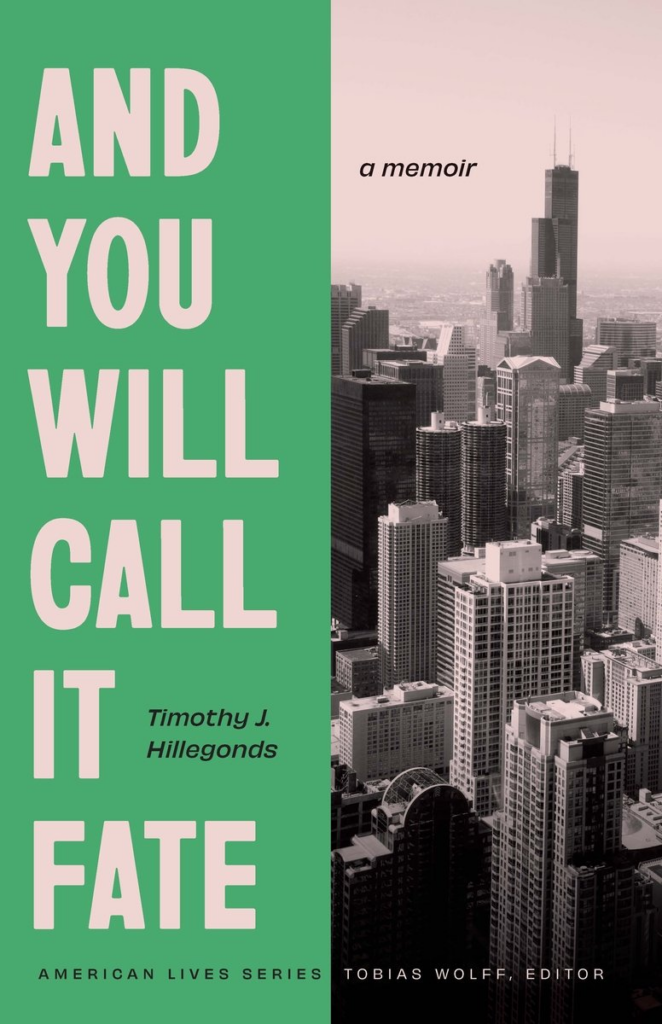
 It’s fitting that this interview should appear in Hippocampus Magazine, because Timothy J. Hillegonds and I met at HippoCamp: A Conference for Creative Nonfiction Writers, back in Lancaster, PA, during its in-person days. We have kept in touch, become sobriety buddies, published a couple of books each, and now regularly trash-talk each others’ football teams. I can’t think of a better relationship arc than that. (Go Lions!)
I was eager to talk with Tim about his new book And You Will Call It Fate: A Memoir (University of Nebraska Press; March 2026) because I am taken with anyone willing to examine concepts of toxic masculinity in this current political and social context. Toxic masculinity is running the country right now, and insofar as a solution will require men to change, I think this is an important book.
I love Tim’s willingness to use his own life as paint on the canvas: he paints a brutally honest portrait of some of the worst impulses that make up the masculine brand and then subverts them by taking great care to excavate and interrogate the trauma behind them. Plus, it’s just a beautifully written book, and who doesn’t want to talk about a beautifully written book with a thoughtful, self-aware author? This book is both gritty and delicious, and I hope Hippocampus readers enjoy the conversation I had with Tim as much as I did.
Penny Guisinger: First off, congratulations on your second book! It’s so well-written, and while I don’t have a question about this, I have to take a moment to call out some of your fantastic phrases like “tall as a bookcase,” “straight brown hair that hung like graduation tassels,” “The Pit looked like a beehive that had just been kicked,” and streetlights spilling “margarine tinted light onto the asphalt.” Bravo! What’s it like to have a second book, and how is it different from publishing your first?
Tim Hillegonds: Thanks, Penny! In terms of my take on having a second book, I guess in some ways it felt like the pressure was off. With my first book, The Distance Between, it felt like this incredibly hard effort—both to write and to publish—and I was worried I might not be able to actually put it out into the world at all. It felt like I had to keep my foot on the gas at all times—revising, pitching, querying—just to see it through to completion.
With this one, I just sort of gave myself over to the process and really didn’t try to control much of it. I held it much more loosely. I figured it would simply take whatever time it would take to write and then it would end up where it was supposed to. Don’t get me wrong, I had to actively fight against my impulse to try to control the process, but I think I did that successfully. What I learned was that it was way better this way.
PG: One of the many things that becomes apparent to readers is that you love Chicago. You write about this place with such deep affection—reverence, really—that it becomes almost a character in the book. At what point did you become aware that this book would be so place-based and that Chicago would elbow out so much space for itself? Did you embrace that and run with it? Or did it happen on its own?
TH: I remember it was pretty late in the publication process and a reader made a comment about place, about how they felt like in that version of the manuscript, the details that often animate the places we write about were largely missing. I was surprised, because I thought I had written the city I see and feel and love, but I realized that maybe I hadn’t. So, I went back to the book with that in mind and I just focused on bringing it to life as best I could. I guess it worked? It’s ironic that after revising almost endlessly, something so obvious could still be missing. I guess that’s why it’s so important to have other people read one’s work. I’m grateful that the reader gave me that feedback.

PG: So, as one writer-in-recovery to another, did you have doubts about whether the world needed another recovery memoir? (Personally, I think we always need more recovery stories!) Did you face messaging or have doubts that you would find a home for it? If so, what helped you pursue it anyway?
TH: I never really thought about this book as a recovery memoir. In many ways, I can now see that it is, but to me it was more about the relationship with Dempsey—and everything in the narrative had to continue returning to him. It almost felt like this really long character study. And even though he gave me the opportunity to get sober, and in many ways my time with him was all about recovery, I didn’t really think about it like that.
In terms of whether the world needs another recovery memoir, I definitely think it does, but I also think the world needs recovery narratives that try really hard to do different things. Recovery arcs are hard to write in ways that are fresh and unique, so I think that we writers really have to work hard to find the freshness in them. Hopefully I was able to do that.
PG: Throughout the book, you grapple with many ways of thinking about and understanding masculinity. At various stages in your life, it seemed that you had different feelings about what it means to be a man, what men should be and do, and how you wanted to exist as a man. It was fascinating to watch this narrator make connections between his beliefs about masculinity change in the context of his relationship with the very toxic Sean Dempsey. So I have two questions about that:
First, you mention that you eventually learned to inhabit “masculinities, plural,” rather than a single, rigid archetype. How does this more “nuanced and expansive” view of being a person influence how you now approach your roles as a father and a husband?
TH: I think what I’m really trying to get at here is that identities are always shifting. We’re constantly learning to understand ourselves differently, and our understanding of ourselves is always changing based on the context of what’s around us and what we’re learning in our lives. I have a wife and a daughter, which makes me a husband and a father, and I spend a lot of time thinking about how my role as a man contributes to my understanding of those roles. I think, more than anything, I’m just trying to unpack the scripts that were given to me and compare them to the script that I’m trying to write—and to make sure that I’m playing an active role in the story I’m living out.
I also think a lot about the fact that being human is inherently self-centered. Many of us are familiar with that David Foster Wallace commencement speech where he gets at the idea that we constantly have to try to get outside of ourselves. I think that has a direct correlation to masculinity in the sense that I’m a man, and I’m a human, and there are lots of male humans out there, but my experience is n of 1—and my job is to try and not forget that, to understand how many other experiences are out there and how my existence affects those experiences.
PG: My second question about it: Currently, our country is being ruled by a group of men who embrace toxic masculinity, and a lot of people voted for that. Does it feel complicated (in a good way or not) to come out with a book that deals with this stuff right now?
TH: I wouldn’t say it feels complicated but I would say that it feels counter-cultural. The type of masculinity that those men in particular are inhabiting is so one-dimensional and so completely unconsidered that it almost feels cartoonish. To me it just seems so put on and so deeply rooted in insecurity that if it wasn’t for the fact that those men hold so much power we could simply laugh and ignore it.
PG: Your decision to leave Sean Dempsey’s firm resulted in him suing you, and that suit ran you ragged for two years and completely crippled you professionally, emotionally, and financially for the duration. When you finally confronted him about the lawsuit years later, he stunned you by asking, “What lawsuit?” Did you have any fear that publishing this book might catch his attention and prompt a new round of aggression?
TH: It was certainly on my mind and something I had to grapple with. But I feel like I did the best I could to treat him fairly, and with love, compassion, and gratitude. Because regardless of how the whole thing ended, I’ll never forget or stop being grateful for the gifts that he afforded me.
PG: Your title comes from the Carl Jung quote, “Until you make the unconscious conscious, it will direct your life and you will call it fate.” Decision-making, powerlessness, and accountability are often very important concepts in recovery. Can you talk about the tension between choice and fate that (so beautifully) builds throughout the book? Do you believe you were destined to meet Dempsey, or was it a series of your choices that led to that moment? How does your concept of fate play out in your life now?
TH: That’s such a tough question to answer. It seems so incredibly unlikely to me that we would meet, but for one reason or another we did. So maybe I was fated to meet him, or maybe it was the result of a series of small decisions that I made along the way, or even decisions that he made along the way. But I know that at some point I had to make a choice. He had given me an opportunity, yes, but I had to make the decision to take it. So is that still fate? Maybe. It might also be Divine Intervention or the universe giving me a shot. I’m not sure that I’ll ever really figure it out.
PG: What’s next for Tim Hillegonds? Are you already working on the next project?
TH: I’m tinkering with a few things but still trying to figure out what’s next. Currently I’m working on a startup that uses artificial intelligence to prevent and interrupt relapse in people with substance use disorder while simultaneously enhancing continuity of care for treatment center providers. The craziest full-circle moment is that in May of this year we have a feasibility and usability study at Hazelden Betty Ford, which is the rehab that I went to 21 years ago. That seems almost as unlikely as meeting Dempsey. Maybe, in the end, that’s fate, too.
 Penny Guisinger is the author of two memoirs, Shift: A Memoir of Identity and Other Illusions from University of Nebraska Press and Postcards from Here from Vine Leaves Press. Her work has appeared in Fourth Genre, River Teeth, Guernica, Solstice Literary Magazine, and others. Pushcart nominated, a four-time Maine Literary Award winner, and a three-time notable in Best American Essays, she is a co-director of Iota Short Forms and a former assistant editor at Brevity. Penny is a graduate of the Stonecoast MFA Program. She lives near Lubec with her wife, college-aged kids, and a slowly evolving number of dogs.
Tim is a wonderful writer. We so agree, Penny. Since reading your interview I have been searching my brain for a clue to the name of the person I loaned my copy of And You Will Call it Fate for I remember underlining phrases and sentences and paragraphs he wrote as if I could never lose the memory of them that way. I even turned pages down. I will keep searching for the friend’s name until I figure it out so I can find those underlined memories. His book is absolutely worth the effort to reread those words again! Plus he is an exceptional person, too. NTMcG