
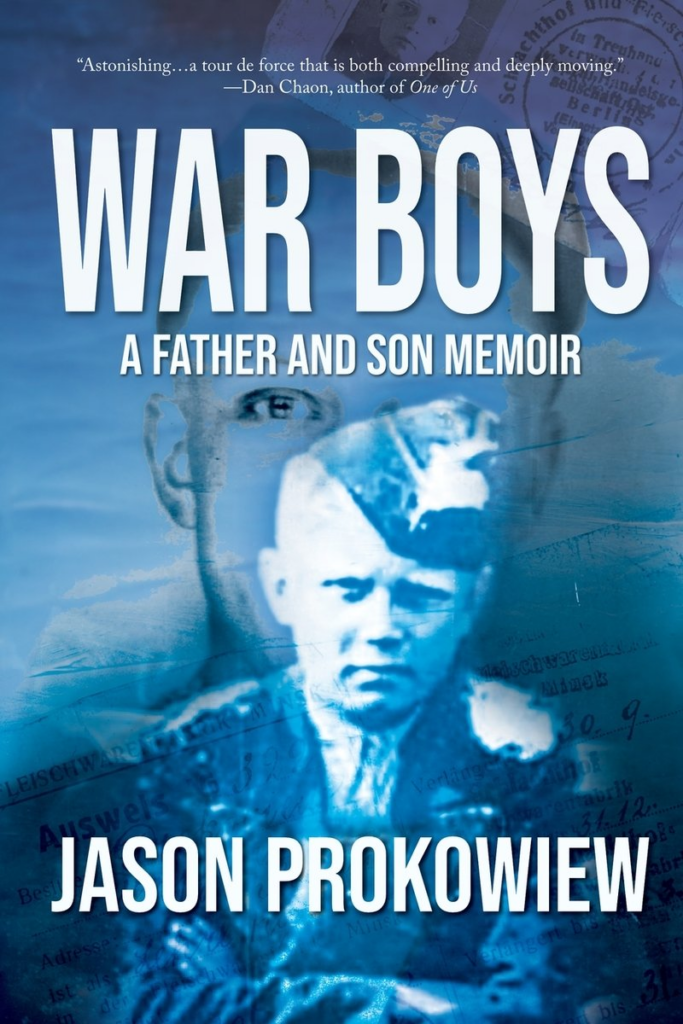
Jason Prokowiew’s War Boys: A Father and Son Memoir (Trio House Press; July 2026) is a braided memoir that tells his father’s story of survival after being orphaned by the Nazis in World War II and the legacy of that trauma in Jason’s own upbringing.
I met Jason in an online GrubStreet memoir class during the COVID-19 pandemic. At the time, he was working on an earlier version of what would become his book. I’ve watched this project evolve over the past half decade (!) and wanted to talk with Jason more about the structure, his process, and the community that got him here.
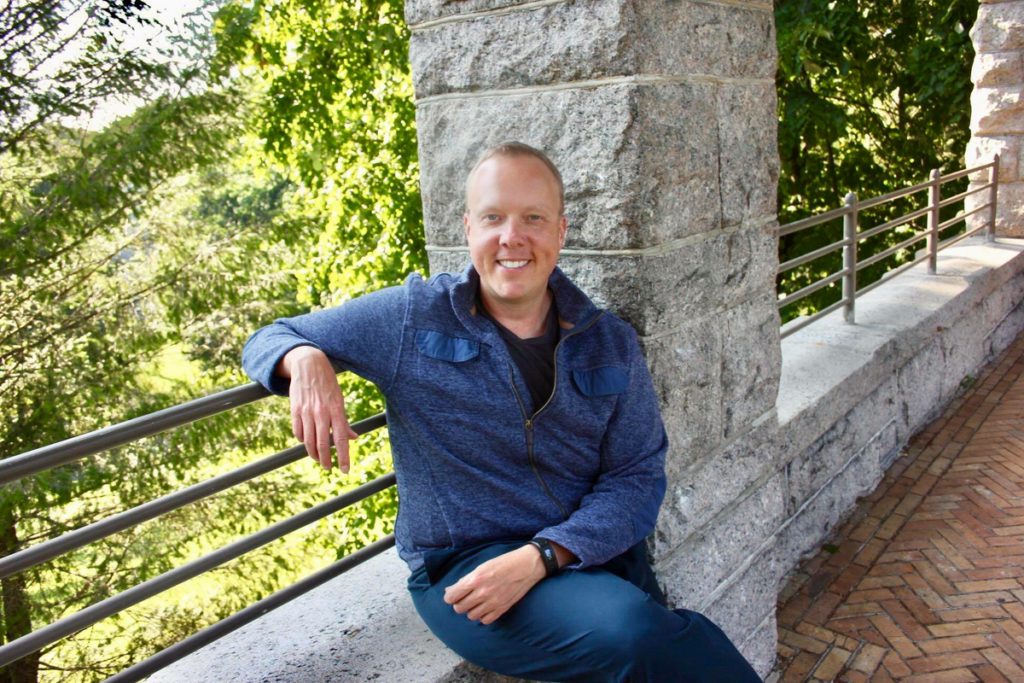
Emily May: War Boys is a braided memoir that weaves your father’s experience of World War II and your own upbringing. How did you decide upon that structure, and what did developing it look like? How does this specific structure work in service of the story you’re telling?
Jason Prokowiew: The structure took a long time to find. When I started writing War Boys in 2003, I thought it would be a retelling of my father’s stories, based on 50 hours of interviews I did with him between 1999 and 2002. I spent the majority of my years in my MFA program just writing his side. I kept at that work until 2009, when I got writer’s block, and like so many before me with writer’s block, I went to law school (just kidding, I know this is unusual). While I was focused on studying and practicing law until 2024 when I retired, I always thought about War Boys, and felt most alive when I talked about it.
I started taking memoir classes again in 2018, primarily at GrubStreet in Boston, reading a lot of contemporary memoirs like Fact of a Body, Heart Berries, and Long Live the Tribe of Fatherless Girls, and was drawn to the high emotional stakes for the writer in them. I realized I wanted to tell my story in War Boys, too, to show what it was like to be raised by a father with war trauma. I took a year-long course at GrubStreet called Memoir Incubator, specifically to give myself time and space to write the Jason narrative.
I worked with the memoirist Mike Scalise, who proposed I use the interviews with my father as a third strand of War Boys, showing how my father and I came together to work on the recordings. It gave me a “now” timeline in the book. The reader might be in World War II Belarus or Germany for my father’s narrative, or in 1980s suburban Massachusetts for mine, and be interrupted suddenly by the interviews, reminded that there is a father and son unpacking these timelines together.
EM: The world of your father Volodya as a child in Nazi-occupied Minsk is rendered so vividly on the page. Talk to us about the process of building that world so that it feels like the reader is on the ground with him.
JP: You have no idea how much it means to me that you feel that way about the Volodya scenes. I studied fiction writing in college under Dan Chaon and Sylvia Watanabe, two teachers that not only helped me with craft but with encouragement. I was so deeply traumatized in college from my familial and community life up until that point, and I think in their own ways, both Dan and Sylvia reached out to me and let me know I could make it as a writer, at a time I wasn’t sure I could make it as anything.
When I read through War Boys more than 20 years after I started writing it, I see myself employing the fiction skills I learned in college, and I see the passion for fiction writing and skills that I was using to churn out those stories for my MFA. While I’ve gone back and revised those scenes, many of them still resemble what they were in the early aughts when I wrote them.
The world of War Boys is a creation of my father’s descriptions, my creativity, and a lot of research. I started a pilgrimage in 2006 to the lands my father grew up on and lived on, first with his family and then with the Nazis, in Belarus. I completed that pilgrimage this year as a Fulbright Scholar to Germany for War Boys. I visited the places my father lived in Germany with the Nazis after they retreated, and the places he lived in Germany as a Displaced Person, once he escaped the Nazis. With both countries, I made sure to go during the wintertime, to capture, for example, some sense of what it might have been like for my father, at ten years old, to survive his first Belarusian winter in the same clothes he’d been wearing in the summer when the Nazis invaded and upended his life. I spent time too in archives and museums, finding pictures of the places described in War Boys, to help me recreate them on the page.
EM: War Boys is, in part, such an intimate portrait of your father as a young man. To achieve this, you straddled the line between biographer and son. The interview process with your dad and subsequent research and travel makes me think of you almost as an archaeologist — unearthing long buried treasure, and getting dirty doing it. What did you learn from this, not only as a son, but also as a writer crafting a narrative? What’s it like writing the truth about someone close to you?
JP: I think I learned that there is a lot of myth-building we do as humans about our own experiences, because my dad had grown accustomed to telling his stories in set ways that felt comfortable for him to tell, but also captivated listeners. He was a survivor, a bit of a hero, in those versions. When I first sat with him to record, his stories were ones I heard throughout my childhood, even if I didn’t ever really pay close enough attention to them. What I think annoyed my father so much at the beginning of our work was my constant disrupting of his storytelling with my questions. I sort of forced him out of the storyline as he’d grown comfortable telling it.
I think there’s truth to all of these versions: the one my father initially told, the one we got to, as well as all the messy middle where I brought on a little deconstruction of the pat narratives. So, when you ask me about “the” truth, I don’t totally relate to that idea. I think in War Boys, the truth is a layered beast. I was still struggling with “the true” version in 2021 in that Incubator class when my instructor Alysia Abbott said this to me, “Don’t try to solve the mystery; convey the mystery.” I felt myself exhale when she imparted that, because I could now imagine a version of War Boys that remained messy, layered, and also held multiple truths.
EM: You’ve written about the importance of community in ushering this work into being. What role did your writing community play in the incubation of War Boys, from the practical to the emotional?
JP: That’s a big question with a tangle of answers. I think a lot about my writing community because I didn’t really find it until about eight years ago. Before that I was circling it, confused if I wanted to commit to it, or if I belonged in it.
I write in War Boys about my personal arc really changing when I was about sixteen, which is when I came out as queer, and also the year that I started singing in my high school choir. Before that time, I was closeted and perceived myself as not being good at or worth anything. Singing was the first thing that I did that was met with positivity from my community, and I thought that was what I would do with my life, and then I started to write and share my work in my high school community, and that was met with encouragement.
As for the writing community, I’m in awe of it, really. Countless times I have felt stuck on how to proceed, and when I’ve reached out, sometimes in abject confusion, there has always been a member of the community there to shake up my way of thinking, to offer a useful idea of how to move forward, or to inspire me, just by me observing their journey. That’s the beautiful thing about being in the writing community: sometimes I’ve felt absolutely stuck but I look at what a friend is up to, what they’re creating, what they’re exploring in the work or the effort they’re putting in to bring their art into the world, and witnessing that often shifts me.
I’m aware of how much I love nonfiction specifically, and feel camaraderie with those writing in that genre. I was recently at AWP in Baltimore to support War Boys, and connected with dozens of memoirists and nonfiction writers, some I knew before, others I met for the first time. When I would lean in with one of these people and talk about our work, there was an intimacy and heft to those conversations that I love jumping into with a fellow nonfiction writer. We catch a few moments to whisper about the difficult stuff we’re grappling with on the page, and that feels like home to me. We then have to pull away and engage with the rest of life, but I know now what they’re working on, and where they are with it, and vice versa, and that to me feels like, “Oh, yes, this is my community, this is where I belong.” Belonging in a community feels still shocking to me, because for so long I believed I would not have one in this life.
EM: War Boys’ journey into the world has spanned a quarter century. There is a lesson in resilience there! I would love to hear more about what this long journey means to you, not only in producing the final outcome, but about what it feels like to live alongside a narrative for so long.
JP: You know, you can never know how long a journey is going to take, right? I thought I’d finish War Boys by the end of my MFA program in 2006, and twenty years later it’s about to be published. I certainly didn’t set out thinking, “How inspiring will it be to others when I get this published 27 years after starting the interview process with my dad!” I would have liked to have gotten this book done and out twenty years ago, but that didn’t happen, and the War Boys of today looks nothing like it would have twenty years ago.
In some ways I think it’s unfathomable that War Boys has taken this long, but then I think of how Alysia Abbott described it as an “epic, multigenerational, global story,” and Mike Scalise, my second reader during the Incubator program, commented that it must have been difficult to find the container to hold these stories. Both these comments helped me contextualize the weight I’d felt trying to tell the story of War Boys, and it made me feel that the difficulty of bringing all of this together wasn’t that surprising. I found some relief in that.
I am grateful for a one-day class at GrubStreet with the agent Sorche Fairbanks, who encouraged us all to think of ourselves as writers, not just the writer of this book we were at that moment trying to sell. That started a shift in me away from thinking of myself just as the writer of War Boys, and towards thinking of myself as a writer of essays, and set me up to start thinking of the projects that will come after War Boys. I think that shift has been helpful with readying myself for what comes after War Boys is in the world.
EM: Thank you Jason! I can’t wait to see War Boys out in the world!
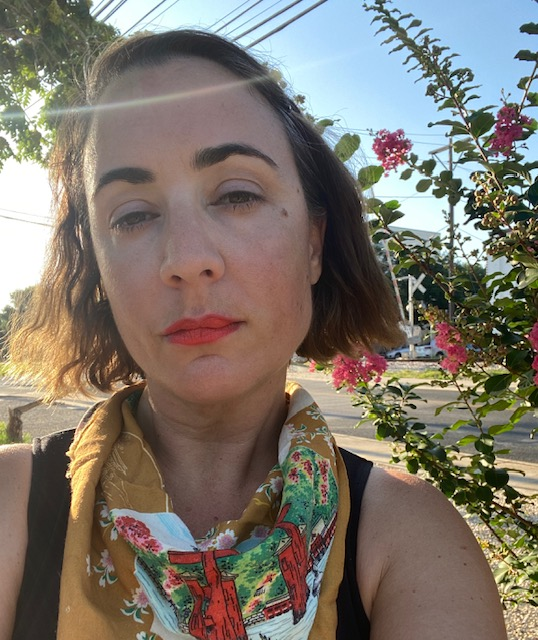 Emily May is the author of the essay collection Some Girls, published by Galileo Press. She studied environmental philosophy at the University of Vermont, and has been a resident at the Vermont Studio Center and the Mineral School. Her work appears in Buzzfeed, Cagibi Lit, Entropy, espnW, and other venues. She sings Warren Zevon at karaoke. Visit Emily at emilyjmay.com.