
 Last week, I was in the tiny backroad hamlet of Nell, Kentucky. Green, rolling hills, meandering lanes, watchful cows, and plenty of structures returning to the earth. Barns, country stores, homes. As I took in the wreckage — and I mean that in the most loving way — I felt a sense of melancholy, but also excitement. This is the land that made me, that made my ancestors.
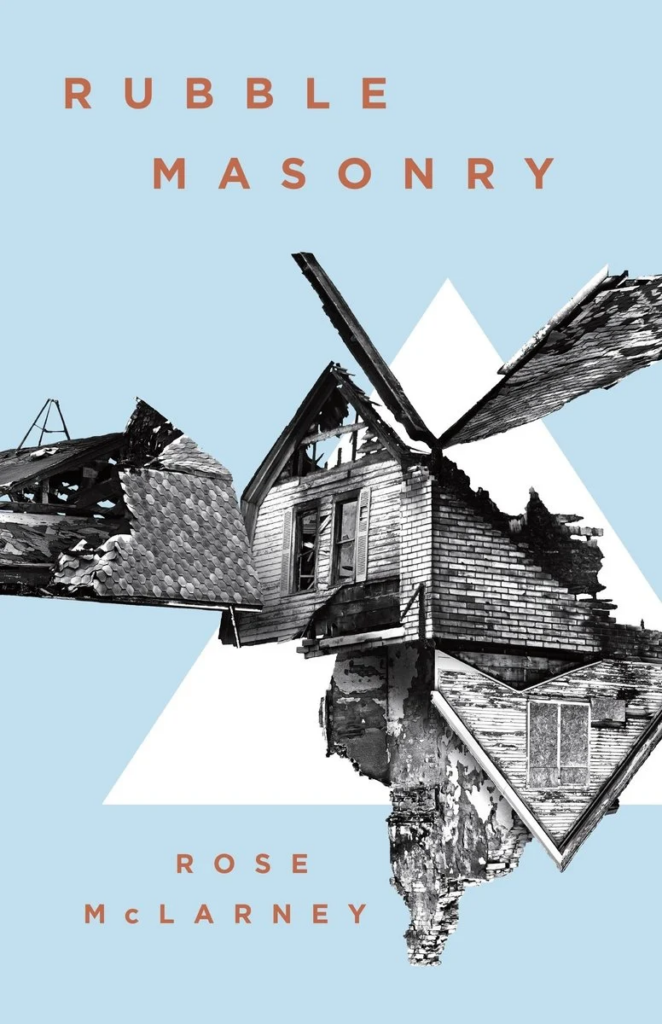
Like Rose McLarney in Rubble Masonry (LSU Press; March 2026), I went to the family cemetery. I studied the tombstones and ‘made no changes or assumptions regarding missing or seemingly erroneous text.’ But in some instances, names for example, I knew otherwise. These are the very things a creative nonfiction writer will do, just as Rose has done here. Identifying characteristics and details of personal experiences have been changed. This is about telling a story that is true to one’s knowledge, emotion, and memory.
These well-written, compact lyrical essays are a study in poetry, but also musings about place, ownership, found items, musical language, a hefty dose of curiosity, and plenty of nuance.
Rubble Masonry, one might need to know, is the process of stone masons, who, rather than using materials to cut ideal measurements, work with found rock’s natural shapes.
While I was in my ancestral homeplace, I examined the rubble of a collapsing tobacco barn, the stacks of rocks of the foundation of the store, the porch now in disrepair. Each rock was shaped uniquely, just as each lyric essay, each human.
This innovative collection positions Rose McLarney at the precipice of a Southern mountain, whether it’s the backroads of Kentucky or North Carolina, or West Virgina, it will remain within me, and hopefully you—as a place we’re all from. It’s about history, yes, but also about dialogue with self and others, public spaces, the natural world, and lineages that circle and connect.
Please join me in conversation with Rose McLarney.

Leslie Lindsay: Rose, it’s such a pleasure to connect with you. You are primarily a poet, and author of Colorfast,Forage, and Its Day Being Gone, both from Penguin Poets, as well as The Always Broken Plates of Mountains (Four Way Books). Rubble Masonry, from LSU Press, is your newest release and it’s a book of lyric essays. I love when poets write prose! It’s such a beautiful melding of compactness meets musicality. What prompted a deviation in form, essay over poetry in Rubble Masonry?
Rose McLarney: Over the years I’ve been composing poetry I’ve collected many pieces of information and quotations that didn’t fit in the small space of a poem, would have overburdened a poetic line. Yet this rubble could be stacked into essays that house new ideas as well as new angles on familiar themes.
The turn to writing prose wasn’t a turning away from poetry. Rather, it was trying to come to prose with everything I’ve learned about musicality and image and metaphor and space and leaps and implications from poetry to craft essays. I wanted to create prose that was linguistically lush yet without syntactical slack or excess explanation. Also, I thought the challenge of trying a different genre would be good for my mind and a good means to reach readers who somehow have been made to feel that poetry isn’t for them.
LL: This is such a thoughtful, slightly melancholic collection — and I mean that in a mature, evolved kind of way — can you talk a little about the process and assemblage of the collection? When did you start writing what became Rubble Masonry?
RM: The first full-length essay, “Weights and Measures,” is from 2018, when my grandfather died. I had returned from his funeral and wrote about that event in what just came out, not entirely by my will, as prose. I was grieving my grandfather but also wrangling with difficult elements of his character as well as my own weaknesses, so, as the writing process continued, the essay widened and became more complex than a tribute. But maybe you can feel something of the quality of a visitation in the writing’s not quite explicable way of conveying the knowledge it has to share.
I finished “Weights and Measures” in less than six months, which is a record speed for me. I sent it to a journal and the journal accepted the submission within hours. Aspiring writers who may be reading my words: Know that this is not how publishing goes (except this once for me, and never again) and that you should not wait for such a sign to make any decisions. That said, I took this rare good fortune as an indicator that I should write more essays. And evidence that there was an audience for them.
I believe I wrote “Blueprints” next, wanting to have an essay for my grandmother since I’d written about my grandfather. “Blueprints” is less leaping than “Weights and Measures,” but it contains many quotations from old correspondence that wouldn’t have fit in poems. So the first essay showed me how much I could get away with in breaking the prose form and the second showed me how prose could serve me in more practical senses.
LL: So many of these are linked essays, meaning themes and motifs circle and braid back. Did you have difficulty ordering them?
RM: I obsessively order and reorder my sequences and sections. For almost two years after I had compiled a collection of essays I would have seen fit to publish individually in magazines and journals, my focus was on arranging the book. Each version of Rubble Masonry’s progression and division into parts generated more writing and revising to fill the gaps and create connections and arcs.
There are eight pieces per section, which maybe few people notice. But I do think readers feel a certain finished quality because of the balance as well as, more significantly, the effects of the progression of the essays. The sections are designed to intersperse the flash pieces, create a tonal evolution, and consider chronology and location.
Rubble Masonry probably doesn’t give the impression of being linear, but it does move from my origins and family in the mountains, to pieces more centered in Georgia where I now live and my more recent adult state, then to a final section that tries to interweave various elements of my story. I’m also drawn to giving some sort of end reward and, despite what seems to be the worsening state of the world, can’t bring myself to close a book on the most negative elements. I tucked the hardest essays in the middle of this book so that the end note strikes a tone of carrying on. At the same time, I certainly won’t force happy endings that are false either, so Rubble Masonry is open-ended, wondering what will follow.
LL: Near my suburban home is a new development. The houses are going up lickety-split. The land used to be an untamed wooded, weedy pile. Now the homes are wrapped in plastic and the driveways are asphalt. Yet, I feel homesick for hills and saddlebags and dogtrot and shotgun houses. You mention this in the essay, “Reintroduction,” What I want is to go back to past times, my knees high-stepping then. Or back further, to crawling on them…or humans clearing the land. Can you talk a little about homesickness? Why are we compelled to these places of our past?
RM: Babies imprint on their mothers’ faces. (And the quail my neighbor incubated, upon hatching, first saw him, and so trail him around his house and yard.) The first place we inhabit makes an indelible impression as a key character in our lives too.
I suppose there’s a hopelessness to wanting the past, since we can’t go back, yet we must progress forward through this physical world’s measures of time. But there’s an authenticity in giving up the pretense that things get better and also a grace to appreciating what has been known and done, loving what has already existed rather than a fantasy.
And so much of learning has to do with remembering knowledge acquired in the past, which is what can help survive the future. Philosopher Daniel Dennett says, Our capacity to relive or rekindle contentful events is the most important feature of our consciousness. I’d add to that that events take place, are in places.
LL: You talk about a type of house called an I-house and another called ‘vernacular.’ These are new terms to me, even though I am very familiar with country homes and small towns. I somehow feel a metaphor tied to just the designations, I-house and vernacular!
RM: I gave a copy of Rubble Masonry to Michael Ann Williams, the author of Homeplace: The Social Use and Meaning of the Folk Dwelling in Southwestern North Carolina, the primary resource for my essay about I-houses, “Storied”—and scurried away because I don’t know what scholars think of my adapting their research into metaphors. But I’m glad you like the interpretations of vocabulary.
I love terminology even — especially — when it’s outside of my field. (In answer to your previous question, I had to stop myself from using the term echoic capacity and digressing into its implications.) And when there is no terminology — such as is the case for houses without names, architectural styles yet to be categorized — or house types known only by pejoratives such as McMansion that I write about in my essay “Another Inscrutable House,” there’s meaning to be pondered there too. Even if that meaning is a berefet-ness of history and intimacy.
LL: Would you say Rubble Masonry is about longing? Or belonging? Does the collection have a shape? For example, my work seems to be elliptical, even though I write about houses and ancestors. Maybe what I am really writing about is time. Can you speak to that?
RM: Those are beautifully phrased inquiries. Longing and belonging are clearly so etymologically similar, yet belonging with that statement of being prefix is asserting itself in a manner that tries to hide the longing inside. My writing doesn’t hide the longing, dwells in longing because I often can’t dwell in the actual times and spaces I’d like. But writing, even if it is filled with the absences of everything else I can never claim — my writing is truly mine.
I’ll take my cue from the physical copy of Rubble Masonry beside me to answer your shape question. The cover designer put a triangle behind the artwork of the house. So, when the publisher asked me what sort of ornament I’d like to use to separate sections in the book’s interior, I chose triangles. Maybe I was drawn to the shape because it echoes a house’s essential form, a roof over the head, or a mountain, rising to a point but with most of its mass level to the rest of earth. Also, now that I think about it, triangles seem stable, if the length of one of their lines is laid at the bottom and the tip is put on top. Yet, if they’re turned to try to balance on the tip, they’re easy to topple. Not unlike a person taken out of her place or a piece of a story out of its context.
Also, Rubble Masonry is a tri-part book. And triangulation is often the quality that makes essays interesting. It can be straightforward to connect two points or themes, but if the writer brings in a third element, the connections become complex and unexpected. I often hear literary discussions of braided essays, but triangulated (or polygonated) might better represent the distances such works span.
LL: Needless to say, I have a total cover-crush on Rubble Masonry. Can you talk a little about the artistic inspirations behind it? Is the photo used from your personal archives?
RM: Locating the cover art for each of my five books has been a great pleasure. I discovered Rubble Masonry’s cover image by David Trautrimas — “On One Hand the Other” — by visiting the websites of galleries that represent artists I knew I admired and then checking out their collections of pieces by every other artist I did not yet know. Trautrimas is represented by Klompching Gallery, which I have never visited, except online, but was led to by following trails from Kimberly Witham. Witham created the exquisite image that appears on the cover of my poetry collection Forage.
Trautrimas’ series from which “On One Hand the Other” comes is “In the Wake of the Bind.” Juliana Zalucky wrote about this series, We often speak of old, neglected buildings in anthropomorphic terms: the term “good bones” suggests that the spectre of death haunts the language we use to describe these forgotten places. What if, after their demise, buildings were released from their foundations? These notions are what came to mind, before reading her articulation of them, when I looked at the opened and winged house of “On One Hand the Other.”
LL: I want to talk, too, about the essay, “(Un) Disclosed.” It’s about so many things, but primarily, your desire to become a mother through adoption. You gain access to some very old orphanage records, and I find this very fascinating, how so much was sealed, undisclosed, erased. I’m curious if you found what you were looking for—either symbolically or literally?
RM: I did not seek any particular answers when exploring the orphanage papers in archives. So I must have succeeded in finding all I could hope for because I gathered the stuff of an essay that strikes you as fascinating. I have not gotten what I wanted in pursuing adoption, a process which had the clear end goal of becoming a mother to a child. But a child has proved to be too much to get, to use the acquisitive kind of language that should never be applied to a living being but that it is hard to avoid in this problematic situation.
In the time between when I submitted the manuscript of Rubble Masonry to the publisher and when the book was printed, my husband and I were chosen by an expectant woman to be the parents to her child. The little girl was born and we brought her home from the hospital. And, also in less time than it took for the book to be printed, the birth mother revoked the agreement and the child we thought of as our daughter was removed from our house (our arms). We should now only call her the child, not publicly by her name, which has been changed anyway.
Though it is within a biological mother’s rights to reverse her decision about adoption and there are many scenarios in which it is best for the child to remain with her biological family, my husband and I were devastated by what happened to us. And, though we are forever altered by this loss, the essays I wrote when we were planning the world we would try to build for our daughter remain true.
The last essay of the book ends with a wish for a child I had not yet met but was (then) sure that I would and an em-dash leading to white space. I still believe that the gesture of continuousness is the right finale. I could have demanded the book be overhauled at some late stage of proofs, but it’s not just because I like my editors that I didn’t do that. The project represents its period of time. It’s a very recent period, but not unlike recorded histories of the far past that tell retrospective narratives that differ from what the people who were living them felt they were experiencing as it happened. My nonfiction is already preserving a lost, more promising era.
LL: They say art should transform the artist, while inspiring others. It should be specific, yet universal. Do you feel you were changed by writing Rubble Masonry?
RM: I’d like to give a heady answer, citing Susan Sontag, something about how art isn’t really an expression of the self, but more mystical. And so my self may have stayed intractably the same while making art that is beyond me. A more bodily and down-to-earth answer is probably more fitting, though. As I grow older and have dealt with illness and disappointments, I often feel diminished. But writing this book made me feel like the scrappy girl I was, who cut firewood and cooked wild game, when I was healthier (and naive-er?), again. I took on a genre strange to me and used unwieldy matter to construct something inventive.
These lines from Larry Levis that I read this morning seem apropos: The first snow has just fallen & if I am older / It is because I have looked out and noticed it. Learning and noticing through writing is a worthy way to pass days for me, and I hope reading the book (or this interview) fills your minutes well.
Leslie Lindsay
Staff InterviewerLeslie A. Lindsay is the author of Speaking of Apraxia: A Parents’ Guide to Childhood Apraxia of Speech (Woodbine House, 2021 and PRH Audio, 2022). She has contributed to the anthology, BECOMING REAL: Women Reclaim the Power of the Imagined Through Speculative Nonfiction (Pact Press/Regal House, October 2024).
Leslie’s essays, reviews, poetry, photography, and interviews have appeared in The Millions, DIAGRAM, The Rumpus, LitHub, and On the Seawall, among others. She holds a BSN from the University of Missouri-Columbia, is a former Mayo Clinic child/adolescent psychiatric R.N., an alumna of Kenyon Writer’s Workshop. Her work has been supported by Ragdale and Vermont Studio Center and nominated for Best American Short Fiction.