

“Adopted people often live with a quiet, lifelong fracture, a deep sense of being unmoored, a feeling of not belonging. No amount of reassuring words fill that void. We are never quite at ease. Never fully home.”
— Louise Brown, “Fifteen Minutes”
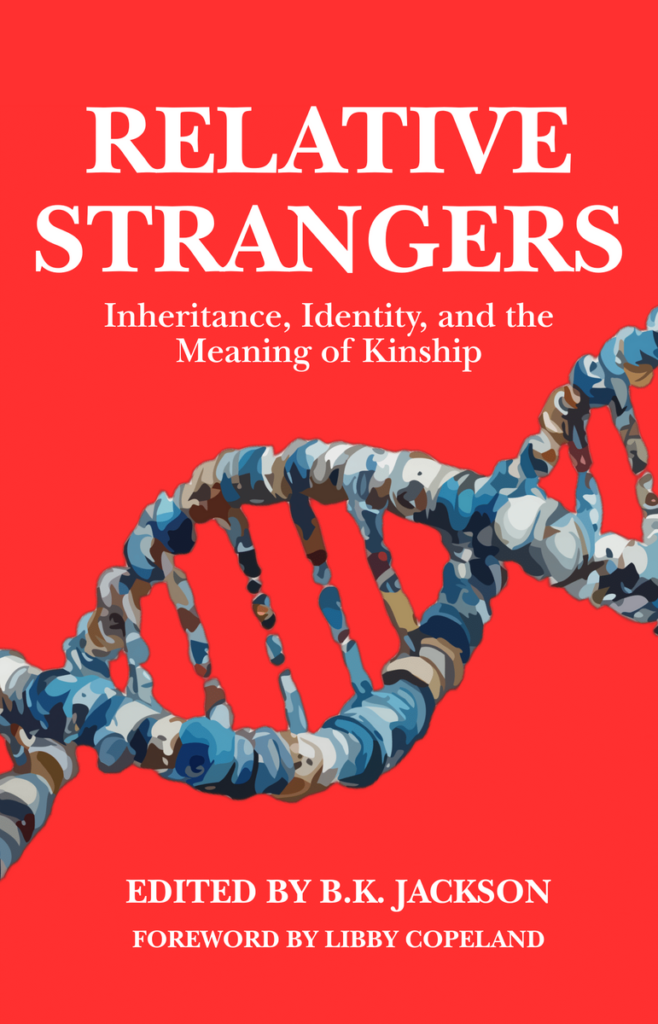 Certain human experiences are ineffable. They are deeply visceral, altering our perception, emotions, or physical reality in ways that others can only truly understand by living through them themselves. Such are the lived experiences uncovered in Relative Strangers: Inheritance, Identity, and the Meaning of Kinship edited by B.K. Jackson (ELJ Editions; 2026).
Not that each contributor to this essential anthology doesn’t try to put language to feeling like an outsider inside your own family (circus mirror), or finding out you aren’t who you thought you were (tectonic shift). But speaking from my own experience as an adult adoptee and sister of four recently-discovered half brothers, a deep thrum of one’s outlier status escapes full articulation. You can circle it and flit in and out, but you can’t make others fully understand anymore than you can make someone who hasn’t gone through it understand childbirth or, I imagine, looking back at earth from outer space.
Which is why Relative Strangers is so meaningful. It offers a comprehensive composite sketch composed by 28 artists each making their own attempt at hardening their experience into a definable phenomena. The result is, if not hardened, at least a three dimensional hologram of the experience of unknowingness. An unknowingness, as editor B.K. Jackson asserts in her introduction, that “can be bewildering, isolating, shame-inducing, and deeply disquieting.”
Reading Relative Strangers can, at times, feel like reading someone’s diary. Each contributor has at one point been at best befuddled, or, at worst, completely in the dark regarding their origin story. Each tries to work that befuddlement out on the page, much like someone works out in their diary whether their crush likes them back. These writers have lived their whole lives with a lurking secret — something unsettling and just beyond their reach. Try as they may to fill the gap with fictional narratives, to make sense of their personal history, and to make themselves feel safe and accepted, they can’t until someone hands them the key to the hope chest where the truth hides. (Often that key is saliva in a test tube sent off to a DNA lab.) Not knowing the truth leads several of the contributors to fantasize, be it an image of a biological parent they create in their mind’s eye or a story about why they were given up for adoption. In some instances, the truth (i.e. a revealing clue or person) stared them in the face and they unconsciously ignored it so as to maintain the protective bubble that surrounded them.
A diary is also a place for secrets, and the adoption and conception process has been — especially in years past — as secretive as nuclear codes (It is less so today thanks to the advocacy of the adoption, donor-conceived, and NPE (not parent expected) communities, and the ubiquity of DNA test kits.) Inside the anthology are numerous heartrending passages about being lied to and gaslit by adoptive and biological parents and relatives. A child’s trust is a precious and delicate gift. The child who still lives inside the contributors to Relative Strangers have had their trust betrayed. And yet, even a betrayal is not enough to break the bond they feel to the parents who raised them, nor squelch the desire to search out those who chose not to. The work is in reconciling the two disparate worlds of trust and betrayal. Again, we rely on narratives and fantasies to fill the gap. What is true? The double entendre title of the anthology and the writers within beg the question.
In addition to belonging and betrayal, themes of identity, kinship privilege, and shame also run through Relative Strangers.
Each contributor sets out to find someone or something — a relative or simply their own history. But entwined in these longings is something more existential, the quest for one’s identity. Imagine waking up one morning thinking you are half Black, then, upon receiving the results of an Ancestry.com DNA test, you learn you’re not Black at all. You are Ashkenasi Jewish. This happened to contributor Kara Rubinstein Deyerin. Here’s how she describes her reaction to the news in her essay “Becoming:”
“When the results came back, the identity I’d spent a lifetime living shattered. My dad wasn’t my dad. We weren’t genetically related. I wasn’t half Black. I had no context anymore, no origin story for my reflection. The face I saw in the mirror was a total stranger….I’d lost one identity and inherited another I didn’t understand. I felt stupid, disoriented, and small—as if my entire life had been mislabeled.”
Inversely, editor Jackson went in search of her Jewish ancestors, only to discover she was Sicilian. That’s what one vial of spit will get you sometimes — a fractured and false identity, a journey from belonging to isolation to a search for a new belonging.
Darcy Ballantyne writes about her “lifelong struggle with identity.” Everyone in her family was fair-skinned, but her skin was brown, making her the odd one out. Her parents lived in a state of denial, claiming to be colorblind. This negative space defined who she was.“Being a Black adoptee was the defining feature of my childhood,” Ballantyne writes. To complicate matters further, she learns the people she believed to be her mother and father were, in actuality, her grandparents. Over time, she began “mirroring the silence, secrecy, and shame about race and adoption” that had been modelled throughout her childhood.
Time to integrate. But how? Deyerin offers one answer:
“There’s a growing recognition that identity isn’t fixed or binary: it’s lived, expressed, and chosen over time. Like gender or religion, ethnicity can be fluid too; it’s grounded in lived experience. Ethnic fluidity means being who you are in practice, not just on paper—claiming the cultures, rhythms, and histories that have shaped your heart. It’s rooted in authenticity. It’s the freedom to honor every story that lives within you, even when they don’t all agree. I now identify as a mixed Jewish woman. That truth holds both the history I lived and the one that lives in me.”
Families, like identity, can also be chosen. And therein lies the rub. To quote an ancient Chinese proverb, “Life is not difficult but for the choosing.” The binary and hence, false choice, is between the family who raised us and the family whose bloodline we share. The real choice is how to integrate these two “families.”
In a number of essays, the writer meets strangers to whom they are related. In some cases, everyone is surprised by, but accepting of, their new kin. In others, the seeker encounters the stiff arm of rejection or skepticism and must struggle to shoehorn themselves into another family’s past. As Dawn Davies observes, the “[b]irthdays, holidays, homework, meals, seasonal changes, holiday decorations. Arguments, slammed doors, apologies. New shoes, braces, cars, college.” This passage illustrates the near impossibility and absurdity of becoming meaningful to another person overnight, despite a shared bloodline. Relationships must be built, shared memories created. A history may live within you but a sense of connection is more elusive.
Privilege is another, fascinating, theme of the anthology. Privilege is often associated with one’s socioeconomic status, but it also gives some a leg up when it comes to race, and, in the context of identity, knowing one’s genetic roots. Jackson writes, “And when everyone else is privileged to know what we don’t — the simple facts about our own existence — there’s often a consuming drive to fill in the missing pieces and attempt to reclaim our truth. Our birthright.”
Most people take for granted their genetic privilege. One of the stated purposes of the anthology is to encourage people to be more aware of it so they can more readily empathize with the community of adoptees, NPEs, and donor-conceived people. So that they stop scoffing at and asking insensitive questions of others who long to know their origins.
There is, as contributor Laura Jenkins points out, shame and a moral imperative lurking behind these ill-advised questions from others who fail to understand. Jennkins writes, “Accusations of ingratitude, selfishness and even personal weakness are often leveled at people who want to know. People like me.”
Most children are weaned on gratitude, i.e. “Eat your peas; there are starving children in India;” “Be sure to say ‘please’ and ‘thank you,” etc. But adoptees get an extra serving of gratitude training: “You should be grateful we gave you a home;” “You should be grateful your biological parents wanted a better life for you than the one they couldn’t provide.” I remember being told as a child how fortunate I was and how grateful I should be that I was loved twice as much as non-adopted children. Was I to feel better about my circumstances, even superior, because I have two sets of parents, even if one set rejected me?
These messages are so deeply engrained we can’t help but feel shame when we break the implicit pact we make with our adoptive parents not to look further than their love for our sense of belonging. Similarly, we feel shame when we reveal secrets that overturn someone else’s life. Revealing our existence to a half sibling is saying the quiet part out loud, i.e. that our shared mother or father was unfaithful and/or had a hidden past life. The shame is misplaced on the messenger for revealing such inconvenient truths.
Parents also feel shame. Shame for keeping secrets. Shame for infidelity. Shame for giving up a child to a stranger. Shame for lying. Shame.
The audience for Relative Strangers is most certainly those who have experienced the trials set out between the covers. I have, and felt a great sense of validation and ‘being seen’ while reading. I also felt an abundance of compassion for the brave contributors. But this book is also for the uninitiated, so they might better understand and appreciate not only their privilege, but why those around them who were born a secret wish to reveal it.
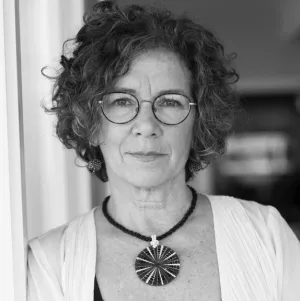 Amy Roost is a freelance writer residing in Bellingham, Washington currently working on a memoir entitled Replacement Child. She is the co-editor of two feminist anthologies and recently earned her MFA in creative nonfiction from Pacific University in Oregon.
I’ve only had time to take a brief look between the pages. This thoughtful review lifted my copy right to the top of the pile.