

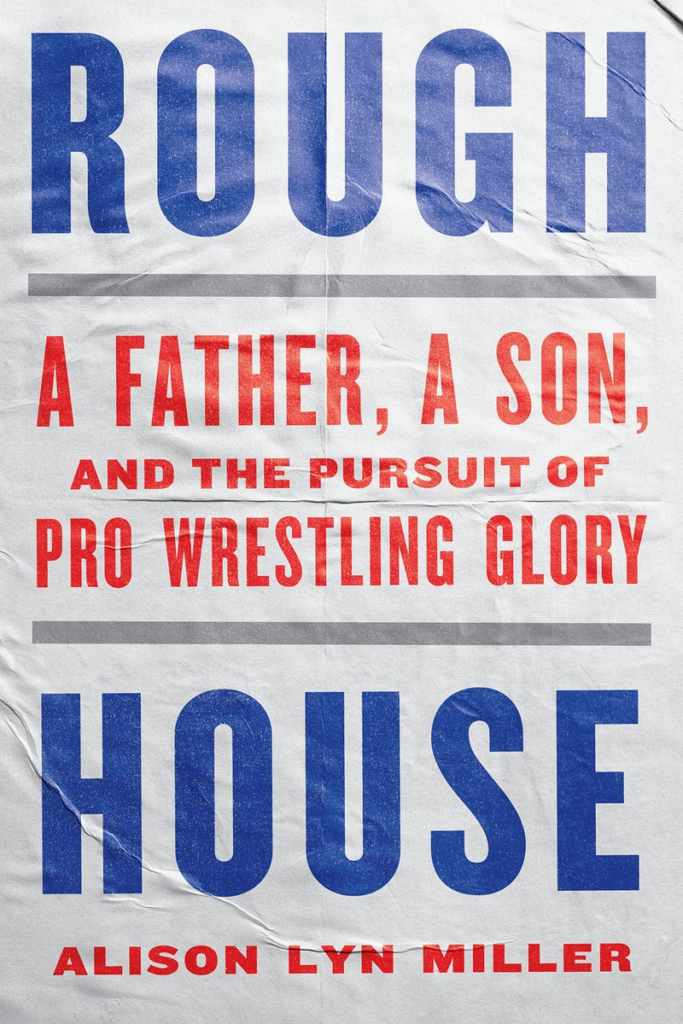
 Never in my wildest flights of imagination did I ever see myself writing the following sentence — and meaning every word of it: I just read a book about professional wrestling that both challenged me intellectually and held me spellbound from cover to cover.
In Rough House: A Father, a Son, and the Pursuit of Wrestling Glory (W.W. Norton; January 2026), author Alison Lyn Miller derives some profound conclusions from a deceptively simple formula. She creates a compelling framing narrative of the conflicting loyalties and expectations between a small-town Southern father, Billy Ray Noblett, and his rebellious son, Hunter. Then she follows the son’s three-year odyssey as a college dropout who becomes the pro wrestler “Hollywood Hunter James.”
Hunter feverishly seeks the fame and fortune his former pro wrestler father never attained and who never wanted Hunter — a straight-A student and amateur wrestling scholarship holder — to ever try to attain. Miller’s gritty yet compassionate portraiture includes the backstories of scores of other bottom-rung, blue-collar Nobodies whom Hunter encounters in and out of the ring, all of them dreaming, drugging, and bleeding to become Somebodies someday. The author’s masterful tapestry of these converging narratives offers an insightful commentary about our country’s most cherished myths and mythmakers, as viewed within the context of our national obsession for “the spectacular amalgamation of theatre and sport” that is pro wrestling.
No, “national obsession” is not an exaggeration. And yes, I, too, was deeply skeptical of anyone making such a claim — until I read Rough House. As Miller points out throughout her book, savvy promoters play upon bedrock prejudices to pump up their “products,” inciting and increasing their fan base with such provocative trash talk as “Pro Wrestling is like Broadway for Hillbillies,” or “Pro Wrestling is the third favorite white trash pastime behind incest and NASCAR.” But as Rough House convincingly argues, the appeal of pro wrestling lunges across all demographics of education, race, and income.
The bear hug of influence this multibillion-dollar industry and its own faith-based religion of performative violence have upon our country — and beyond — beggars the imagination. This flamboyant and far too often grotesque pastime holds in thrall a bewildering array of VIP devotees: Zohran Mamdani, Lillian Carter (President Carter’s mother), Andy Kaufman, Roland Barthes, Dennis Rodman, Cyndi Lauper, Werner Herzog, Billy Corgan, et al. Indeed, it is difficult to imagine a different pop culture spectacle that could single-handedly promote, imbue, and validate virtually every aspect of two US presidencies, including, but certainly not limited to, the installment of our present Secretary of Education, Linda McMahon, who was the co-founder and former CEO of World Wrestling Entertainment, and one of only three members of Trump’s original Cabinet to survive his second term.
Miller’s overarching theme in Rough House is that we must take pro wrestling seriously. To her, it is both a wildly-lucrative industry that rewards the beautiful and the ugly so long as they can sell their story — no matter far-fetched or self-obsessed — and an elevated art form that embodies the never-ending bloody battle that is The American Dream
The author certainly takes pro wrestling seriously. She spent five years researching the history of pro wrestling and delving into the professional and personal lives of her subjects. Within the first few pages, she telegraphs her sincere and respectful concern for the “backyarders,” the working-class folks who devote their dwindling free time “banging and bouncing each other on trampolines illuminated by construction work lights, dreaming of World Wrestling Entertainment or All Elite Wrestling ring glory.” Miller’s prose is at its most lyrical and laudatory when she explores the hardscrabble roots of pro wrestling:
“In Georgia, small-town shows have been alive for as long as anyone can remember,beacons of escape just down the street where magicians of violence perform acts so beguiling that, for a few hours, the outside world slips out of view…
We’re taught to control our feelings, to walk away without making a scene. Around the ring we let loose. The quiet acknowledgement that everyone walks away unharmed grants fans license to celebrate violence, it feels good… it’s catharsis, for ten dollars at the door.”
Miller sees the pursuit of glory via “America’s most curious almost sport” in terms of the archetypal hero’s quest for narrative mastery of self and society:
“Bad guys cheat, beat up the good guy, the good guy comes back. The encounter ends with a finisher, a splashy, recognizable move to ink the match into the fans’ memories. This simplistic approach taps into the most rudimentary conflict of our existence. It’s no wonder it persists. Pro Wrestling is unabashed, larger than life, and easy to pick on. And if we allow it, [it] [is] lovable and unifying. A treasure.”
But Miller also sees the dark side of pro wrestling’s all-consuming “challenge of blurring the line between reality and entertainment,” a world where “everything is demanded and nothing is guaranteed.” She explores in depth the tragedy of legions of wrestlers destroyed by bodybuilding cocktails and recreational drugs to accommodate their “larger than lifestyle.” She cites the memorial website Wrestlerdeaths.com, which profiles the ranks of pro wrestlers who died of heart and other organ failures before the age of 50.
Miller also indicts the remorseless corporate exploitation of these living human action figures. Before the reader can eyeroll and reflexively dismiss pro wrestling as the pathetic province of stupid sweaty steroidal studs in spandex — pro wrestling as the last best proof of testosterone’s toxicity — Miller reveals that World Wrestling Entertainment “pegs female viewership at 40 percent.” Moreover, Miller contends that the reason behind fewer women entering pro wrestling than men has “nothing to do with sexism, but supply and demand… women wrestling stars are more expensive because they are fewer, and they are fewer largely because of the demographics and demands of women in the workplace and as mothers.”
Rough House raises some troubling questions even as it artfully and diligently provides answers to many others. The book’s very narrative structure sounds an ominous thrum of uncertainty that competes with Miller’s spirited defense of pro wrestling. Hunter’s saga is bookended by two stark realities, two “heels” (bad guys in wrestlerspeak) that no “babyface” (good guy) could singlehandedly prevent or redeem: the COVID Pandemic of 2021, and the Winder, Georgia mass shooting in September 2024, which took place at the high school where Hunter graduated three years earlier. Miller deliberately lingers on the shooting, pointing out that it was the 385th mass shooting that took place in 2024, in a state with some of the most notoriously lax gun laws in the nation, before proceeding to extoll the virtues of the benefit match held in Winder to heal and unite the community in the wake of the tragedy.
Why does Miller do this? Is she suggesting that pro wrestling merely portrays the violent psychodrama inherent to American history and popular culture, but does not celebrate and perpetuate its cruelties and inequalities? Is she claiming that it is always so much better to be bashed on the head with a folding chair swung by a caring colleague in a carnivalesque setting while pursuing fame, redemption, and catharsis — than it is to be mowed down by an assault rifle brandished by a teenager who, in their very own demented way, is seeking the very same goals?
Read Rough House and decide for yourself. You will be glad you did.
 Brian Lee Knopp is a retired North Carolina private investigator. In 2019, he published the revised 2nd edition of his 2009 memoir Mayhem in Mayberry: Misadventures of a P.I. in Southern Appalachia (Cosmic Pigbite Press). His most recent publication is Dreams I’m Never Gonna See: The Takeover of WDIZ Rock 100/FM and Other Essays (Cosmic Pigbite Press; 2024). A former professional sheep shearer with an MA in English literature from the University of Texas at Austin, Knopp has taught nonfiction writing for the UNCA-Great Smokies writing program, and his work has appeared in Hippocampus Magazine (2024 Pushcart Prize nomination), Stoneboat Journal, WNC Magazine, Now & Then: The Appalachian Magazine, The Great Smokies Review, and elsewhere. He lives in Asheville.

This review goes a long way toward salvaging my childhood attraction to pro wrestling. I haven’t seen any of it for more than 60 years, and don’t expect to ever again, but this makes some sense. I might even read the book.
T
If it weren’t for Brian Knopp’s review, I probably would take a pass on this book.