

 Sometimes, as a reader and reviewer, I find myself in a bit of a taxonomic pickle. Often, within one genre there’s a name for some quality or approach that doesn’t easily map to other genres, and this can make talking about form both interesting and messy. As a poet, I’m familiar with the ars poetica, a poem whose very subject is poetry itself.
In ars poetica, a poet turns to face the poem, asking what it is and what it demands. It’s a form with a long tradition, from Horace to every MFA student who has eventually written one as a rite of passage, proof that you have lived with the art of poetry long enough to have opinions about it. I have written my own, and there is something clarifying in the exercise: to make the work your subject is to commit to it in a new way, to stop writing around your understanding of poetry and instead write from within it.
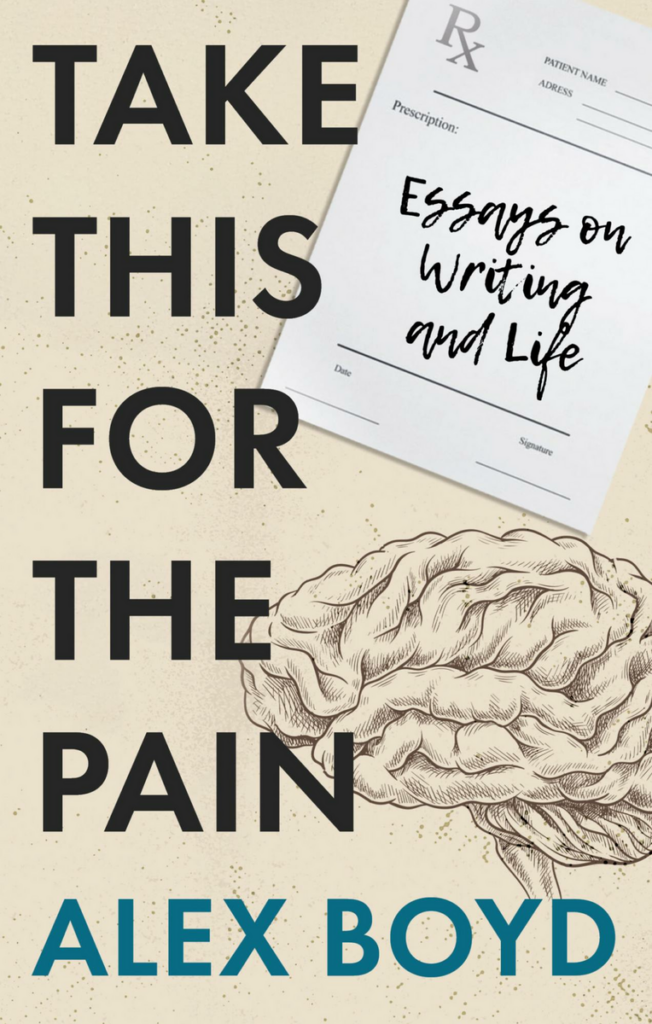
When I came to Alex Boyd’s Take This for the Pain: Essays on Writing and Life (Palimpsest Press; June 2026), I found myself reaching for an equivalent term for prose that takes writing and the writer’s life as its subject. Perhaps such a term exists, but I came up empty. It helps that Boyd is a poet as well as a prose writer, someone who has spent a writing life reading widely, reviewing carefully, and reflecting on what that life means.
The book he has made from that practice falls unmistakably within the tradition of the ars poetica, transposed into prose and spread across decades, an ars scribendi if you will, from the Latin meaning the art of writing.
If my cursory Google search is any indication, there does not seem to be a real critical tradition for ars scribendi in the way there is for ars poetica. Prose writers have worked without a term to encompass their writing about writing. Perhaps you will indulge me ars scribendi, because, to my mind, Boyd’s book is the art and life of writing, and understanding it that way changes what you expect from it.
Take This for the Pain has elements of essayistic forms we’re familiar with but requires a different lens. The craft essay comes close in some cases but implies instruction. Personal essay is too broad. Book and culture reviews, which comprise a significant portion of Boyd’s pieces, are what they say they are — reviews — but the term lacks the accumulated weight of a complete artistic sensibility being examined over time and across the full scope of the book.
“I believe it’s possible to use accessible language to uncover profound meaning and some of the deeper tensions we struggle with, even as we should acknowledge there are still spiritual elements in the world,” Boyd writes in his introduction. “To deny these elements is to insist there are no quiet embers lying around to allow something inspired.” From the outset, Boyd cues us to a sensibility at work, and why these essays, arranged in three sections — Writing, World, and Reviews — deserve to be grouped together as a cohesive whole.
Boyd’s selections showcase a writing life that is also intimately shaped by reading. In one of the early essays, “Charlotte Brontë: The Only Self-Help Author You Need,” Boyd uses the genre conventions of self-help in order to say something simple and specific about Brontë’s influence on his own writing: “if you want to be a writer (or anything else) learn it like there’s little else in the world.”
Later, in that same essay, he applies the lesson of Jane Eyre in a contemporary context: “These days people fuss when there’s a lineup at Starbucks and we’re in danger of losing touch with something important — simple enough, the delay between desire and gratification, which makes something finally, sweetly satisfying.” The essay ends with a rather pointed assessment of the usefulness of authors like Brontë and Jane Austen in modern life, culminating with the observation that both “provide rich, graceful reminders that happiness is sometimes behind a certain amount of adversity.”
The Writing section of Take This for the Pain includes “Shadows and Footsteps,” an essay about mentorship that distills much of Boyd’s philosophy into a single sentence: “Maybe the only important lesson for younger writers, whether they learn it from their elders or not, is that to write good books you must read good books, and that the humble improve.”
The World section moves furthest from the ars scribendi framework, turning outward toward lived experience rather than the practice of writing itself, but its emotional core is an essay about Boyd in his twenties, taking his first international trip to Ireland. Here we see his writing sensibility in the process of being formed, an approach that animates the other sections of the book. Boyd has signaled from the book’s outset that he believes in “quiet embers lying around to allow something inspired” and in his Ireland essay, we see a young writer learning in search of those embers. From within the remains of Trim Castle, Boyd observes “something curious about standing inside roofless, partial walls that once housed people, a shifting place with one foot in the past and one in the present — looking at the sky, looking down at part of a wall.” It’s a quiet reckoning, but also a lesson in the kind of dual attention that a writing life requires.
The deeper moment comes later, in a cathedral. Boyd drops a coin in a box, lights a candle for his mother, and finds himself “picturing my thoughts leaping up, solid as rope to whatever intangible machinery our faith hopefully feels.” The image is striking precisely because it doesn’t resolve. It postulates faith as mechanism, prayer as something nearly physical, hope built into the grammar of the sentence. This connection is not incidental. Later, a local girl happens upon Boyd scribbling in his journal, one that will later be stolen (an early loss that reads, in retrospect, like an initiation, not unlike Hemingway’s lost manuscripts) and she asks if he’s writing a book. It’s the kind of moment made for ars scribendi, that instance where someone else sees the writer in you before you’re certain you are one. Writing becomes an art made of faith in words, faith in self.
By the third part of the book, it is easy to see how the young writer scribbling in that Irish notebook eventually becomes the critic of the Reviews section, and it’s here that the ars scribendi framework asserts itself most forcefully in Boyd’s treatment of Jonathan Franzen’s How to Be Alone. Boyd notes that Franzen’s old rotary phone and typewriter are described in loving detail, and that it’s ultimately “the use of abandonment” of objects that gives them character. Boyd posits this as a quiet argument against the disposability of consumer culture, and though he is writing about Franzen, the concern is plainly his own, the same concern that surfaced in the Brontë essay when he invoked that long Starbucks line as evidence of something subtly lost. Modern life may provide plenty of content, but in Boyd’s eyes it also fosters existential conundrums.
The more searching moment comes in “Art and Terror,” an earlier essay in the Writing section, though its full weight only becomes clear once you’ve read the entire book. In contemplating 9/11, Boyd turns directly to what writing cannot do:
“After the attacks I asked myself what good poems or novels could do in a world where people fly populated planes into populated buildings. My views on the value of writing wavered because certain kinds of actions are thousands of times louder than the word. Suddenly I was making the mistake of demanding that writing and art have an immediate and measurable effect on the world.”
This is ars scribendi at its most honest. It is not a defense of writing but a reckoning with its limits, and it reframes the book’s title in an important way. Take This for the Pain doesn’t promise a cure; it offers an analgesic. A savvy reader, Boyd understands the difference. Writing, by his account, is an act you reach for not because it resolves the world’s violence or slows its velocity, but because it captures one of the quiet embers still lying around. That is a more modest and, ultimately, a more trustworthy claim than literature usually makes for itself.
What Boyd has assembled in Take This for the Pain is less a loosely connected “greatest hits collection” or a “new and collected” (to use another poetry term) than an account of a life organized around the act of writing, and a simultaneous reflection on the act of reading that makes writing possible. Like the ars poetica, Boyd’s collection turns to face the work itself, even if it doesn’t have the comfort of a literary tradition to lean on. That lack of a tradition is not a critique, but perhaps another ember Boyd leaves us.
In Ireland, the young Boyd observes that “if anything provides faith on a lonely journey, it’s people who help others and refuse to admit it’s anything other than common decency.” He’s writing about a stranger who stopped to give him a lift, but the sentence describes what Boyd’s collection does, as well. It’s generously offered, without ceremony and without overclaiming its own significance: take this for the pain because, even though it won’t fix what ails you, it helps.
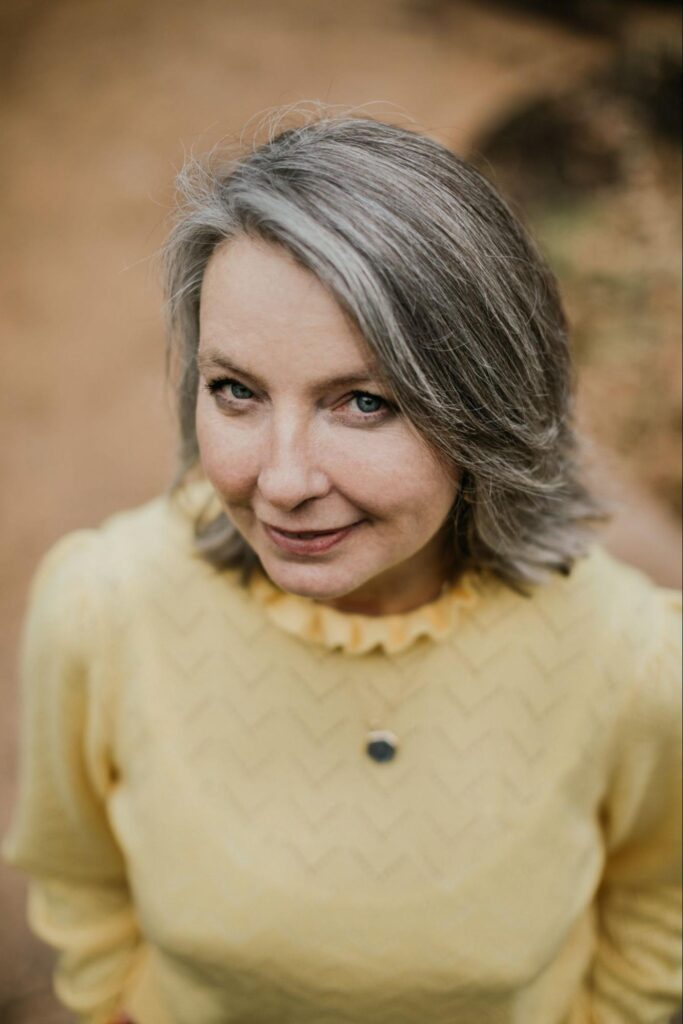 Renée K. Nicholson is a writer, scholar, and narrative medicine leader whose work spans poetry, creative nonfiction, fiction, and academic articles. She is the author of six books, including Fierce and Delicate: Essays on Dance and Illness, Postscripts, and Feverdream. Her debut novel is forthcoming in 2027. Her writing has appeared in The Gettysburg Review, Bellevue Literary Review, AWP Writer’s Chronicle, and Synapsis: A Health Humanities Journal, where she is a contributing writer. She currently serves as series editor for the Connective Tissue imprint at WVU Press and is a member of the National Book Critics Circle.
Thank you for this very thoughtful review, it’s appreciated.