

A ballerina glides across the dance studio. Her coach, a thin old woman, mimics the movements beside her. The ballerina turns her hips and the coach follows suit. She extends her arm, pointing at the ballerina’s raised leg and says something that makes the young woman smile. She speaks softly, patient and gentle, her frail body moving alongside the dancer as though asking “Is this what you mean?”
This intimate little scene touched me, because the pupil was showing off to the teacher. I couldn’t help but think, “Isn’t that what I’m trying to do in writing workshops?” I’m moving alongside the writers, a mirror in which I hope they’ll see what makes them want to dance on the page.
I’ve written before about being in dialogue with our three selves as memoirists: writer (examining our lives), editor (looking at craft) and narrator (the persona we embody). But when I am teaching, I am what I can best describe as a three-legged table: the confidant (instilling trust), coach (facilitating as a figure of authority) and critic (analyzing and interpreting the text).
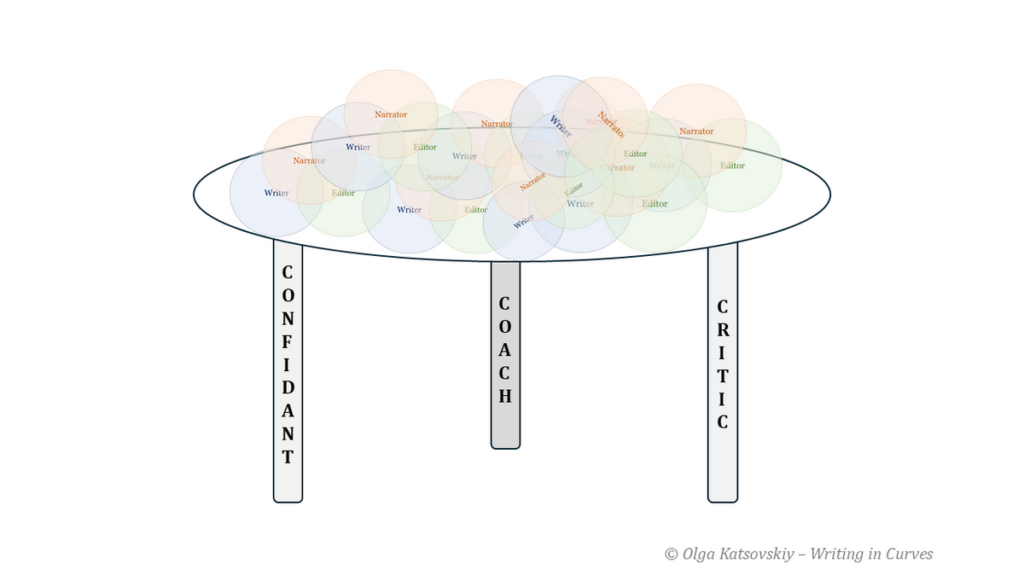
As a confidant, I feel it is my duty to build rapport and create a space where writers can be vulnerable. I’m not a peer in the classroom, even though I am a writer too. I’m not a therapist, even though I empathize. I probe and listen and try to ask the right questions to help writers find the stories they need to tell.
I’m not in class to make friends. I’ve had a friend enroll in class once, but there was no preferential treatment and no catching up on our lives. I treat everyone equally and facilitate discussions, disclosing very little about my personal life. Sometimes I run into students at the coffee shop before class. They’ve joined me on occasion, sitting together before heading out to class, but I treated them as I would in the classroom. I’d ask them how their writing is going.
I broke my own rule once. I invited a former student to a reading to showcase an essay she wrote in my class, and we went out for coffee afterwards. I never heard back from her, and being ghosted really hurt my feelings.
The coach is the voice of authority, the toughest part of teaching. It has little to do with writing and craft and everything to do with sharpening soft skills. It’s the leader who sets ground rules and boundaries. Some people like to push buttons and it’s essential to remain calm and stern.
In my Writing in Curves workshops, we mark up hard copies in class and return them to the writer at the end of a session. The work never leaves the room. I’ve found this method helps to build trust, and students provide more authentic feedback. Once, a student left the room and came back with a hole puncher. I watched in disbelief as he punched another student’s copy to put in his binder. I stopped everything and asked him to return the printout. He insisted on holding onto it since he “didn’t write anything on it anyway.” I asked the writer in question, “Are you OK with him keeping your paper?” The room went quiet. “No, I’d like to have it back please.” That convinced him to follow the rules and showed others I won’t back down.
I picture my critic the way Toni Morrison sees a good editor, someone who looks at a piece of writing objectively. “Cool. Dispassionate. They don’t love you or your work.” It’s the same critic I lean on when I’ve read submissions for literary magazines. I care not about the writer’s name or their portfolio, but only the work in front of me. The critic tries to figure out the writer’s intention, considering the strengths and possible areas for improvement. I’ve been a student myself in classrooms where instructors shy away from the critic. They shower students with compliments or lean too much on their peer writer, turning class time into a social hour.
Each leg of the metaphorical table must be weight-bearing to support a productive workshop. Once I showed “The Crash,” by Ashley Espinoza, to demonstrate repetition in flash essay. I asked the group what they thought of the technique and someone blurted out, “She should have gotten an abortion.” This! After dedicating a good chunk of class to the importance of talking about the narrator (not the writer). My coach and confidant reminded the student to focus on the story, rather than passing judgement on the writer. Finishing with “Would you have said this to the writer’s face if she was here?” Silence. “You wouldn’t, because we’re not here to judge each other’s life choices.” The critic shifted the discussion back to the narrative.
At the end of a teaching night, whether I am sitting on the bus or shutting down my laptop, I am spent. I’ve come to realize it is because my relationship with students is one-sided. I’m always reaching and giving my undivided attention, my time and energy.
I don’t think instructors talk enough about the emotional toll it takes, how hard it is to juggle and hold up all those voices on the table. All at once. That’s another cost of being an instructor, not having enough time or energy to get into the headspace to write our own stories. Writing about writing and teaching are entirely different realms I’ve come to love. I don’t do it for coffee money. I do it to elevate others expecting nothing in return. I do it because I love the dance.
 Olga Katsovskiy is a coffee-powered writer, educator, healthcare administrator, and editor-in-chief at JMWW journal. Her essays have appeared in the Brevity Blog, Pithead Chapel, Short Reads, true. magazine, and elsewhere. Find more at writingincurves.com and Instagram at @theweightofaletter