
Readers might know me as a memoir fan; I’ve read and reviewed many a memoir since my Hippocampus Magazine contributions began in 2022. This month, however, I’d like to review not one, but two craft nonfiction books. To cover two books in the same review seems risqué, like wearing a crop top and Daisy Dukes on my next trip to Japan. (Although, Pride month did just start…)
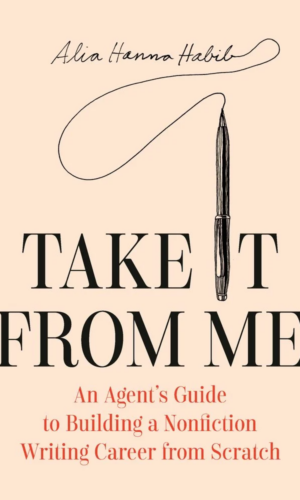
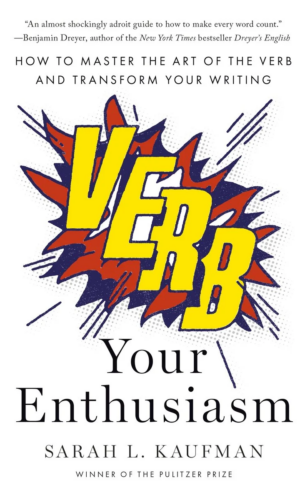
And yet when I read these two books, I had a lightbulb moment: they complement each other. Alia Hannah Habib, in Take it From Me: An Agent’s Guide to Building a Nonfiction Writing Career (Pantheon; Jan. 2026) offers a macroscopic view for your writing, walking you through an entire fashion collection of ideas.
Sarah L. Kaufman, in Verb Your Enthusiasm: How to Master the Art of the Verb and Transform Your Writing (Penguin Press; April 2026), however, brings us down to the level of fabrics and notions. That journey from macro to micro delighted me.
I found myself loving Habib’s advice for nonfiction writers, and she dispenses it with utmost generosity. I might not be the ideal reader — I have both a growing platform and a beautiful agent — but within these pages, I found myself taking notes of things to try next.
What I liked best is a point that literary citizens like Jane Friedman and Allison K Williams instill in their students and readers: platform does not equal social media follower counts for most nonfiction writers. Or at least, not exclusively. And Habib walks you through the steps to build that truer platform.
Habib’s decision to start the reader off with pitching instead of education (saving the MFA soliloquy for the second chapter — to degree or not to degree), illustrates the practical application of her book. Starting off your path to a writing career with actual writing is a smart move, and learning to pitch is a skill that can serve you through the rest of that career.
Habib also goes into a discussion of platform, too, in her Chapter 2.5, treating it as an offshoot of the educational process of writing (Chapter 2), but marking it with, in my mind rightfully, more significance than your book proposal (Chapter 3, with the challenging subtitle: Don’t Be Boring!). Chapter 4 discusses the value of working with an agent, and then Chapter 5 describes the pain of being out on submission (which is where I am in my own writing journey).
Let me offer a brief aside on writing career pain. It isn’t limited to the submission phase of your career. It can start from the moment you put the proverbial pen to paper. Getting the first draft down can hurt. Revising that draft can hurt. Pitching to literary mags (and elsewhere), with the rejections that entails will definitely hurt. And the process of finding an agent, with the form rejections, the ghosting, and the long need to pick yourself up and keep trying, is agonizing. And I assume that the pain doesn’t evanesce into non-existence once an editor/publisher joins hands with you, either.
But a book like Habib’s can foment resilience and perseverance in a writer by describing the journey, from pitching to publication and beyond, in ways that forewarn, reassure, and inspire writers. And I would be remiss were I not to mention her appendices on contracts and foreign rights.
If, as you ascend Habib’s steady ladder, you wish to consider smaller steps that will both improve your writing and delight your readers, pick up the Kaufman book next.
Kaufman starts with a call to arms in a chapter named “Energize.” (Forgive me if I heard that imperative in a Star Trek: The Next Generation transporter room voice.) Drawing on her experience as a journalist, she describes the importance of the right verbs from the perspectives of both writer and reader. Lines are drawn, and enemies, like obfuscation, are named.
From there, Kaufman zooms out to review some grammar fundamentals, describing not only the functions of verbs and their different uses within sentences — including participles, gerunds, and verbal nouns — but also reminds the reader of how nouns, pronouns, adjectives, and adverbs are used. Starting from her third chapter, “Take a Stand,” however, Kaufman presents page after page of actionable, understandable writing advice, all designed to make sentences powerful and presented with bountiful examples. And, from my perspective, to make writing more fun. The challenge to examine your verbs and how you use them — are they accurate, are forms like the passive and the subjunctive employed with care, is there poetry on the page — delights me.
But of equal (or perhaps greater) pleasure are the moments when Kaufman finds philosophy among verbs. In her ultimate chapter, “Transform,” she begins with a note that Ulysses S. Grant penciled to his doctor during the last days of his life, when his worsening throat cancer made speech impossible. “The fact is I think I am a verb instead of a personal pronoun. A verb is anything that signifies to be; to do; or to suffer. I signify all three.”
From that launch pad, Kaufman not only reviews how verbs have been defined over the centuries, but touches, too, on the power of verbs to change the way a reader views the world. What other benchmark of success should a writer aspire to?
Each chapter within Verb Your Enthusiasm includes prompts and exercises, offering the reader an immediate way to transform the lessons into practical experience. One of her recommendations, one that I followed, was to create a list of verbs that catch your eye. My favorite additions to my list so far include to ‘tesseract,’ to bring more of yourself into a hidden, fourth dimension, to make yourself smaller in the hope of escaping notice, and to ‘velvet,’ to softly fade from view.
Both Habib and Kaufman, in different but surprisingly complementary ways, have penned craft books worthy of my, and (hopefully your) bookshelf.
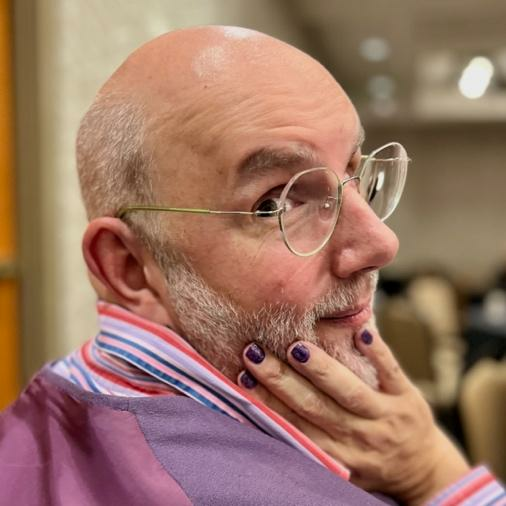
Brian Watson’s essays on queerness and Japan have been published in The Queer Love Project, The Audacity’s Emerging Writer series, and TriQuarterly, among other places. They were named a fellow for the 2026 Lambda Literary Virtual Writers’ Retreat for Emerging LGBTQ+ Authors and a winner in the 2025 Pacific Northwest Writers Association’s Unpublished Book contest. They share OUT OF JAPAN, their Substack newsletter, with more than 900 followers. Their agent is Alisha West at Corvisiero.