
Review by Elizabeth Austin

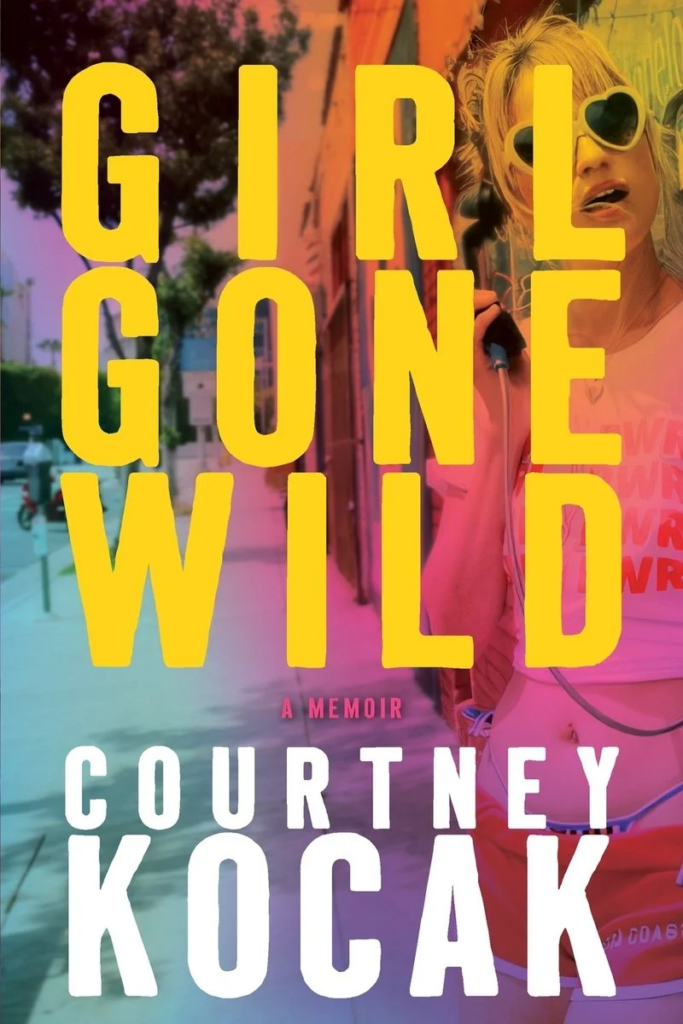
Courtney Kocak’s Girl Gone Wild: The Hollywood Misadventures of a Small-Town Girl (Trio House Press; April 2026) opens with the author at twenty years old, alone in a gray Chevy Corsica, rationing Adderall through the Rockies, and belting Lisa Loeb into the Utah dark. She’s driving through the night on nothing but a cassette wired into a Discman and sheer will, and by the time a stranger’s headlights pull up beside her at a desolate rest stop, you’re fully in her hands. She’s heading to Hollywood, and immediately you settle in, because you know this is going to be a ride.
The book spans roughly two decades, from Kocak’s adolescence in Jackson, Minnesota through the indignities of trying to become a working actress in the early aughts. We tumble alongside her through modeling stints, sex work, an abusive relationship and its long aftermath, and finally into a life of professional artistry. She calls it a coming-of-age story, and it is that, but it’s also a cultural reckoning, a structural argument about what the entertainment industry costs women, and a vibrant, honest account of female ambition.
The memoir is structured theatrically: opening curtain, intermissions, curtain call, mirroring Kocak’s years spent trying to perform her way into her life. The structure makes that legible without belaboring it, her comic timing is excellent, and her eye for telling details is merciless. Photo shoots found through sketchy online ads, gigs answered out of financial desperation, oddball job interviews that turn out to be something else entirely, a stint on a notorious reality-TV tour— she renders early-aughts Hollywood’s margins with clarity and considered understanding, never losing the specific, absurd texture of each encounter even as the underlying stakes stay serious.
The book’s central achievement is Kocak’s ability to hold the full moral complexity of her past without prosecuting her younger self or letting her entirely off the hook. The chapters detailing an abusive relationship are unflinching, tracing the slow process of understanding what’s happening to her, trying to extricate herself, and reckoning with what she wasn’t able to protect along the way. She doesn’t soften the choices she made in those years, but she doesn’t pretend any of it was made in a vacuum, either. Kocak contextualizes without excusing, indicts without absolving, and does all of it while remaining completely readable.
Throughout, the book sits with a question that doesn’t have a clean answer: what does a woman owe the life she was told to want versus the life she actually has? Kocak doesn’t resolve this tension so much as inhabit it with humor and honesty, and without sentimentality. She is very funny, but the comedy isn’t a defense mechanism or a deflection; it’s how she tells the truth.
The closing pages, in which Kocak sits with her mother in the kitchen of her childhood home and the two confront the weight of their irreconcilably different dreams for her life, are so moving. She doesn’t give her mother the ending she wanted, and she doesn’t shy away from the cost of that. Instead, she offers readers a truth: that loving someone and disappointing them can be the same act, and that sometimes the most faithful thing you can do is live your own story, and then tell it.
Kocak’s Girl Gone Wild is fearless and funny and formally inventive. It’s a memoir that refuses easy redemption not because she’s withholding, but because she’s after something more useful; something real.
 Elizabeth Austin’s writing has appeared in Time, Harper’s Bazaar, McSweeney’s, Narratively and others. She is currently working on a memoir about being a bad cancer mom. She lives outside of Philly with her two children and their many pets. Find her at writingelizabeth.com and on Instagram @writingelizabeth