Reviewed by Amy Goldmacher

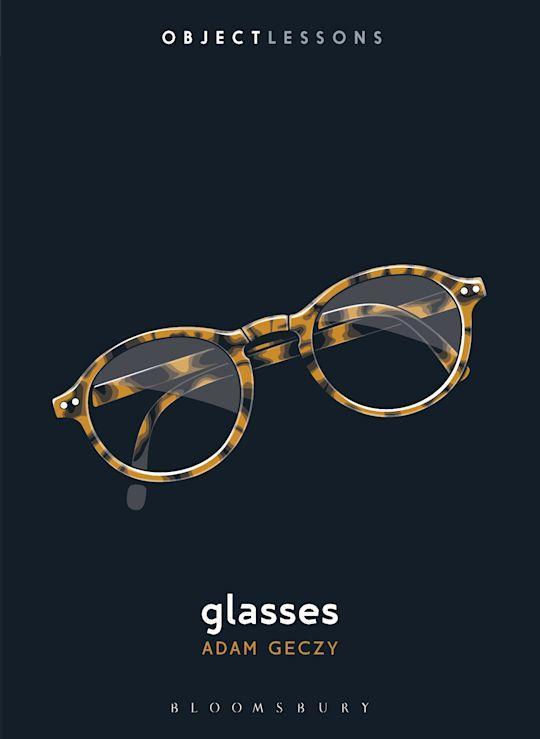 Glasses, as of July 2026, is the latest in the series of 100+ books in Bloomsbury’s Object Lessons series. These tiny (approximately 25,000 words each) tomes are delightful, deep yet digestible dives into “the hidden lives of ordinary things.”
As a glasses-wearing twelve-year old, Adam Geczy recalls watching the 1964 film Tomb of Ligeia, based loosely on Edgar Allan Poe’s tale, where the main character has an eye condition that requires him to wear dark glasses outdoors that is a metaphor for his disconnection to the world, which (spoiler alert) leads him being blinded. And thus Geczy’s eyes were opened (literally and metaphorically) to the many functions and perceptions of glasses.
(My personal eye-opening moment was the Twilight Zone episode “Time Enough at Last” from 1959 where Burgess Meredith’s myopic bank teller finally gets his wish to be left alone in a library after an apocalypse, but … well, we won’t spoil it for you.
Glasses addresses the question, “What does it mean to wear glasses? There is more to the answer than correcting vision. Glasses alter, enhance, and shield the way that we view the world, and the way the world sees us.”
I imagine many, if not all of us avid readers and writers require this assistive technology. I certainly do; I’ve been wearing glasses or contact lenses to correct my inability to see six inches past my nose since approximately 1980.
Geczy weaves facts about and references to glasses in history (origins are traced to the mid-thirteenth century); literature (references to glasses in Shakespeare’s King Lear, As You Like It, Henry VI, Much Ado About Nothing, and The Winter’s Tale); cinema (from Disney to the Harry Potter series); fashion and popular culture (Elton John, specifically, and celebrities in general, but not Iris Apfel, strangely); and culture (from stereotypical features to superhero disguises).
He touches on futuristic visions of what glasses can do, referencing Geordi Laforge from Star Trek’s bionic visor and the main character from The Chronicles of Riddick’s night vision implants and tinted goggles for light sensitivity. Nowadays, glasses can enhance hearing as well as vision and incorporate AI. Is there anything glasses can’t do?
In just an introduction (“Rose Colored Glasses”) and six cleverly-titled chapters (“Looking Better,” “Looking Smart,” “Looking Good,” “Looking Different,” “Looking Inward,” and “Looking Into the Future”), Geczy shows that glasses are the interface between us and the world:
Glasses are full of connotations and semantics, but they are also seamless with everyday life.
Glasses remain shorthand for the scholar, the bookworm, the introspective thinker, the savant. They suggest a life of the mind, a gaze turned inward or focused intently on the world. In this way, they are not just tools but talismans — objects that carry the weight of centuries of cultural meaning.
As an almost-lifelong wearer of glasses, whose lenses and frames come at a not insubstantial cost, and for whom glasses are considered jewelry for the face, I had hoped for more of the author’s personal story. We are told that at four, Geczy was diagnosed with monocular dominance, where one eye does all the work, and he endured surgeries, patches, and, of course, glasses. He describes how, “at five years old, I became the child with thick lenses and a lens patch — an image that elicited quiet sympathy from adults and casual cruelty from peers. I hated it.” But these reflections made me wonder… How does the author see himself now? And what can glasses-wearing readers learn from his life in glasses about themselves and how the world sees them?
At the end of the book, Geczy states (or maybe he confesses?) he has multiple pairs of readers all over his house that he can slip on and off as middle-age necessitates. My glasses are a more permanent feature on my face and of my identity. Whether your own specs are a sometimes-accessory or a lifeline, you’re sure to find something fascinating in this book.
 Amy Goldmacher is a glasses-wearing anthropologist, author, and coach. She is the winner of the 2022 AWP Kurt Brown Prize in Creative Nonfiction, and her experimental glossary-form memoir, Terms & Conditions, can be preordered at a discount before Oct. 6, 2026. You can find her on social media @solidgoldmacher and at amygoldmacher.com. Her newest frames are yellow.