Reviewed by Anna Rollins

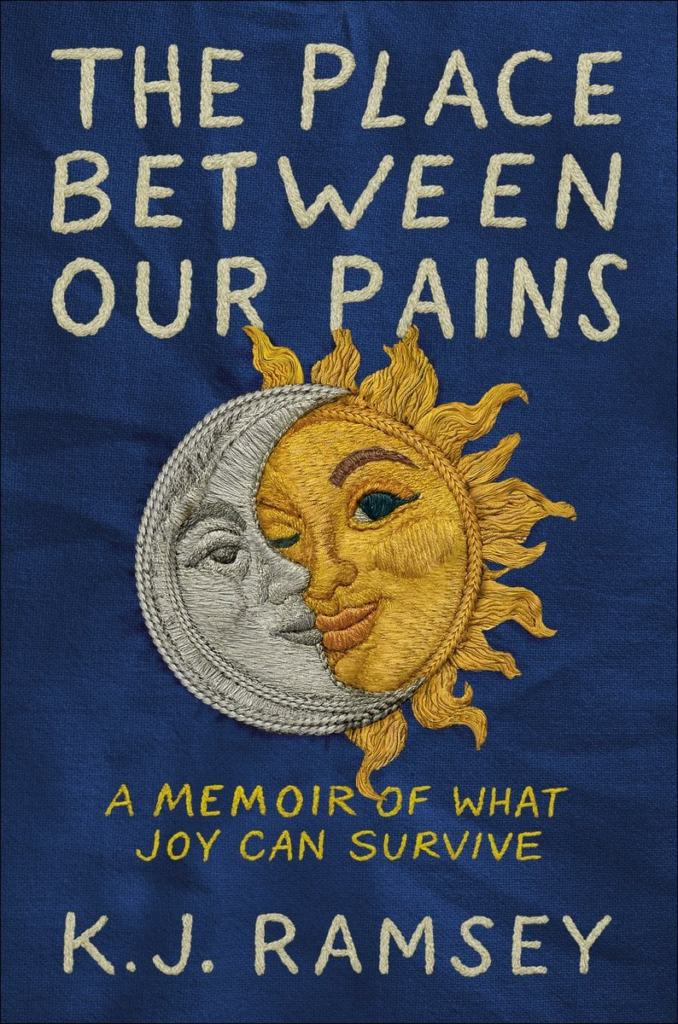 K.J. Ramsey’s The Place Between Our Pains: A Memoir of What Joy Can Survive (Convergent Books; May 2026) was, upon publication, Amazon’s top new release in the category of “Death.”
In her memoir, K.J. Ramsey describes with brutal honesty her experience with chronic illness, medical gaslighting, and trauma during her young adult years. Even though Ramsey has been to hell and back, she has just as much to say about hope as she does suffering. She is “not just fighting disease [but] fighting despair.”
The project of Ramsey’s memoir echoes the sentiment expressed by Susan Sontag in her seminal book Illness as Metaphor: “Everyone who is born holds dual citizenship, in the kingdom of the well and in the kingdom of the sick.” Ramsey begins her book in the kingdom of the well: on a road trip out west with a close friend, she was the healthiest she’d ever been in her adult life. But her state of grace quickly turns.
Before Ramsey became seriously ill, she and her husband were hoping to grow their family by having a baby. Then medical horror rained fire upon their lives. After a year of frequent anaphylaxis and unsure diagnoses — did she have lupus? Ankylosing Spondylitis? Both? — she sought help at the Mayo Clinic. Her body was covered in stretch marks, not from carrying new life but from suddenly gaining over fifty pounds, the brutal side effect of high dose steroids. She had not been given informed consent on the potential consequences of her treatments. The steroids, the ones that would save her life, would also lead to her bones becoming necrotic.
Ramsey is a trauma therapist and the author of two other books about recovering from spiritual abuse. She left the high-control religion of her youth and has spent much of her career assisting others in recovering from abuse in faith spaces. In The Place Between Our Pains, she discusses the sacrifices chronic illness has required of her. Losing her health meant losing her autonomy, as she relied on family members to assist her with mobility and basic, daily tasks like using the bathroom. Ramsey’s life became consumed with medical treatments, and she was forced into pausing her clinical practice. After so many years of giving care to others, she had to learn how to become the recipient of care.
Ramsey curses early and often in her memoir, even providing research regarding the psychological benefits of swearing. This feature contributes to the relatable tone of her narrative. Her prose is both direct and lyrical. In writing about a medical device (a port) that almost killed her, she invokes natural imagery: “We spend decades building careers that can buy us homes of wood and brick and stone, but something smaller than an eyeball can burn the home of our bodies right now.” She utilizes alliteration, telling the reader that fire does not just burn — it can also build. She examines a hollowed out redwood, a decayed space turned domicile, “home to bats and birds and bears.” In this way, she envisions her inflamed body as a space still hospitable to abundant life.
The memoir is sectioned in four parts, each with cinematic vignettes. Part one opens with a road trip. In this section, the reader spends time in the natural world — camping and swimming and hiking — and the place-based prose feels similar to the nature writing of Annie Dillard or the travelogues of Cheryl Strayed. But then, in the latter parts, we descend into the cold and clinical walls of countless hospitals, and her story of illness is reminiscent of Sarah Manguso’s Two Kinds of Decay and Suleika Jaouad’s Between Two Kingdoms.
Ramsey’s perspective becomes most distinct as she interprets her experience of physical fragility and the failures of the medical system through the lens of faith. Not happy-go-lucky, glass half-full faith — but hope-filled, nevertheless. Her narrative is not rooted in toxic positivity but in learning to live in the “thin places,” those liminal spaces where pain and joy coexist, where limits allow for the flourishing of love.
 Anna Rollins is the author of Famished: On Food, Sex, and Growing Up as a Good Girl. Her groundbreaking debut memoir examines the rhyming scripts of diet culture and evangelical purity culture. Her writing has appeared in The New York Times, Slate, Electric Literature, Salon, Joyland, and more, and she has also published scholarly work in composition and writing center studies. An award-winning instructor, Anna taught English in higher education for nearly 15 years and is a 2025 West Virginia Creative Network Literary Arts Fellow. Follow her on Instagram and Substack @annajrollins