
Reviewed by Carolyn Roy-Bornstein

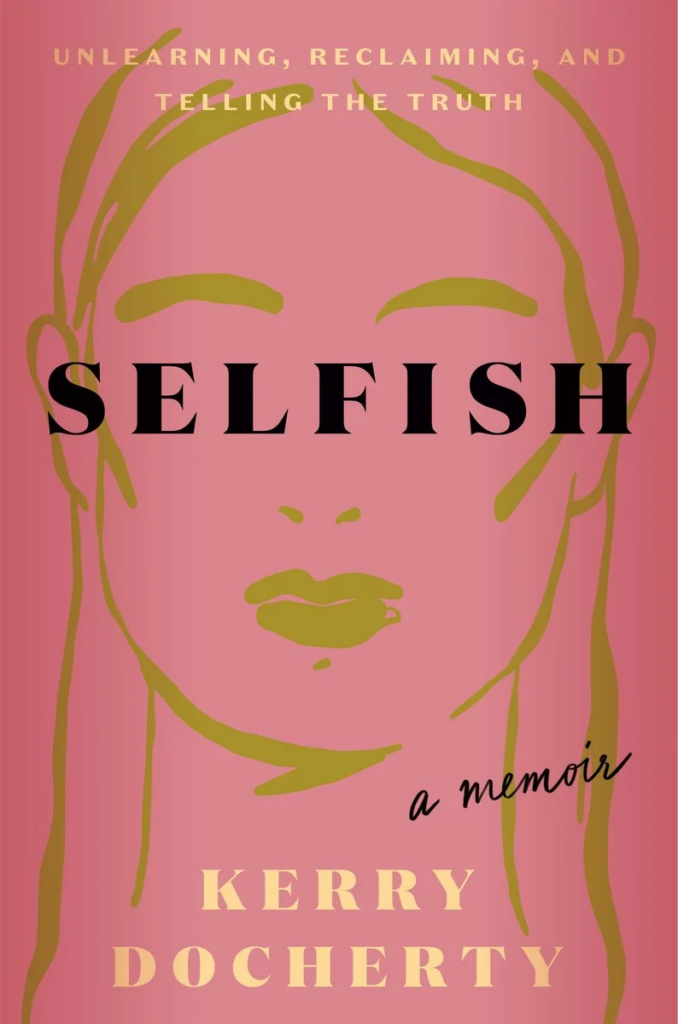 In the introduction to Selfish: Unlearning, Reclaiming, and Telling the Truth by Kerry Docherty (Harmony; April 2026), the author is sitting with her husband Alex on a couch in a therapist’s office. Alex declares that this is not a marriage issue; that they are there to negotiate Kerry’s salary in the family clothing business which also employs her husband, his twin brother, and his mother. Kerry wryly notes, “This was obviously a marriage issue.”
Her husband accuses Docherty of not being fully invested in the family brand. “You just do what you want,” he tells her. When she asks him why he doesn’t do what he wants, he replies, “Because I’m not selfish.”
And there it is. An accusation. A word that is easily used to disparage a woman who goes after her true desires, while a different word might be used to describe such a man —a mbitious maybe, in the best sense of the word. That word introduces one of the threads in this book and asks us to consider what and whom we value and why. What determines a person’s worth? Is there one skill set which is more deserving of reward, praise, and recognition above others? It explores what is worth standing up for and speaking out against.
Another arc involves the Flaherty clothing company, conceived of and founded by Docherty’s husband, his twin brother, and their mother. At the beginning of the book, the company is a fledgling start-up with all the anxieties and fears that venture engenders.
The heftiest theme pushing this narrative forward and pulsing beneath its most important throughline is Docherty’s constant yearning: to make a difference in the world, to tap into her innate creativity, and to be authentic and tell her own truth.
These threads merge and weave throughout the book. Docherty joins the Flaherty business, using her skills as a lawyer in reading contracts and managing human resources. (The first several homes Docherty and her husband occupy as a couple, they share with Alex’s twin brother, and the family persuade her husband that the time is not right to try to get pregnant after their decision is made. This gives readers a sense of the challenges she faces in this particular business environment.) She tries to put her own spin on the brand, focusing on sustainability in their products and inclusivity in their designs. And while these efforts somewhat appease her urge to be a force for good in the world, there is still deep within her a creative itch that isn’t getting scratched, an originative spirit that hasn’t quite found its place.
In memoir, the protagonist must change, learn, and grow. Readers of the genre are looking for this transformational journey from the author. Readers will find that transfiguration here, both in the story Docherty is telling and the words she is using to convey that tale. Her writing at the beginning of the book mirrors the vague, unfulfilled yearning the author feels. She tries to articulate her needs and desires — to her husband and to us, her readers. It is a clumsy longing with an ill-defined object. We see and feel her need to create, but she is still asking herself what that creative project might be. This urge to fashion something meaningful out of the disparate threads of her life ultimately drives her into a relationship that both serves as validation of her creative impulses but threatens to undo everything else she has built. She surrounds herself with poets and songwriters, hoping for inspiration, but fails to realize until it is almost too late that, like Dorothy in The Wizard of Oz who had the power to return home all along, she only needs to believe in herself to be the artist she longs to be.
In making this discovery, Docherty’s own writing becomes bolder, surer. She asserts herself in her marriage and in her business dealings, but also on the page. There is clarity in her writing and a firm belief in herself that directly translates into this unflinching Socratic examination of her life choices. With brave language and hard-won confidence in her own ability to create, she reclaims that loaded word of her title and finally understands, she can be her own muse.
This book will appeal to creatives looking to peel back the curtain on the creative process, to feminists looking for an understanding of what going after a dream can look like, and to anyone wanting a compulsive read by a talented writer.
 Carolyn Roy-Bornstein is a retired pediatrician and the writer-in-residence at a large family medicine residency program. Her work has appeared in The Washington Post, The New York Times, The Boston Globe, JAMA, Poets & Writers, The Writer magazine, and other venues. Her most recent book, A Prescription for Burnout: Restorative Writing forHealthcare Professionals was published with Johns Hopkins University Press in April 2026.