
Reviewed by Linda Lowen

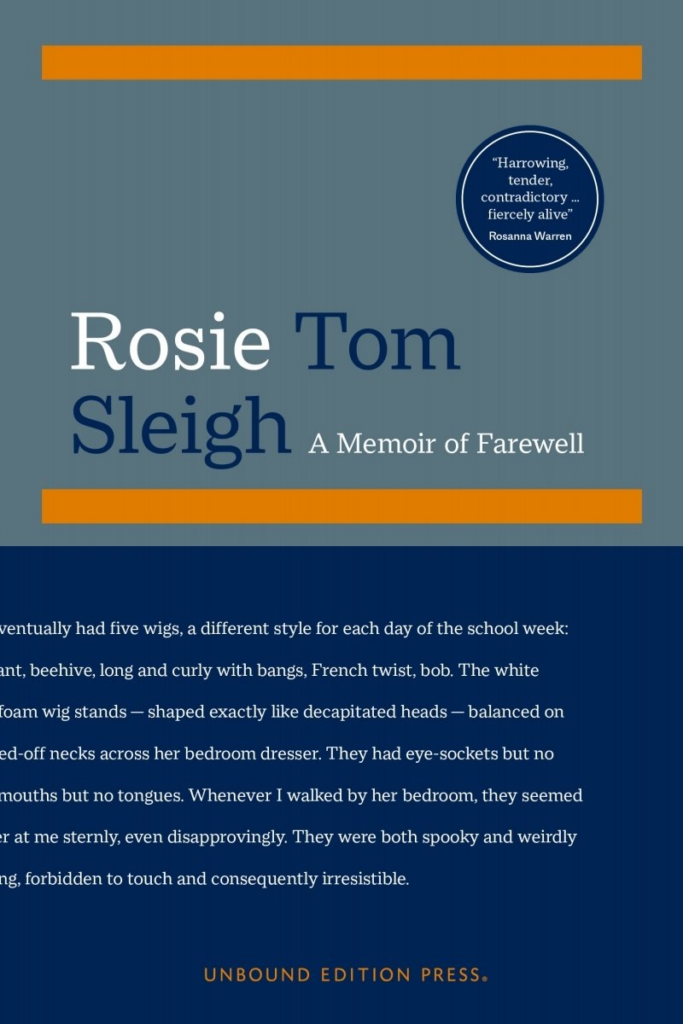
Prior to 1995, any writer who hoped to publish a memoir faced an impenetrable wall built atop the foundational belief that only celebrity stories ‘sell.’ If you weren’t a household name, you were persona non grata to agents and editors—until one extraordinary narrative from an unlikely source toppled that wall.
“Long before jumpstarting the memoir revival in 1995 with The Liar’s Club, [Mary] Karr was a prize-winning poet,” wrote Robert M. Enslin in a publication for Syracuse University, where Karr still teaches. “Writing verse helped her compete for her mother’s attention, while growing up in rough-and-tumble East Texas.”
Thirty-one years later, another poet — who began writing verse for similar reasons — has produced a book of similar merit. Tom Sleigh has earned numerous awards, fellowships, and Guggenheim and National Endowment of the Arts grants. He’s published in the New Yorker, The Atlantic, and Poetry magazines. He’s also an essayist, dramatist and journalist who has reported from Somalia, Libya, Lebanon, Iraq, Syria, and Kenya.
The mother whose attention he craved is the titular figure of Rosie: A Memoir of Farewell (Unbound Press; May 2026). But those expecting a simple mother-son narrative are warned; the memoir lands closer to Kiese Laymon’s Heavy in its knotted complexity. At the forefront is assisted suicide, but other themes — mental health, chronic illness, infidelity, sexual abuse — flicker in the background
Sleigh’s earlier reflections on Rosie have appeared in The Threepenny Review, Plume, Five Points, and The Sonneteer. In an interview with writer Sari Botton, he discussed his lifelong desire to write a book about her: “When she died at 97 by her own hand, I knew that if I didn’t start working on it immediately, then the impulse might pass.” What began as a way to keep her close “was just the opposite…I didn’t feel a sense of resolution… Instead, it felt like I’d lost her a second time.”
That melancholy is evident throughout Rosie. A tight bud of a book that withholds its secrets until almost halfway through the narrative, it begins with a deceased Rosie wheeled out “to a battered Chevy station wagon outfitted as a hearse” by an undertaker after “lying in state under a full length blanket of white dog fur.” About the odd covering, Sleigh explains, “first dog to last, she kept only breeds with white fur.” She’d comb them weekly, collecting the “expanding white cloud” of dog hair for “the Dog Weaver who would card and spin it into thread, and then weave it into my mother’s dog-fur couture—a shawl, a lap robe, and of course the blanket-cum-shroud.”
This isn’t, however, a sweet memory of a quirky woman. Sleigh notes, “The ease that came into my mother’s strained face whenever she stroked her dogs” was not present in family interactions. With her dogs, “her humaneness… flowed back and forth in a communion of consciousness I envied.”
Even with her passing, Sleigh still cannot pin her down, cannot solidify her role in his life: “Given how unpredictable my mother could be, I should have known that not even death could keep our relationship from evolving.” Straightening her room afterwards, he finds two journals of Rosie’s musings from age 84 to the present.
“I was dumbfounded,” he writes. “I thought I knew almost everything about her—and now…I’d found out a secret she’d kept from me for almost twenty years!”
Those journals “felt both spooky and miraculous, like the zombie quality of something living that’s also dead. Writing was our bond. No matter how estranged we became, it always brought us, if not together, as close as we could come.”
Those entries are reproduced in typeset script to differentiate them from Sleigh’s own words. The book is structured as a series of responses to Rosie’s entries. Glancing at the first one (shown below), he is “dismayed that she’d prefaced her first volume with a quote taken from an early poem I’d written. I felt like a Peeping Tom who sees something he wished he hadn’t.”
The Library
Another life, another world since the books
Called me out into a headshaking daze:
- T. Sleigh
Literature … extends our sense of life.
- me.
What do I believe in? I believe in that whose
meaning does not depend on my believing in it
— Change.
- me.
He voices the eeriness of reading her words “as if she were speaking to me — even through me — from beyond the grave.” He admires “the way she asserted her authorship with that emphatic, lower-case me, at pains to distinguish her own thoughts from the extensive quotations she copied out.” The journals “reminded me that she was indeed an English teacher, sniffing out plagiarism and unacknowledged sources wherever they might lurk.“
Beyond the “philosophical musing,” the journals recorded Rosie’s physical decline, a situation which had haunted Sleigh. “Back in 2012 when she was 87 years old and had another decade to live, she called and said, ‘I don’t think I’m going to make it to my next birthday,’” just two months away. She frequently spoke “with a touch of theatrical irony… halfway serious. She often brought up suicide, more as a way of blowing off steam in a kind of game we played.” When she asks, “Can you help me out here, Son? And tell me how I might kill myself?” Sleigh’s response “Of course,” is automatic; he delivers it by rote, “never thinking for one instant that eventually she would do it.”
Ten years later, when she ends her life in 2022, medical aid in dying, “what some internet wit had dubbed the MAD law—was legal in California.” Sleigh’s panic has now transmuted into aching hyperawareness: “An abyss looms between the jauntiness of my mother and me playing at suicide, and her holding, gingerly, the little brown plastic bottle of medical hemlock in her hand—her good hand, that is, not the one crippled by stroke so that it looked like a squirrel’s paw, a paw afflicted by a Parkinson’s tremor.” He describes the nightmarishness of “contacting everyone as if scheduling a birthday party, only it was a death day party, negotiating with one and all ‘what days and times might work for you.’”
The goodwill Sleigh builds in the first thirty pages is banked against the uncomfortableness ahead. Rosie is beyond quirky. What her sons and husband experience edges into abuse. Sleigh’s expository paragraphs and Rosie’s journal entries about her early life illustrate how she broke free from her dirt-poor Kansas upbringing. Her slow realization of the gender divide and her disinclination to be a wife and mother offer some justification for her actions. “I remember the first time I got an inkling of my having any special intelligence. I was 43!” she wrote. “Imagine the vast years of unworthiness I must have experienced…the thing that surprises me the most was my complete lack of resentment or even awareness of this disparity…I believed that men are naturally more important…Despite this perpetration, I was really obsequious to my own children simply because they were boys.”
Rosie is an irresistible literary memoir with a vibrant, easy-to-follow story despite Sleigh leapfrogging chronologically throughout the text. He avoids a common pitfall that sinks many poets (and, more recently, influencers) writing books; though individual scenes and moments may captivate, the structure isn’t there. And no wonder, as the short form of poetry and social media posts isn’t the ideal training ground for a sustained long-form book requiring a narrative through line, tension and stakes, and an inevitable yet irrevocable outcome.
All those necessary elements are present in Rosie. As darker themes emerge, Sleigh’s approach resembles that of Kiese Laymon in writing “Heavy.” In a 2018 interview with The Paris Review, Laymon was blunt: “I’m black and from Mississippi. My people do not play that tell-all-your-business-type stuff. But at the same time, I think there are some things we do need to talk about and reckon with. A reckoning, I think, is different than a tell-all.” For Laymon, “it was important for me to write it all out. All the stuff I’m talking about is in the subtext of the book. In a tell-all, I don’t think there’s much subtext. Everything is just explicit…there’s a ton of subtext in Heavy and I think people will know the emotional registers that I’m trying to play with.” Sleigh is explicit with details but stops short of providing a definitive answer. That is neither a failing nor uncommon, as many adult survivors of childhood trauma will testify.
Respectful, non-judgmental, and poignant, Rosie literally comes alive through the inclusion of family photos, Sleigh’s Rosie poems, and a QR code linking to companion videos by documentary filmmaker Ed Robbins.
Sadly, publishers in today’s diminished memoir market have returned to the viewpoint that non-celebrity stories are risky. As Sleigh told Sari Botton, “the hardest thing was to find the right publisher/editor who would understand the book. Several did understand it, several simply said they didn’t know how to sell it.” Despite the odds, through Sleigh’s careful cultivation, Rosie blooms.
 Linda Lowen is a longtime book reviewer for Publishers Weekly where she also writes feature articles and author Q&As. She’s compiled nonfiction ‘best of’ book roundups for Reader’s Digest, contributed craft articles to The Writer magazine, and she reviews theater in upstate New York. Her creative nonfiction has appeared in various outlets including the Sunday New York Times and the anthology Tiny Love Stories: True Tales of Love in 100 Words or Less (Artisan, 2020).