Reviewed by Sayantani Roy

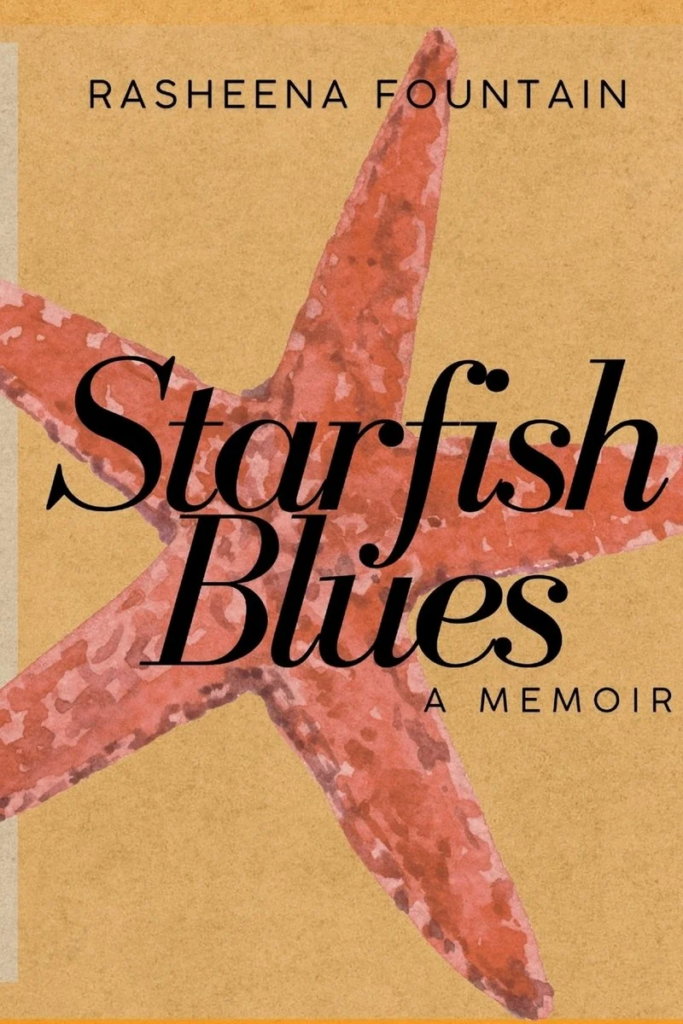
In her memoir, Starfish Blues: A Memoir (Climate Conscious Collabs Press; April 2026), Rasheena Fountain, writer, educator, musician, and environmentalist, speaks from the complex intersection of womanhood, her black and queer existence, and her moving through the world as a proud, single mother. It’s an aspirational book, as she says in her eloquent introduction, through which she wants to exhort kinfolk and skinfolk to explore the world fearlessly. She delves into her roots, the lives of her sharecropper grandparents, who were part of the Great Migration, her feisty mother, who she was warned against emulating, and her lettered and distant father, whose exhortation, “Don’t forget to touch the starfish,” she has carried with her, despite their fraught relationship.
She reckons with a painful past where the demarcation of Black and White lives was drawn in stark lines. In reckoning with the notion of what constitutes home, she talks directly to her ancestors, her daughter, Faith, and even fauna, such as starfish and the cabbage worm, considered a common pest. She talks to the Salish Sea, on whose shores she found another home, and to the blues, which lent structure to her book with its repetitions, improvisations, and AAB structure—laying out the problem (A), reiterating the problem (A), and then constructing a solution or even a non-solution as a movement forward (B).
Interspersed between the chapters are some of her beautiful poems that echo and embody these sentiments and sensibilities. She discovers that freedom may be as complex as bondage and raises the question that if freedom can’t be found in the place one wants to call home, how and where does one seek it? It is a complex book that, at times, seems all-encompassing with its themes of living amid racial injustice, experiencing the pain of a broken home, inveighing against patriarchy and homophobia, redefining personal faith, and acknowledging at once the sacredness and sacrilege of Indigenous lands. But it is never prescriptive or moralistic, and never once does she shy away from telling the truth the way she perceives it. It’s as if she wants to recount her life story to her daughter Faith. She embraces her role as documentarian with this book because, in her own words, “Someone must bear witness.”
The book starts with the chapter, “I’d like to free the idea of Black exploration.” The very idea of a Black explorer was once alien to Fountain just as it is to many who are prejudiced. She begins with a quote from Matthew Henson, a Black explorer, who, along with fellow explorer Robert Peary, was among the first Americans to reach the North Pole, but whose name is not spoken in the same breath. Right underneath Henson’s quote is a photo of Fountain’s Granddad, whom I momentarily mistake for Henson. Fountain, through her skillful storytelling shows us that the true mindset she seeks is an embodiment of Granddad’s explorer nature. He was indeed the first explorer in her eyes, watching David Attenborough shows, gutting fish in the kitchen, and taking her with him to meet his cohort of friends. He knew how to inhabit the world with his beautiful Black values, even though he had fought in the Korean war and unwittingly had become part of American imperialism. He taught her, “Where there’s Black joy and laughter, there’s sacrifice.” Every turn she takes, every anecdote she tells, isn’t mere recounting. Each story is intentional and bears the gravity of history, hope, and accountability. And this accountability is something that anyone, regardless of background, must partake of.
In the first few chapters she lays out the problem for us. She weighs in on her position as an aspiring environmentalist who isn’t entirely welcome in the new place she yearns to call home. But even as she navigates the perils of tokenism, she decides to “write into the complexities of Black history.” She confronts Henson’s role in perpetuating prejudices about the Inuit, with whom he had intimate and friendly relationships. But while she knows Henson’s legacy wasn’t pristine, she admires how he overcame the oppressive sharecropping system and opened Black imagination. “A negro Explorer at the North pole. Can you imagine?” she asks. Later, telling her Granddad’s story, she asks the same question: “Can you imagine? A Negro in Korea?” Her awe is fraught and unadulterated at the same time.
The chapters then take on an epistolary shape as she looks deeper into her past, and addresses first her maternal Grandma, and then her father. We see her Grandma vividly—a calm and devout woman who left Merigold, Mississippi, and migrated to Illinois for better prospects. However, in Fountain’s growing up years, gang violence and drug addiction riddled their Chicago neighborhood, and the house, where Grandma welcomed kith and kin, was watched by the police for drug activity. There were occasions when gunshots rang out and she motioned them to dive down: “Get on the floor.” Fountain asks this Black dreamer if she ever thought of returning to Merigold, in Bolivar County, named after Simon Bolivar, a South American liberator and abolitionist. Did that desire go away, she asks? Did it morph? Repeat like a blues refrain? In asking these questions and striving to construct her own answers, Fountain deftly lays out the complications of existence that race and displacement can bring about.
In her epistle to her father, she reiterates the starfish story and just like a blues refrain, we see this story in a new light, imbued in a new tone. Every year her father sent her the same message in a birthday card: “Touch the starfish.” Masterfully, Fountain adopts the third person perspective to tell us about a little girl who doted on her father and saved photos of him in a memory box, going places, hugging a grizzly, or draping a Burmese python over his neck. This removed perspective helps to put some distance between her father’s story and herself, given their fraught relationship. But in the telling, her father, who in some ways resented Fountain’s way of moving through the world, becomes her true Black explorer. How pithily she acknowledges that he’s an explorer, “not in the way that society has come to idealize and mythologize explorers, but in the way he learned to be free on unfair grounds.” With this realization she moves onto the next section, where she delves deeper into her own history to dissect her own inhibitions and to find joyous liberation by breaking free.
Fountain tackles several interlacing strands with aplomb. Her meandering narrative does justice to her claim that her journey to blues on guitar was not linear. Her riffing on Chicago blues entwines deftly with Black life in Chicago, recognizing both its horror and joy. “You can pluck and stomp on frets — on the constant legacy of enslavement — racism — the slow steady bass line that changes pitch but never dissipates.” The stomping and improvisations manifest in Blackness, in refusal, in resilience, but also as summer block parties, house music, and the lushness in Grandma’s garden. During her stint as DJ Assassin Star, Fountain sees “God in house music,” and then finds herself shaking to reggae riddims. Homophobia and patriarchy mar some of the joy when she starts a lesbian reggae night and is uninvited by the male DJ who tells her spitefully that “…Rastas don’t mess with gay people.” Fountain rhapsodizes on her musical experience in a beautiful poem right after:
“so we allow God here
share our bodies stomp on floors
and reach for house ceilings
as praise to the selecta
queer-mixing our lives”
With every chapter she moves towards the truth of what exploration for Black people is meant to be. She addresses her mother, whose joyful abandon was belittled as “ratchetness.” She invokes Audre Lorde, whose lessons of “un-silencing” she vows to imbibe. She writes another epistle to her childhood neighborhood of Austin, Chicago, where she watched a bullet-ridden black man crying, “I don’t wanna die,” which she interchanges with “I can’t breathe.” For her, Du Bois’s ‘double consciousness’ becomes “this feeling of surveillance and a need to be geared up on threatening ground.” In her revisiting of her ancestors’ story and her life in Austin, stories spiral into each other, and each time a different facet of Black existence is highlighted.
Finally, she admits her disenchantment on the shores of the Salish Sea, where she learns that a big part of white environmentalism is putting forth the erroneous and dangerous tenet that organizations need to get Black people out there in order to make them care about nature. She zeroes in on the real crisis, the unspoken rhetoric that “Black people are not worthy of safe environments.” The real solution for Black liberation, she argues, is in searching for ways so that “Black bodies can exist safely outside,” unpoliced and unconstrained. This urgency “must be bigger than escaping to National parks for temporary joy,” she says. As for reveling in the pristineness of nature, she reminds us that open spaces aren’t necessarily unsullied and that imperialistic atrocities on Indigenous lives occurred under the guise of Manifest Destiny. How sound her logic, how firm her conviction.
Fountain’s writing is expansive and exploratory but never verbose. She writes with intention and insistence and boldly code-switches from time to time. But alongside the conviction of her message, what stays with me most are the vivid images that make her stories come alive. Her joyful Grandma pensively staring into the dark after a hard day’s work. Her Granddad smiling fiercely (all teeth!) in her favorite photo of him that busted any misconceptions about him. Her daughter helping to water the kale on her patio, wondering if the white butterfly they just saw was the same cabbage worm that, for them, had become the mascot of resilience. At once informative, incantatory, and tender, Fountain’s book is one of its kind, and much like her life, it stands at the junction of many possibilities.
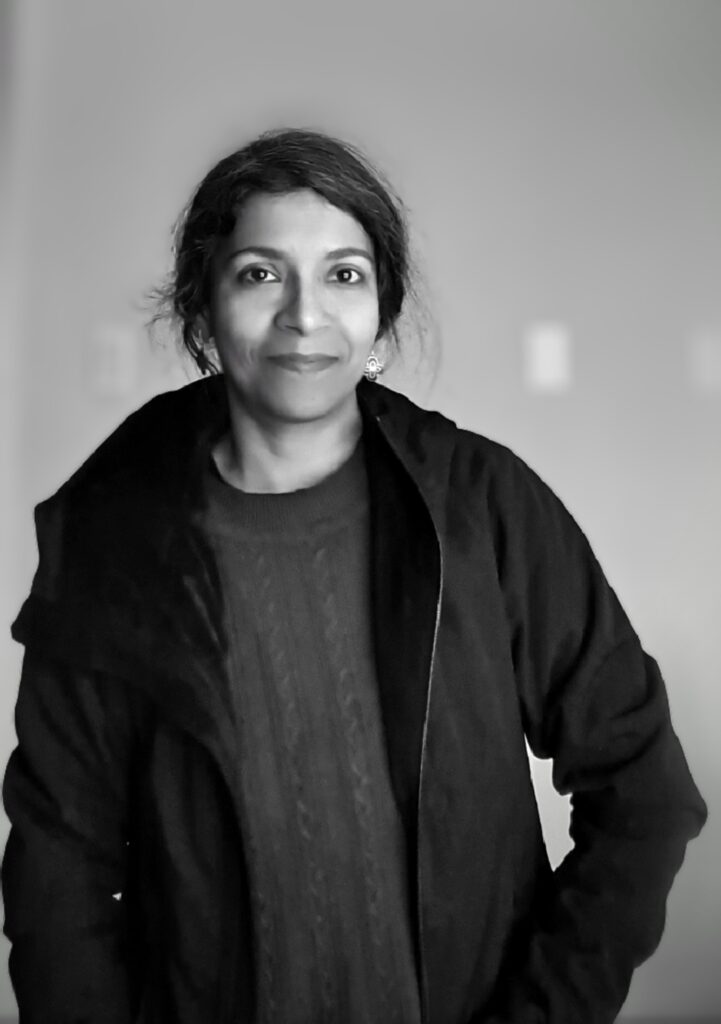 Sayantani Roy works out of the Seattle area and has placed work in Emerge Literary Journal, Heavy Feather, Grist, Mayday, Timber, West Trestle Review, and elsewhere. She is an MFA candidate at the Rainier Writing Workshop, and her work has been supported by AWP and the Jack Straw Cultural Center. See more at: https://linktr.ee/sayantaniroy.