Reviewed by Marissa Gallerani

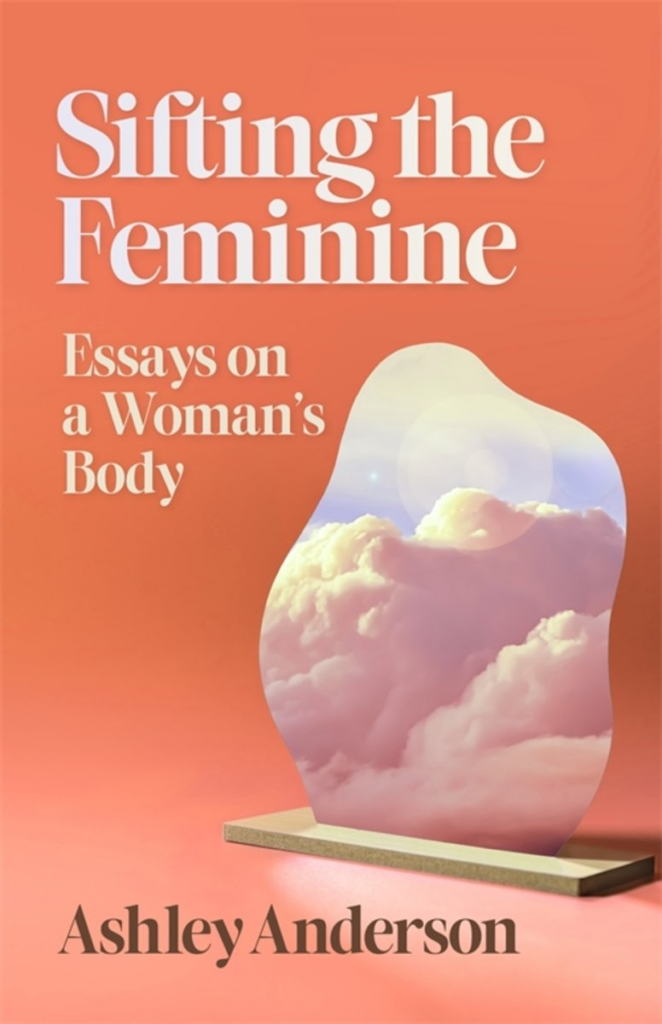
Sifting the Feminine: Essays on a Woman’s Body by Ashley Anderson (University of Georgia Press,;March 2026) is a collection of essays examining Anderson’s relationship to her body and her chronic illness in a post-Roe world.
The book is structured into separate essays that are dedicated to different body parts. Frequent themes include Anderson’s PCOS diagnosis, the impact it has had on her body, her experience as a woman in the world, and what this means for her reproductive rights. (Note: This book was written before the terminology for PCOS changed to PMOS.)
The overturn of Roe v Wade haunts the text, as Anderson notes that women with PCOS are 5 times more likely to have miscarriages, and this casts a pallor over her desire to be a mother: would she be able to access the appropriate reproductive care if she miscarries? It pervades her thinking, especially on dates. “The server stops by,” she writes, “and asks if everything is ok. My date says yes, despite not knowing that I am sitting across the table contemplating having children, where I live, and if the combination of his wants and my realities could kill me.”
As the collection progresses, the essay subjects become more esoteric, and less concretely linked to Anderson’s physical body. While the author does not owe us any information about her body, at times it feels like we’re being kept at an arm’s length, which made it harder for me as a reader to connect with Anderson’s experience. Then again this begs the question: do I need to know the details? Or is that just another way that patriarchy demands women exhibit and expose their bodies? Is the typical framework of stories that we’ve been given wrong all along?
The last essay explores this in particular, with references to Freytag’s Pyramid, the erstwhile diagram that is used in many a writing workshop. Anderson unpacks this and other traditional language structures noting, “The idea that language is patriarchal and women’s experiences are unrepresentable by language systems clicked in my head.” Anderson is trying to develop something new here, a way to encapsulate her experience within the bounds already given.
The unfortunate reality about essay collections is that they can be uneven, and while the overall theme is consistent throughout, some essays are stronger than others. Anderson is working through the implications with us, writing in real time how she envisions the new paradigm in American politics as it applies to her and her life. It is a worthy exercise even if the outcome is a bit disjointed.
The last two essays in particular are standouts. “Field Notes on What Adorn Us: A Case Study,” and the titular essay “Sifting the Feminine Bones,” both play with form combining Anderson’s academic background with creative writing, and the exploration of self becomes more experimental.
The ultimate rallying cry of Sifting the Feminine is that Anderson’s body deserves the same amount of respect as any other body. The disparity of treatment and access to resources is a distinctly feminine experience in America, and Anderson’s individual experience is a microcosm of what American women now experience.
 Marissa Gallerani is a queer and disabled writer and teacher living in Providence, Rhode Island. She received her MFA from The Newport MFA at Salve Regina, and has taught at multiple institutions of higher education including the New England Institute of Technology, Salve Regina University, and Write or Die. She has been published in The Harvard Review Online, the public’s radio, and The Financial Diet, among others. Marissa’s Substack, The Chaotic Reader, details her wide-ranging reading adventures. A life-long SFF fan, Marissa is currently at work on a science fantasy novel.