
Reviewed by Brian Watson

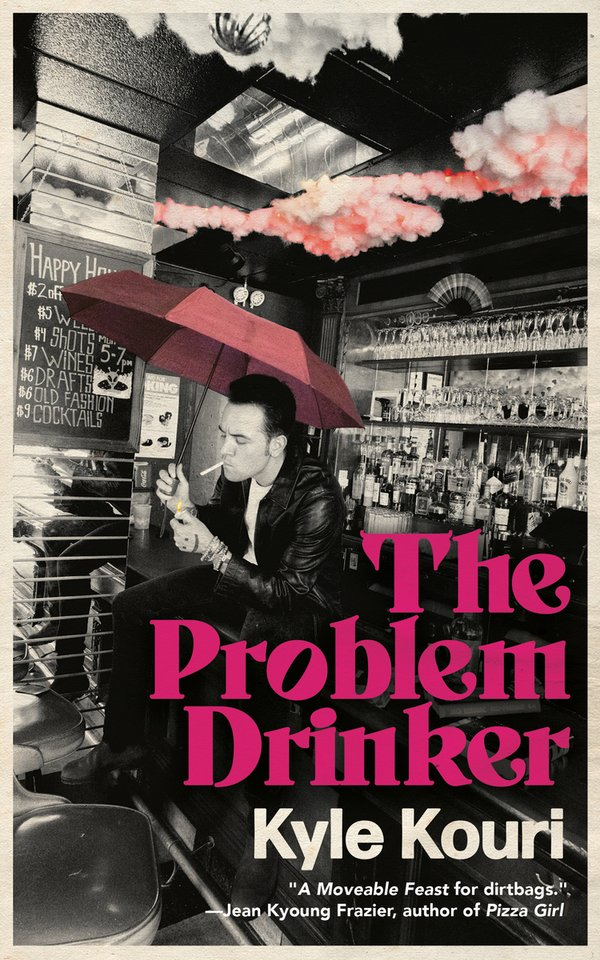 The Problem Drinker (Clash Books; June 2026) took me on one heck of a ride, a ride that ended in a loud burst of uproarious laughter when I found a blurb from Kouri’s girlfriend, CJ Leede, famed author of Maeve Fly, that reads, “Best book I’ve ever read. Author’s super hot.”
Goals.
Kouri’s memoir, as lyrical a narrative as they come, opens with a two-paragraph-long chapter. Kouri has learned that his sister, B, almost died from an alcohol overdose. (The chapter’s title is .6, B’s blood alcohol level at her collapse.) Kouri states, “I make myself a drink. I’m not the one with a problem.” Immediately, my bullshit detector goes off. Am I about to read two hundred pages of oxymoronic denial? Or is this going to be one of those dreadfully boring (to me) recovery memoirs with frequent invocations to a higher power and mentions of AA meetings?
But then the second paragraph arrives: “Sometimes I get so close, I feel like I am you.”
Dammit. Empathy triggered in eleven words.
The Problem Drinker, even absent the alcohol (which, I admit, is an unfair subtraction, even in the hypothetical), is a hard book for other writers to read. The pain of agent rejections and submission rejections is so vivid I imagine some of my colleagues asking for a trigger warning. Kouri depicts that particular trauma so harshly, compounded by the success of his girlfriend’s writing, that I caught myself nodding along, grimacing. It’s knowing that Theodore Roosevelt had it wrong. Comparison isn’t the thief of joy. Comparison shoots joy in the heart and then comes back with another shot to the head for good measure.
Add to that litany of rejections the dysfunction of Kouri’s nuclear family, his grief from his father’s death compounded with grief of a heart-friend, his girlfriend’s brother, and then, near the book’s conclusion, the Palisades Fire tragedy in 2025, and you could be forgiven for assuming that The Problem Drinker is a raft borne along solely on the bleakest of currents.
It isn’t.
Two things save Kouri’s memoir from utter bathos. The first is his ongoing commitment to his own goodness and his joy, as random as they come, as briefly as they remain. Early on in Kouri’s relationship with Leede, she experiences a panic attack in midtown Manhattan, late at night. Kouri sits down with her on the steps of the Saint John the Divine cathedral and holds her, reassures her, talks her through the anxiety.
In the middle of the memoir, a pair of tragedies — Kouri’s sister is near death after the 0.6 blood alcohol overdose and Leede’s cousin Nick, someone Kouri is also particularly close to — pushes Kouri into a period of heavy dependence on his drinking. When Kouri and Leede travel to Copenhagen before needing to fly back to Texas for Nick’s funeral, their grieving habits stand in stark contrast: Kouri leans heavily on whiskey at night; during the day, Leede walks for miles. Because Kouri’s drinking leads him to pass out one night, he misses that Leede experienced another panic attack. “I was out cold and couldn’t do anything about it,” Kouri writes. “Like an asshole.” When, in Texas for the funeral, Kouri asks Leede what she needs, and she asks him to “not get too drunk tonight,” Kouri agrees, “because I would do anything for her.”
I’m not sure whether I gravitated to the beauty of the scene because of the clarity with which Leede describes her isolation when Kouri is passed out after his whiskey or because, problem drinker though Kouri is, he still maintains the love for Leede, the desire to protect her, to rein his drinking in and honor her. After a hundred pages of wondering whether Kouri was indeed that asshole — albeit one I had developed empathy for — I get to see him act on love. Wow.
The second salvation is in Kouri’s writing. When I, someone physiologically prevented from using excessive amounts of alcohol, still wondered, on page 64, what kind of redemptive arc might lie in wait, I read:
“Maybe this project is my reckoning, my intervention with my problem, not a drinking problem, but a problem with taste, with idolizing, with romanticizing something that didn’t pan out. Just like cigarettes and male fantasies.”
Writing as an intervention. Hell, yes.
There are the quirky spellings that the editor at CLASH left intact because, yes, they are an indication of Kouri’s voice: “…every single person is drinking a martini and alone, staring at the bar like anamatons, anamatrons? You know, the robot thing.”
There’s also the chapter titled “The Grief Song,” which begins with a resonating and true observation: “Of all our failures in America this one is perhaps the worst: we don’t know how to grieve.” I have written and continue to write thousands of words on this topic alone, from the lack of true grief leave from our jobs to the crushing inability of parents to foster healthy grieving behaviors in their offspring. Americans are mocked for their empty smiles, but worse than their vapidity, those smiles carry the burden of grief evasion. Kouri went on, a page later, to share a sentiment I can also inhabit: “Because the truth, at least for me, is that experiencing death young didn’t make anything better for me, didn’t make me stronger, it just sucked.”
And then there’s this (secretly, yet if I’m being honest, nearly completely) relatable desire:
“I want my books to be as exclusive as possible, totally esoteric and elitist, only relatable to a privileged few, pissing on the rest of the world and then setting fire to it, laughing while everybody burns and whines about it.”
Near the end, there comes a three-paragraph chapter titled “Philosophy.” The entire second paragraph is Kouri quoting his mother, in response to his concern over how his family appears in his pages. She offers the greatest words any memoirist can hope to hear from a relative.
“Oh I’m not worried about it. It’s your story to tell, Kyle. That’s the nature of writing nonfiction. I have my story, my perspective…. If I don’t like what you wrote, I’ll live with it, and we’ll talk about it. Of course… I haven’t read it yet, ha! But my feeling is, an artist’s job is to create, accept the consequences of their creation, and exist with a certain amount of melancholy.”
No reliance on Anne Lamott’s quip about people behaving better. Just the fact that each of us has our stories. Their publication does incur consequences, does invoke melancholy, but that’s what we sign up for when we write. And if nothing else rings true after reading The Problem Drinker, we must acknowledge melancholy’s power to inspire good writing.
Brian Watson
ReviewerBrian Watson’s essays on queerness and Japan have been published in The Audacity’s Emerging Writer series and TriQuarterly, among other places. An excerpt from Crying in a Foreign Language, their memoir’s manuscript, appeared in Stone Canoe in the September 2025 issue. They were named a finalist in the 2025 Pacific Northwest Writer’s Association’s Unpublished Book contest, and in the 2024 Iron Horse Literary Review long-form essay contest. They also won an honorable mention in the 2024 Writer’s Digest Annual Writing Competition. They share Out of Japan, their Substack newsletter, with more than 600 subscribers. In 2011, their published translation of a Japanese short story, “Midnight Encounters,” by Tei’ichi Hirai, was nominated for a Science Fiction and Translation Fantasy Award.
Brian Watson’s essays on queerness and Japan have been published in The Queer Love Project, The Audacity’s Emerging Writer series, and TriQuarterly, among other places. They were named a fellow for the 2026 Lambda Literary Virtual Writers’ Retreat for Emerging LGBTQ+ Authors and a winner in the 2025 Pacific Northwest Writers Association’s Unpublished Book contest. They share OUT OF JAPAN, their Substack newsletter, with more than 900 followers. Their agent is Alisha West at Corvisiero.