
Interviewed by Rudri Bhatt Patel

 In recent years, I’ve gravitated toward flash. I love the brevity of the form and how so much emotion and depth can be conveyed with the fewest words possible. Scrap: Salvaging a Family (ELJ Editions; Feb. 2026), explores how relationships are impacted by history and generational trauma.
In a series of short episodic vignettes, Castle tries to understand her father’s origin story to help navigate the uncertain terrain of her relationship with him. As the reader works through each flash, different themes emerge: anger, uncertainty, love, grief, and forgiveness.
Castle writes her flash with a poetic tilt and visual mastery. Each vignette could be its own story. What the reader learns and will find relatable is a better understanding of these questions: Where do we come from? And how does that impact and shape our current relationships? The brevity of her prose and universality of her themes will compel you to read this memoir-in-flash in one sitting.
Please join me in a conversation with Luanne Castle.
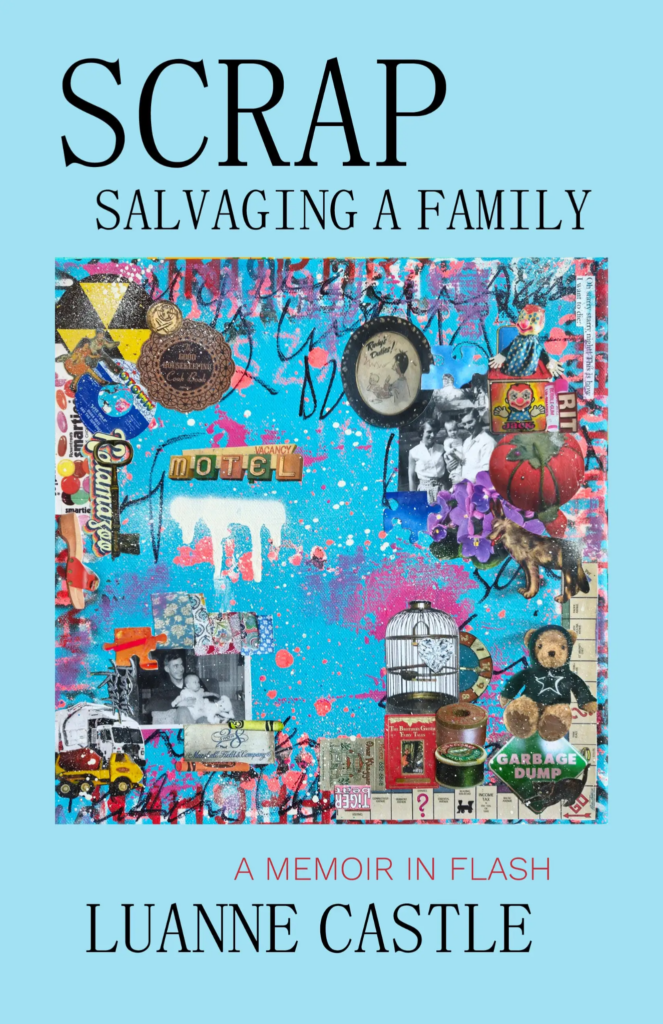
Rudri Bhatt Patel: Scrap: Salvaging a Family has an interesting cover. There are bits and pieces of the vignettes scattered throughout the box. How did you choose the individual scraps to portray on the cover? Were your choices organic or strategic?
Luanne Castle: Because scraps of fabric, metal objects, and memories are part of Scrap, I wanted a cover to represent the idea of putting things together in scrapbook or collage form. The collage art of Toronto-artist Lorette Luzajic was perfect for the project, and I commissioned her to create a 12”x12” collage for Scrap. I jotted down the beginnings of a list of possible images for her and we discussed it. Then she read the manuscript and expanded the list, focusing on objects and images that she found within the story. After the collage was completed, Luzajic designed the book cover.
RBP: The dedication to your memoir-in-essays depicts the following quote: “I believe that what we become depends on what our fathers teach us at odd moments, when they aren’t trying to teach us. We are formed by little scraps of wisdom.” Why did you choose this quote, and were you aware of these words prior to writing the book? Did the quote, in some way, inform the vignettes you chose to depict?
LC: About midway through working on Scrap, I discovered these words in Umberto Eco’s novel Foucault’s Pendulum, and they really resonated with me. I had already decided on the title for my book, so it seemed as if Eco’s passage had been written for me. I wouldn’t say that I consciously wrote to or from the quote, but it was there in the back of my head from then on.
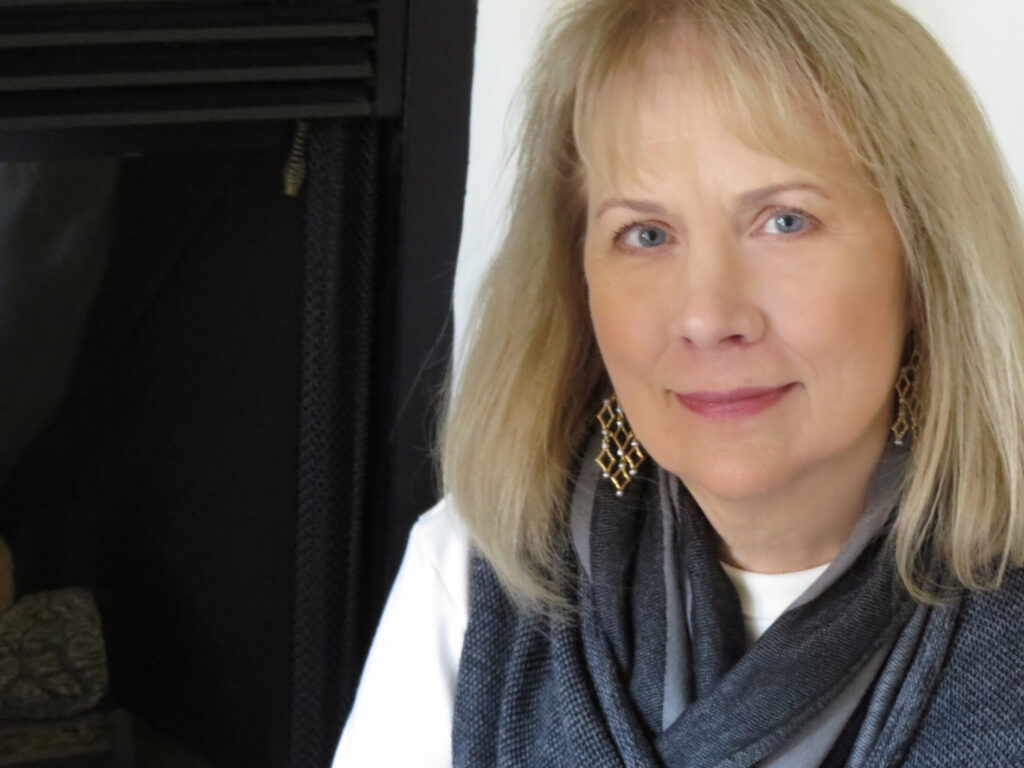
RBP: Scrap opens with the definition of bastard. Throughout your work, you take unconventional approaches in your prose. You bold first sentences; some vignettes are shorter while others are longer. Part I of your memoir is much longer than Parts II and Parts III. Do you feel like the various forms you embrace strengthened the meaning in your narrative? At what point did you decide to make your story an experimental memoir?
LC: I thought of my story for years as a traditionally structured memoir, revising and rewriting over and over again. But chapters never worked for me. I instinctively despised the extra words it took to bind everything together. This isn’t the way memory works. And my story had to cover a lengthy period, truly starting with my father’s father’s youth and leading up to my father’s passing. That’s not how memoir usually functions.
Once I began to write flash and microfiction, I realized that Scrap would benefit from that form. Memory can be defined as memory + reflection. I decided I wanted to make reflection separate from memory, so that meant adding mini essays to micros. At that point, why not add poetry, a play script, my father’s birth certificate? Scraps that, when pieced together, make a whole more authentic than artificial chapters.
RBP: Forgiveness is a complicated theme that you present in your work. As you learned about your father’s backstory, how were you able to navigate your feelings toward understanding him better. Did the writing help you forgive him in real time, or did you have a complete understanding of his perspective before you wrote Scrap?
LC: From the first moment I began to write my memories about my relationship with my father, I was beginning to heal. Every memory written out was a burden released. For me, writing was the best form of therapy, better than therapy visits, although I used the material from those for crafting the middle section of Scrap.
During the time my father was sick and then dying, I jotted down notes and rough drafts of events. But my focus was his daily phone calls and talking him through his illness and our past. It felt as if the barriers between us were melting away, and I just kept my mind open. I didn’t realize I was finally forgiving him until later, after he died.
RBP: Since you’re working with various memories throughout your childhood, adolescence and adult years, how did you decide what to include and exclude? Did you have help arranging the pieces of your flash memoir or did you consult with an editor or publisher when assembling your manuscript?
LC: Because it took me eighteen years from start to publication, I had plenty of time to work on the project until I felt it was the best I could do. I feel very hands-on about it, not wanting anybody else to tinker much with the book. That said, in the first few years I had wonderful feedback from workshop peers and later I had a couple of beta readers who were very helpful. However, this was all done before Scrap was rewritten into the experimental form it now has. The early prep helped me create the last version by making me extremely familiar with every craft aspect of the story. The final run through by other eyes was done by two different writers working through Black Lawrence Press manuscript consultations.
RBP: You mention “obsession” in your final pages in response to your own question, “Why do I keep writing about my father?” Has writing about him in Scrap given you the comfort and permission you need to move to other themes you want to write about?
LC: I do think that by completing something so personal and important to me my mind is freed up for other projects. I have a new book coming out this fall from small press Shanti Arts, Hunting the Cosmos, which is radically different from Scrap. The book is a collection of microfiction and poetry inspired by the art of Spanish-Mexican artist Remedios Varo.
RBP: Please write your own question – a question you wished I asked but didn’t. (I include this in my interviews of authors from time-to-time to give them some freedom to talk about a theme that hasn’t been discussed in other interviews).
LC: You mention how Scrap is experimental in shape with first line bolding and varied lengths. One unusual detail that I worked on at length has not been mentioned by anyone in reviews. This is probably good because if it were mentioned, it might mean that a reader found it disturbing. I am talking about punctuation for dialogue. I use italics or dialogue set off by hyphens rather than quotation marks. I found quotation marks and paragraphing for dialogue to be very jarring and opaque and wanted something more organic and transparent.
RBP: As you were writing your memoir, were you also reading other work? How did your reading and craft knowledge inform your process? Would you recommend that writers read similar work as they’re crafting their manuscript?
LC: Since I worked on Scrap for so long, I read a lot from different genres. However, there were books I found very helpful because they were stories I could relate to—not that they were necessarily similar stories, but I felt some kind of connection. This is an incomplete list:
- Evidence of V by Sheila O’Connor
- The Bill from My Father by Bernard Cooper
- The Liar’s Club by Mary Karr
- Still Life with Rice by Helie Lee
- The Secret Life of Objects by Dawn Raffel
RBP: Writing a memoir about a difficult parent can be daunting, and many may not know how to start. What have you learned from writing Scrap on how you were able to write your truth on the page?
LC: It did help to free up my thinking after my father passed. I’m not going to hold that back. But from the beginning, I tried to write as though he would never read what I wrote. Maybe I tricked myself by thinking I didn’t ever have to publish if I didn’t want to. Once I forgave my father, it was easier because then I had my story arc, as well as a story that readers could find inspirational. After all, many people have one or more difficult parents. It’s possible to take control of one’s life and reactions and end up with a rewarding life anyway.
RBP: Memoirs and personal essay collections are harder to market. What would you tell those who are currently working on memoir about how to move forward with the project despite possible setbacks?
LC: I can only say what worked for me. At some point during writing my memoir, it became clear to me that getting a memoir picked up by an agent and one of the “big five” was as difficult as winning the lottery. I queried one agent I thought might be a good fit. She asked for more pages but then ended up telling me she was quitting and going to write her own book. I didn’t query anybody after that. Once I rewrote Scrap in its final experimental form, I knew looking for an agent would be pointless and began to look for a small press. My book was accepted by ELJ Editions, and I was thrilled.
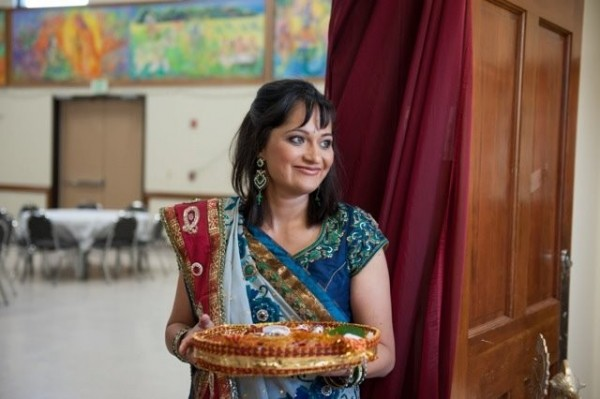 Rudri Bhatt Patel is a former lawyer turned writer, editor, and educator. She is the co-founder and co-editor of the nonprofit literary journal, The Sunlight Press. With more than two decades of editorial experience, Rudri is a freelance writer and teaches classes through Writers.com. Her work appears in numerous outlets, including The Washington Post, Forbes, Business Insider, Saveur, The Lily, Electric Literature, Civil Eats, JSTOR Daily, Eater, and elsewhere.
Great interview!! Can’t wait to read this book.
Congratulations to Luanne on the stellar review! Having read Scrap, I concur wholeheartedly. I also enjoyed Rudri’s in-depth and insightful interview.