Reviewed by Fiona Banham

 When F. Scott Fitzgerald asserted that the highest form of intelligence is having the capacity to hold two contradictory ideas in one’s mind at the same time and still retain the ability to function, he was pondering a specific scenario: that a person might be able to see a situation as being entirely hopeless and yet, at the same time, remain fiercely determined to resolve it.
By all accounts, then—Fitzgerald’s, and most certainly my own—Molly McCloy is nothing short of a genius.
McCloy’s moving memoir, Nine Grudges: The Spiteful Origins of the Happiest Dyke on Earth (Red Hen Press; Sept. 2026), is awash with surprising and stirring contradictions. In essence, this is a story about childhood trauma, persistent emotional and verbal (and occasional physical) abuse, and a dysfunctional upbringing that leaves McCloy and her beloved brothers, Tom and Jake, battling variegated combinations of depression, addiction, and disordered eating several decades into their adult lives.
As the title suggests, the memoir documents nine particularly poignant instances of abuse, meticulously outlining the circumstances surrounding each incident and unpacking the short- and long-term impacts on the children with a quite frankly astounding degree of self-awareness. These heart-wrenching accounts of little Molly being dragged across the floor by her hair, little Molly being fat shamed, little Molly being mocked for expressing her daughterly love in a birthday card, are so vividly depicted that I not only felt the sickening shame of a passive bystander as I read them; I felt as though the assaults were being directly inflicted on me.
I know what you’re thinking, then: this must be an important but heavy book, with so many sombre themes, surely one to avoid during the bleak winter months up ahead (especially over here in Scotland, where those dark nights are so very long). It seems impossible that such a story could simultaneously be outrageously funny, uncompromisingly witty, and utterly entertaining. Given what she has been through, it would have been so easy for McCloy to throw a pity party and invite us all along to perpetuate the “McCloy family curse” of broken hearts and dreams. Instead, she hosts a stand-up comedy night, challenging us to look unabashedly into the eyes of her most harrowing early experiences and find the light that she shone unrelentingly to stop her world from falling apart. No wonder McCloy is renowned for her inspiring workshops on writing about trauma in engaging and creative ways; in this, her memoir is nothing short of a masterclass.
The most nuanced writing of all comes in the form of McCloy’s multifaceted portrayal of her father, “Maddog Mike”, the perpetrator of all this abuse, the source of so much hurt and betrayal. After learning what little Molly had to endure, I was desperate to hate him, to put him into a neat little box labelled “antagonist” or “villain”. But McCloy never quite allows us to, never quite lets us forget the fact that her formerly abusive father isn’t a monster in man’s clothing; he’s just a human, grappling with his own specific breed of brokenness, as we all do. She is keen to emphasise—and rightly so—that his own traumatic childhood did not excuse his behaviour towards his own children (the narrative that her loving but fearful mother had historically peddled to justify the abuse).
McCloy has also come to accept that not even 7,965 apologies – or “anti-grudges” – would be enough to reverse all the lasting damage he caused to her self-esteem, to make her father into the “Good Dad” he failed to be when she needed him at 7, at 13, at 21, as she navigated her rapidly-evolving sense of self. And yet, at the same time, an earnest, wholehearted apology could prove enough to bring to life the possibility that “Good Dad” could exist in the present and in the future, despite his inescapable and undeniable fallibility.
The final moments of the memoir, and everything that follows, could not be a more perfect manifestation of the old adage, ‘nothing ventured, nothing gained’. McCloy is 22, living away from home and seeing her dad only at Christmas, from a safe yet stilted emotional distance. After a harrowing nightmare in which her dad, under interrogation, reaches out to her and implores her to help him, she decides to write him a letter, and then another. In doing so, McCloy puts herself through each of the traumatic experiences that resulted in the nine grudges once again, forcing herself to re-live them, to embody them fully. Herein lies another stroke of genius: the book’s structure mirrors the letter she wrote to her dad, so that we, too, replay the depths of her pain as she pours the nine grudges out of herself in ink. She is very clear that she let go of all expectations for the letter, that she wrote it as much for herself as for him. His response, and the nature of it, are more than she ever bargained for.
Indeed, much as she wanted to share her story, McCloy admits that part of her motivation for writing more expansively about the nine grudges was as a therapeutic exercise for herself. Writing with such raw honesty and vulnerability is an incredible act of bravery, letting the world see her in the moments she felt at her very weakest, when she felt the least proud of herself and her family. In taking such a risk, McCloy opens up an unparallelled sense of connection to us as the reader, making us feel as though we’re chatting with a friend we’ve known for years.
Readers may not necessarily have grown up with abusive fathers, but perhaps we have someone in our lives who loves us and yet struggles to use words to express that. Perhaps we have loved someone as fiercely as McCloy loved Elle—the first woman she fell in love with—and yet haven’t found the courage to tell them how we feel. This book speaks to the very heart of the human experience, in the form of our relationships with those we love.
That’s why I believe we all have so much to gain from witnessing the power of forgiveness written in a warm smile shared between a flawed father and his beloved daughter-in-law, seen through the eyes of a woman whose immense courage—combined with a rigid determination not to take herself too seriously—have, against all the odds, made her into the very best version of herself: that is, the Happiest Dyke on Earth.
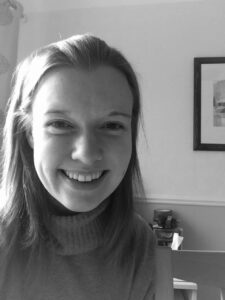 Fiona Banham is a writer, editor, and teacher living in Scotland. She has an MLitt in environmental history from the University of St Andrews. She is an adjudicator for the international flash fiction competition NYC Midnight, and writes for the music and culture journal KLOF Mag. She is currently working on her first novel – a sapphic historical fiction – surrounded by tea and cats.