

At forty below zero, machines mostly don’t matter. Metal turns stubborn, oil thickens, batteries surrender. Anything that runs usually does so because someone planned a day ahead, plugging in heaters and hoping the cold didn’t win anyway.
We walked.
It was my second winter in Unalakleet. I had first come at sixteen to help a missionary family, expecting to stay a month. When a family emergency took them away, that month stretched into a winter largely on my own. I stayed through the summer, went home briefly that fall, then returned to the village on my seventeenth birthday. This time, I had chosen to come back. I believed I was supposed to be there, that there was still something I could offer. I hadn’t expected to find myself alone again. As winter settled in, so did the old loneliness, along with the first quiet doubts about whether I had made the right choice.
By then, I had convinced myself I understood what survival there required. I had endured enough cold, enough isolation, and enough quiet fear that I no longer startled easily. Nothing, I believed, could surprise me anymore.
That morning, I stepped into the kitchen and stopped. Luther, an Alaska Native, was already there, sitting at the table as if he had always belonged in the room. I hadn’t talked to anyone in days, and seeing him there brought a small rush of relief. A year earlier, I had found him in this same kitchen when I was struggling to keep the house warm. He had taken me out that day and shown me how to find firewood.
He didn’t knock. People didn’t, not if they knew you. He nodded once.
“You want to go fishing?”
He didn’t say ice fishing. In winter there was no other kind.
We had fished together before, farther upriver for trout. This time, he led me the other way, toward the ocean. Where the Unalakleet River met the Bering Sea lay less than a mile from the house, a broad, exposed stretch of ice that belonged more to the ocean than the land. That was where people went for smelt and tomcod when the cold settled in.
Outside, the air hit like something solid. Each breath caught halfway down, sharp and unfinished, as if my lungs had forgotten how to work in weather like this. Snow squeaked under our boots, a dry, brittle sound, more like Styrofoam than anything soft. We moved without speaking, the village shrinking behind us as the white opened wide ahead. I was glad to be doing something. I hadn’t had fresh food in months, and I wanted badly to come back with fish.
At the shoreline, the land flattened into a wind-scoured expanse of sea ice. The ice wasn’t smooth or glassy. It had broken and shoved against itself, leaving rough ridges and heaps of jagged ice across the surface.
Bundled in a snow suit, goggles, face mask, and gloves, I moved awkwardly, careful not to expose any skin. I could feel each breath through the mask. Moisture gathered on the outside and froze, and even behind the goggles, condensation collected at the corners of my eyes until ice formed on my eyelashes.
We weren’t alone. Figures stood scattered across the ice, each beside a small dark opening cut through to the water below. No one spoke. By then, the quiet felt normal to me. So much in the village seemed to pass without needing to be said, and in winter, that familiar quiet settled even deeper. At that temperature, conversation meant exposing skin, wasting heat, admitting weakness to the cold. Everyone moved quietly, efficiently, as if language itself might freeze if used too freely.
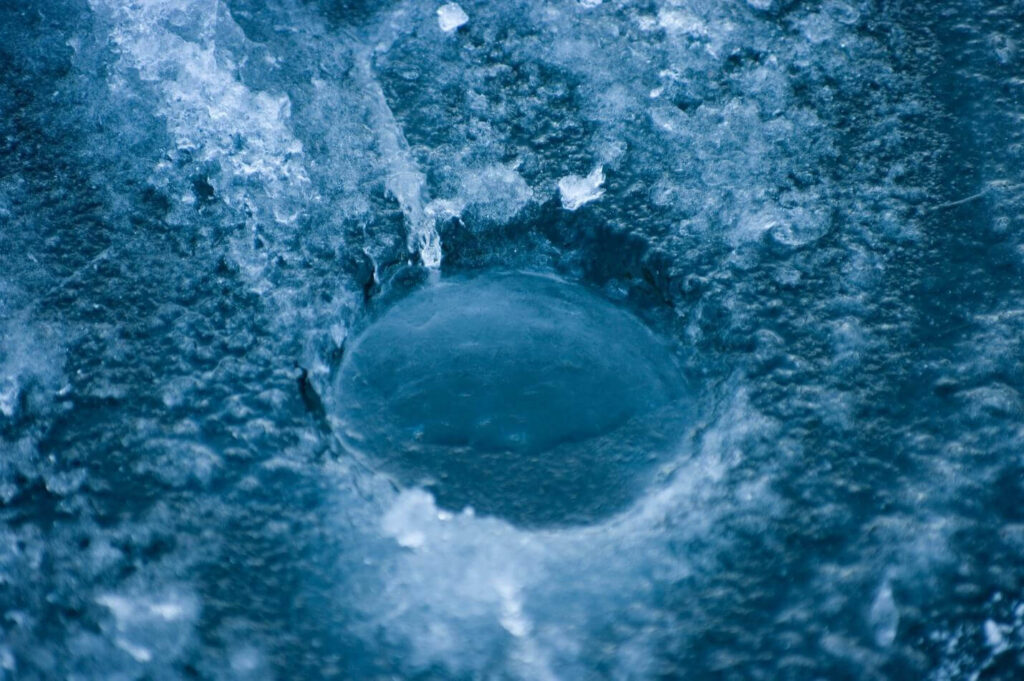
This was a common spot. The ice was thick, at least three feet, but the holes never stayed open. Left alone, they sealed themselves shut again within minutes, the surface knitting back together as if the ocean were trying to erase the intrusion.
He led me to one of the partially frozen openings. A cloudy skin had already formed over it.
From his pack he pulled a small hatchet and struck the surface. Each blow rang sharp and metallic, echoing across the empty expanse. The brittle layer shattered, revealing black saltwater beneath. Slushy fragments floated upward, already trying to freeze again.
He cleared the loose ice away with the head of the hatchet and the side of his boot, never exposing skin. At that temperature, even a few seconds barehanded could cost you.
By the time the hole was open, a new film had begun forming.
This would be constant. Break it open. Fish quickly. Repeat.
From his bag he pulled two short sticks no longer than my forearm, each already wrapped with line, hook tied, ready to use. There was no tying of knots, no threading the line, no fine adjustments. Nothing that required bare fingers. Everything had been prepared beforehand because it had to be.
He handed one to me without explanation.
I lowered the line into the dark water.
The first tug startled me. I jerked upward, and a small silver fish burst from the hole, twisting violently. It struck the ice with soft wet slaps, body bending frantically — then stopped. Completely. Frozen mid-motion, mouth open, eyes bright and fixed.
“Smelt,” he said. Or maybe “tomcod.”
Soon more lay scattered around us, each one locked into its final pose within seconds of touching the air. Around us, other fishermen worked the same way, silent figures bent over their holes, pulling life from the ocean and watching it turn instantly still.
We dropped the frozen fish into an old plastic grocery bag, the kind reused until it finally tore. Nothing out here was single-use. Everything had another purpose waiting.
The hole kept trying to close. Every few minutes, we shattered the forming ice again, pushing slush aside with our boots and tools, reopening the dark water beneath. It felt less like fishing and more like holding a door open against something determined to shut it.
My fingers ached even inside my gloves, a deep warning pain that pulsed with each movement. But the bag was growing heavier, and that was what mattered.
Back at the house, he emptied the bag into the sink and turned on the water. The fish rattled against the metal basin, stiff bodies knocking together like pieces of wood.
Then one of them moved.
A faint twitch. Another flicked its tail. Within seconds, several were writhing slowly, mouths opening and closing as if waking from sleep.
“They’re alive,” I said.
He didn’t look surprised. “Yeah.”
No explanation. No emphasis. Just confirmation.
I watched them struggle in the cloudy water, trying to reconcile what I was seeing with everything I thought I knew. Frozen meant dead. That was a rule. But here, the rules didn’t hold.
When it was time to cook them, he didn’t clean them the way I expected. He rinsed them off; that was all. They were too small to bother gutting, not worth the time.
The fish hit the pan whole. Skin blistered and tightened, turning opaque as heat replaced cold. As he flipped them, the skin split and curled back.
That was when I saw the worms.
Thin pale coils threaded through the flesh, revealed as the meat separated. Some were embedded deep, others loose, unmistakable once noticed.
My stomach tightened. All that work, wasted. Our meal was ruined. Another day without fresh food.
“Is that… worms?” I asked.
He glanced at the pan, unconcerned. “Yeah.”
He kept cooking.
“You don’t throw them out?”
He shook his head slightly. “Just eat around them.”
Eat around them.
No apology. No explanation. Just a practical solution to something that barely registered as a problem.
By then, I thought I understood what life in the Alaska bush could ask of me. I believed I had seen enough to stop being shocked. But standing there watching those fish cook, I realized how much of my confidence had been built on surviving situations that still operated within familiar boundaries.
This wasn’t one of them.
When we finally sat down to eat, hunger overruled hesitation. The meat was hot, soft, richer than anything that came from a box or a can. I found myself adjusting automatically, navigating around what I had seen without speaking about it. He ate without looking down, without caution, without hesitation.
For him, this wasn’t compromise. It was simply food.
I thought about what it had taken to put that meal on the table: the brutal cold, the long walk, the constant fight to keep the hole open, the unsettling discoveries. Back home, I would have rejected it without thinking. Here, rejection wasn’t part of the equation.
Warmth spread slowly through my chest as I ate, pushing back the cold that had settled deep inside me. With it came a quieter realization: how many layers of comfort I had once assumed were permanent, how easily those layers had peeled away.
Survival didn’t arrive clean. It didn’t care about preference or disgust or expectation. It offered what it offered and left the rest up to you.
I still had more to learn. Not about fishing, not even about Alaska, but about how little control I really had over what would be asked of me next.
When we finished, he stood, nodded once, and left as quietly as he had come.
Outside, the cold waited, unchanged, patient, and absolute.
I watched him walk away until the white swallowed him completely, thinking about the frozen fish that had come back to life in the sink, about the worms I had learned to ignore, about how quickly confidence could dissolve when confronted with something truly unfamiliar.
I wasn’t unbreakable. I wasn’t finished becoming who that place required me to be.
I was just a kid who had been cold and hungry and certain he had seen it all, and who had discovered, once again, that he hadn’t.
But that day, I had been fed. I had been shown a way through.
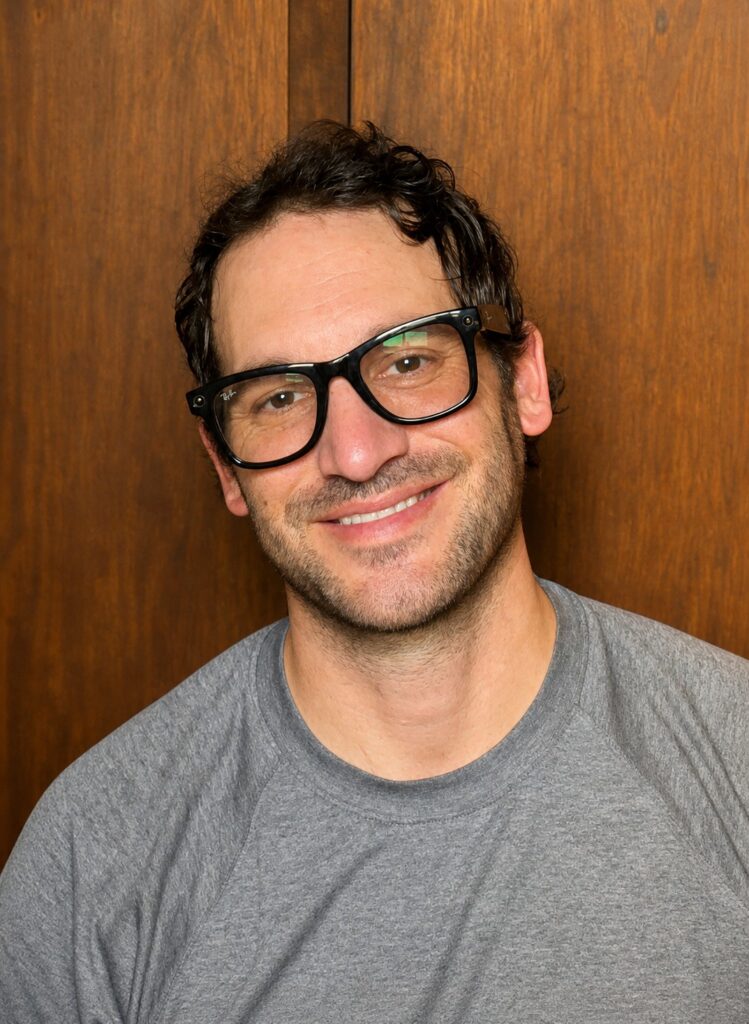 David Shepard is a writer living in the Pacific Northwest. At sixteen, he left California for a remote village on Alaska’s Bering Sea coast, an experience that continues to shape much of his creative nonfiction. His essay “Eat Around the Worms” marks his first publication. Shepard has also served in the United States Marine Corps and works in the electrical construction industry. He is currently revising a memoir and writing essays about Alaska, belonging, survival, and home.
IMAGE CREDIT: Marcus Ramberg via Flickr Creative Commons
I love your piece, and I’m writing as one who caught that Alaska bug. I cycled across on 2 solo trips with my tent and sleeping bag. I ended up in Haines, and I stayed with a woman who traded massage for fresh fish. Nightly, we cooked them on a campfire, eating with the fishermen and members of the Tlingit community. When I tried to explain Alaska, all I could say is that everywhere else I’ve been in the world people essentially had the same jobs. Different language, but they worked in sales or banks or farms. Where I was, it wasn’t like that. Main Street had little you could buy. You really captured the sensibility of the residents, a wondrous and completely alien world view. I bartered in a pawn shop where Inuits brought in mammoth Ivory and Bolo balls and very old hand carved bone harpoons. I helped the owner and got paid in items like these. My other job was to walk the goat and secure her in her stall at the end of the day and make sure that the grizzly bear that had been hanging around didn’t get her. Thank you for your splendid recreation of life in Alaska.
Thank you so much for reading! Alaska is a untamed wilderness and your experience sounds amazing, we should swap stories.
Great story. The title is perfect!
Thank you!
Love this: “I wasn’t finished becoming who that place required me to be.”
Thank you!
This is stunning. You had me standing beside you on that ice, feeling the cold, watching those fish freeze—and then watching them come back to life.
But it was “Eat around them” that stopped me. Such a simple sentence, and suddenly this becomes about so much more than fish or hunger or survival. It becomes a lesson in what life offers us, what we once thought we could never tolerate, and the ways we learn to make our way through anyway.
And then: “I had been fed. I had been shown a way through.”
Beautifully restrained. Beautifully told. I won’t forget this one.
Thank you so much for your kind comments. The things that you mentioned made me feel that you truly understand what I’m trying to express. -David
Four CNF pieces sit above yours in this issue. Yours was the one that drew me past the first paragraph. Why? Because you have a story to tell and you are not trying to show off, stylistically. Of course you also have some lived experience that is unfamiliar to most of us. If I could offer one suggestion: I would think about, in future pieces, is—am I explaining what I have just shown? Can I give the reader more credit—to gather the meaning from the actions I’ve depicted. Good luck in your future endeavors.
Eric Tosky
Eric,
Thank you for taking the time to read my piece. I appreciate your feedback and I agree, I will continue trying to put more trust in my readers going forward.
Excellent writing, I could feel and see through your eyes. Great job opening up. You are extremely talented.
Thank you!
David,
What an amazing story!!!! All we can say is keep writing we want to know more !!!
Michelle and Angel
Thank you guys, I really apricate the support.
Thank you guys, I really appreciate the support.
Hi David!! What an amazing story! I realize how little I even know about my incredible Grandson. Proud Grandpa
Thank you,Grandpa. You melt my heart.