
Reviewed by Nan J. Bauer

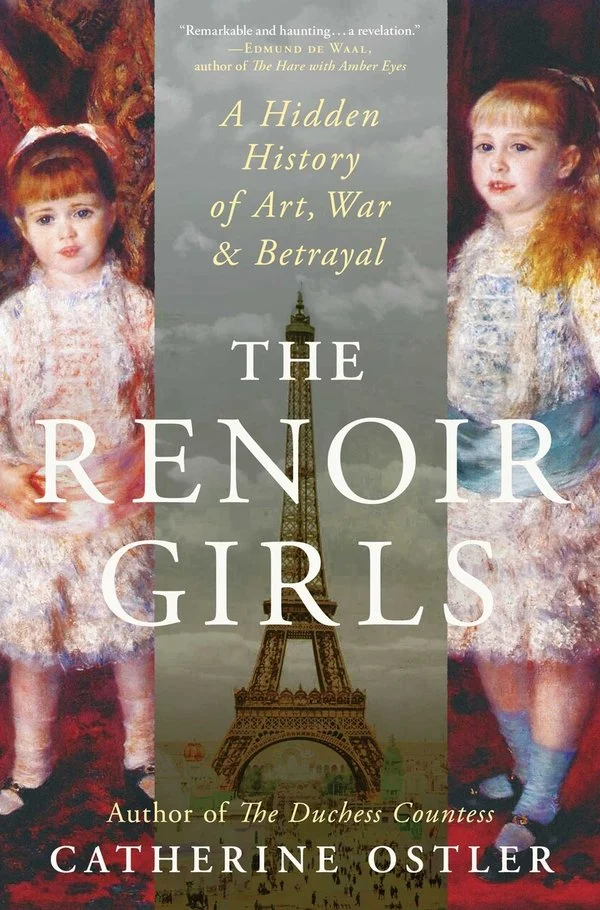 One wears blue, the other pink. They stand side by side as they have for more than a hundred years — initially in Paris; today, after a century-long world tour, in Sao Paolo.
They are The Misses Cahen d’Anvers, Alice in pink, Elisabeth in blue, and they are the subjects of “the most beloved picture in this modernist museum,” according to Catherine Ostler in her new book The Renoir Girls: A Hidden History of Art, War, and Betrayal (Atria Books; July 2026).
The painting “takes us by the hand and leads us into that gilded life, when flourishing, flamboyant Paris was the heart of the civilized world.”
But Ostler is not just breathlessly chronicling the luxe frippery of the Belle Epoque, where life for the rich was “not only adequate, but positively sumptuous.” A world where lovers have secret meetings in the hothouses of botanical gardens, where supper tables are “decorated with diamonds and piles and piles of macaroons.” What initially captured the author’s attention was learning of the fate of Elisabeth, who would die in Auschwitz six decades after Renoir painted her portrait, along with relatives, friends, and over a million more.
The Cahen d’Anvers family, “a Jewish banking dynasty,” includes another Renoir subject: Irène, older sister to Alice and Elisabeth. The post-Revolution, post-Napoleon French political landscape in which they live is a confusing one, with monarchists and Bonapartists in heated matches against staunch anti-monarchists—referred to, somewhat ironically for current US citizens, as Republicans. It shocked me to see the importance of titles in the Cahen d’Anvers circle. Despite the revolution, there are counts, barons, marquises—a massive contingent that I found impossible to keep straight, particularly as Ostler provides exhaustive guest lists for the family’s endless fabulous parties.
It’s a relief when she takes a break from the inventory and paints her own pictures, as when she describes the northern beach Trouville “with its stripy tents, cabins, and fluttering flags…Through the day the sea changes: green, yellow…marked with white horses…or calm, with sails shining like seagulls’ wings.”
The endless rounds of banquets and boating parties and what people wore and who they slept with brought to mind the court of Louis XVI and Marie Antoinette — not just the extravagance, but the unawareness of how fragile the existence is. Are the Cahen d’Anvers and their circles ignoring the virulent antisemitism that is increasingly overt, or are they truly oblivious?
Ostler weaves their narrative with the story of Captain Dreyfus, a Jewish captain falsely accused of spying for Germany; he would be sentenced on false charges to the notorious Devil’s Island prison off the coast of French Guiana, purely on the basis of his Jewishness.
Achieving a pardon — thanks in no small part to the heroic efforts of the writer Emile Zola — took years. Meanwhile, the journalist Edouard Drumont, who’d written a wildly successful pamphlet La France juive — “a pent-up dam of hatred” — began his toxic journal, La Libre Parole, which regularly featured racist diatribes and would peak at 300,000 subscribers. By contrast, the left-wing L’Aurore reached about half that many.
Yet the Cahen d’Anvers continue to cruise aimlessly on their yachts as antisemitism slashes and burns its way through France. There’s a brief period of respite from the divisions when WWI begins, when the French unite to push back the threat of Germany. Unfortunately, that alliance can’t withstand the rise of Hitler, and of the appeasing government under Petain, which delivered Jews to the Nazis — including Elisabeth, the girl in blue, and her nieces and nephews who would also die in the camps.
“This book…is necessarily impressionistic,” writes Ostler. The details are thick and numerous as brushstrokes, and even when I stepped back, I still wasn’t quite sure where Ostler wanted me to look. Was it at the mystery of Alice’s father, a question she continually noodles over and eventually resolves? What happened to Renoir, the painter, who pops in only occasionally to either make a racist remarks about Jews or to accept yet another commission from them? Why did the Cahen d’Anvers proudly display the portrait of Irène in their salon but keep the pink and blue picture in the servants’ quarters?
And while I finished the book with, appropriately, impressions of Alice, Elisabeth, Irène and their mother Louise, I wanted more — especially in the cheeky voice that Ostler occasionally allows to emerge, as when she writes of a socialite fallen on hard times, “What a contrast to her former mink-and-martini Manhattan life,” or when she includes a random footnote about the “Unlucky Mummy” alleged to have sunk with the Titanic (!).
But that is not to deny the significant accomplishment of this enthusiastic, encyclopedic record of three sisters and their fates. It’s a reminder of how easily all forms of hatred rise — and how easily any of us can be blinded by glitter. At least, in their portrait, they are smiling and unaware of the future forever.
 Nan Bauer is a writer currently based in Southeast Michigan, and is completing a memoir on life on the front lines of AIDS during the late 80s in New York and Key West. Her writing has appeared in The New York Times and here at Hippocampus Magazine; her Substack,Oh Yes I Did, is updated weekly. Check out her Look of the Week and Book of the Week reels: @nanjbauer.