Reviewed by Brian Watson

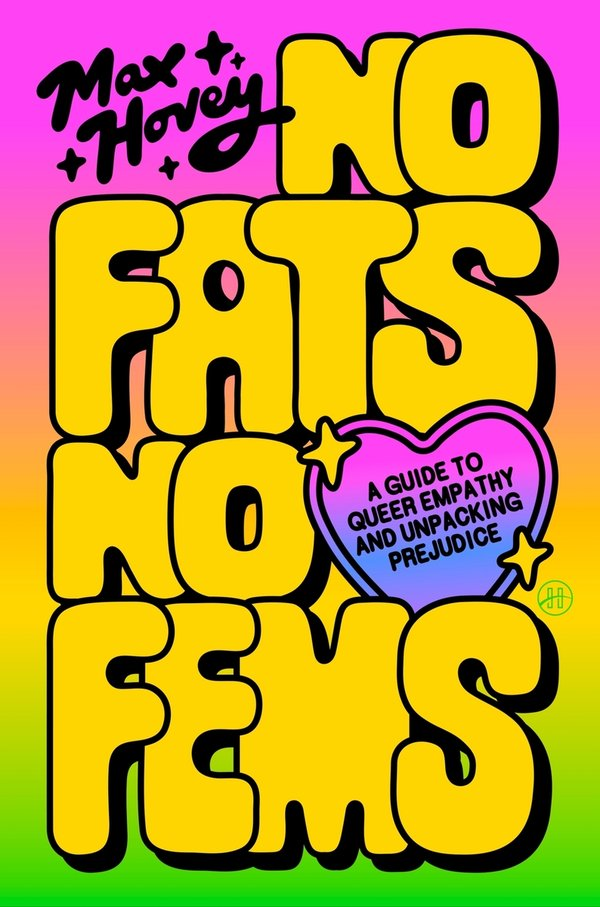 Rarely am I aware of an author when I select a work to review (although my hand is hopefully first in the air for new work from old favorites like Alexander Chee and Melissa Febos). It’s the title that grabs me. No Fats, No Fems: A Guide to Queer Empathy and Unpacking Prejudice (HarperOne; May 2026) by Max Hovey, is one such title.
Let me begin with some comings-out that will help to explain why I was eager to read this collection of essays.
I am fat. I have only ever been the average weight for my age and height at birth, when the scales read seven pounds, ten ounces. Shortly thereafter, a constellation of reasons added to my growing circumference. I have dieted on and off over the years, but as Harvey Fierstein’s drag persona Virginia Ham sings in Torch Song Trilogy, “the poundage returned to the scene of the crime.” I am—ironically? No, gratefully?—what is referred to as “miraculously fat” in Japanese, in that I have no metabolic disorders and, equally miraculously, no sleep apnea, so I don’t qualify for GLP-1 medications either, a fact that reinforced my acceptance love of my zaftig dimensions.
I am femme (and I won’t butch it up by abbreviating the feminine ending). Photos of my childhood make it clear I have always been given to contrapposto poses and limp wrists. When speaking both English and Japanese, I do so with the accent, the noticeable intonations and feminizations that beam forth to ping on international gaydars the world ‘round. I paint my nails and wear jewelry, never listening to Coco Chanel’s advice to take off a piece (because no one should listen to Nazi collaborators like Coco).
And I am queer with a capital Q.
Hovey’s book spelled out for me, anew, all the reasons why I embrace a queer (and genderqueer) identity. Hovey and the amazing people he interviewed for No Fats, No Fems have highlighted so much of what can be wrong within the (white, male, North American and British) gay mindset. The misogyny. The racism. The obsessions with youth, with performative masculinity. The fatphobia and the internalized homophobia and, hence, the transphobia.
In chapter after chapter, Hovey leads with his best skill as a writer: his humility. I think that any queer person can wax eloquent on how patriarchal, colonialist, and capitalist mindsets have birthed prejudices and biases and phobias. What Hovey excels at is acknowledging that he might not be the best person to speak to those issues (for example, women can surely speak with more authority on misogyny). He therefore weaves quotes from his many interviewees that bolster his theses with facts from other lived experiences.
Readers are introduced to a chorus of queer voices from the United Kingdom. We meet other content creators like Shell Rowe, Char Ellese, and Ryan Lanji. There are authors, consultants, and journalists like Shiv, Maxine Heron, Andrew Gurza, and Charlie Craggs; queer charity workers like Asad Zafar, Ignacio Labayen de Inza, and Dani St. James; drag performers and artists like Danny Beard, Le Fil, Romone, Beth McCarthy, Tyreece, Uzo Emenike, and Daisy Puller; advocates and activists like Dee Whitnell, Ady Del Valle, Felix Mufti, and Yasmin Benoit.
Hovey has also done his homework. The endnotes include nearly one hundred citations from sources as diverse as studies into online dating, reviews of hate crime statistics, HIV treatment papers, and, perhaps my favorite new trivium, a research paper that notes that eighty percent of male-male swan couples successfully raise their (adopted) offspring, compared to a shockingly low thirty percent of male-female swan couples. “There in the twilit world of the heterosexual,” as I am wont to say.
Although the meat — pardon the pun, Max — of the book lies in the ways it guides the reader to an examination of unconscious prejudices (debunking, in the process, that white gay male fallback, “I’m not a racist, it’s just a preference”), a deeper understanding of harmful fetishizations, and the painful ways all queer people are taught to parrot colonialist, capitalist standards, specifically when it comes to misogyny, colorism, ableism, and fatphobia, I spent the most time re-reading the chapters that bookend the work.
Within the introduction, after a citation from Le Fil that includes this note of clarity, “When you can communicate, you’re an army; when you’ve got your community, you’re a whole tribe,” Hovey prepares a counter-argument for the (statistically usual) white gay men who not only reject the queer identity — does anyone else recall that horrid New York Times op-ed?—but who also believe that those selfsame white gay men will preserve what few rights they have left if they agree to jettison our queer, non-binary, and trans siblings.
Hovey joins the chorus I have long sung: no one living on the rainbow today would have any rights at all were it not for those siblings again under attack. Yes, there were liberation “homophile” movements before Stonewall, where men and women neatly attired performed orderly marches around federal buildings in buttoned-down shirts and neckties (for the men) and white blouses and skirts for the women, but it was the riots at Stonewall (and the seven other demonstrations and riots, from 1958 onward, in cities like Los Angeles, San Francisco, Philadelphia, and Milwaukee), where our attacked siblings stood up for all of our rights.
Within that introduction, Hovey waxes eloquent on privilege, as well, charting the twelve axes along which privilege can operate and effect influence within Western societies. Within that chart, I noted that although I have the least privilege when it comes to my body size, gender, and sexuality, there are seven other axes where I have more privilege: race, neurodiversity, citizenship, language, ability, education, and housing. And there are two other axes where my privilege is at a median level: mental health and income.
In the eighth, ultimate chapter, “The Fight Isn’t Over,” Hovey presents actionable steps designed to guide the reader to change, while embracing all of our rainbow siblings as the community where that change can have the most immediate benefit. There is the reminder of the value of Pride events, especially in places like the UK and the US where demagogues chart their success through villainizing queer events (and inspiring attacks on them). There is the ask for greater representation for all on the rainbow, and the ways in which the reader can bolster that ask.
Most importantly, there is the gentle benediction Hovey shares. We can recognize the biases our societies have inculcated within us, but we do not need to shame or blame ourselves for those biases.
“I’m not saying we don’t have to accept responsibility for our prejudices, because we do. They may not be our fault, but we and we alone are responsible for unlearning them and making change. So don’t beat yourself up over it. Speaking to ourselves negatively will not serve anyone. Instead, focus on putting the work in to unlearn those prejudices. That’s where true allyship starts.”
Brian Watson
ReviewerBrian Watson’s essays on queerness and Japan have been published in The Audacity’s Emerging Writer series and TriQuarterly, among other places. An excerpt from Crying in a Foreign Language, their memoir’s manuscript, appeared in Stone Canoe in the September 2025 issue. They were named a finalist in the 2025 Pacific Northwest Writer’s Association’s Unpublished Book contest, and in the 2024 Iron Horse Literary Review long-form essay contest. They also won an honorable mention in the 2024 Writer’s Digest Annual Writing Competition. They share Out of Japan, their Substack newsletter, with more than 600 subscribers. In 2011, their published translation of a Japanese short story, “Midnight Encounters,” by Tei’ichi Hirai, was nominated for a Science Fiction and Translation Fantasy Award.