
Reviewed by Helene Kiser

 Grief does strange things to our experience of time. Anyone who has lost someone knows the dichotomy: you live in the present with your loved one gone and simultaneously in the time before, when they were alive and next to you. Many grief memoirs describe this sensation.
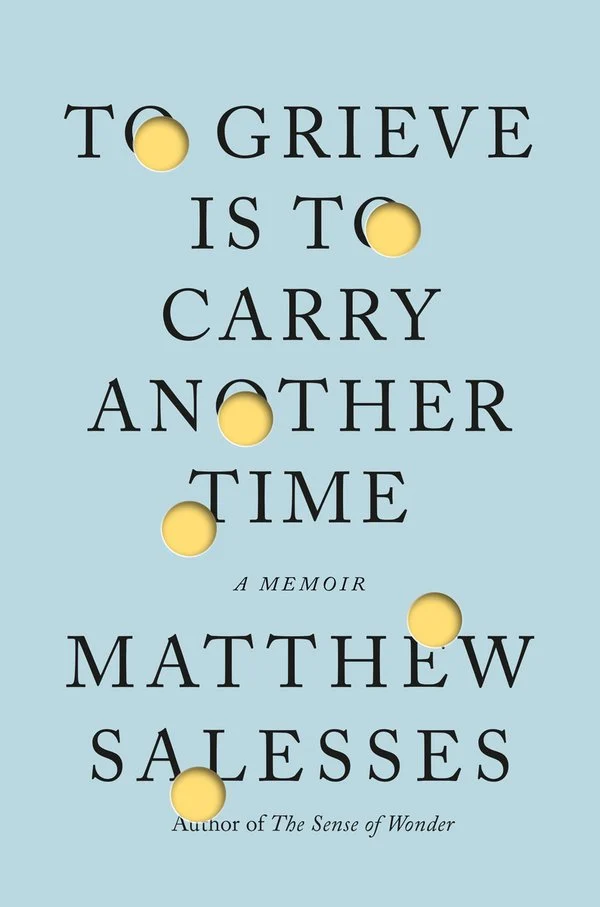
To Grieve Is to Carry Another Time (Little, Brown; Dec. 2026) goes farther and deeper, taking the doubling seriously as a subject. That the exploration comes from Matthew Salesses gives the book a particular charge: this is the author of Craft in the Real World, a writer who has taught us whose expectations shape a story. Readers of grief memoir will come for the subject; writers, adoptees, and anyone carrying an unfinishable loss should come too.
The memoir braids Salesses’ life — Korean adoptee, father, husband and, after her death from stomach cancer, widow to Cathreen — with an expansive constellation of other minds: physicists, philosophers, scholars, psychoanalysts, sociologists, theorists, and poets, each pulled in to help think what feels unthinkable. The narrative is divided into ten parts that arrive in 136 numbered small pieces; like the book’s examination of grief, the passages themselves are not presented in linear fashion. And as any griever knows, non-linear is precisely how our experiences of grief move.
The book’s spine is its title’s claim—that to grieve is not to move on from a time but to carry it. Salesses reads physics the way the desperate read maps, looking for a route back. He describes moments while playing with his children after Cathreen’s death when he, forgetting she was dead, would instinctively begin to call out to her before his brain remembered. “My past no longer seemed to lead to my present. My life had been thrown out of time.”
I read this book as a widow. My husband died five months after his lung cancer diagnosis. I also read this book as a writer; as Salesses considers the liminal space of grief through time, my forthcoming memoir examines it through language. I know well that desperation for a route back. Five months is its own kind of time — long enough to grieve someone while he is still beside you, short enough that the diagnosis and the death feel like the same days. Salesses gave me a physics for what I’d only had a feeling for: the days are not behind me. They are the time I carry.
Threaded through is an older set of losses. Salesses grew up adopted, unsure of who he was, and Cathreen was a living link to Korea, to language, to a self he’d been assembling his whole life. Her diagnosis came just after the birth of their second child, as Salesses was finishing his degree program and starting his teaching career. “So much of our married life, to that point, had seemed like waiting for our real lives to start. Finally, we were ready. And then….”
Every griever understands “and then.” In the narrative we tell ourselves about ourselves, it’s the inciting incident. The turning point, the moment in time when everything changes. Yet despite the impossibility, we experience our life in multiple timelines where everything is simultaneously true: the before and the after. Salesses uses the developmental milestone of object permanence to emphasize the bewilderment of absence, noting the devastating truth that “Grief forces your brain to unlearn one of the first lessons that love ever teaches it.” Losses don’t wait their turn; each one opens the ground beneath the others.
Salesses notes that the longer two people build a shared life, the more difficult returning to solitude becomes. The continuity breaks and the survivor must choose to move forward while carrying the past or to remain suspended in an “imaginary present” in which only the past is real. In a kind of answer, the book turns toward the living because it must: there are children in it, a second marriage, and the absurd, tender logistics of a household that grief does not excuse from operating. “To grieve is to feel that you are in the wrong time,” Salesses writes, adding “The same is true of love.”
The memoir enacts everything his Craft in the Real World argued — that plot, closure, and “moving on” are conventions, not truths, and that other traditions of storytelling hold differing possibilities. And while many grief memoirs treat loss strictly as subject: this is what happened to me, Salesses instead treats grief as an instrument for understanding grief. On my bookshelf, I’ll place it near The Year of Magical Thinking, Crying in H Mart, and Things in Nature Merely Grow. It’s rigorous, high stakes, and philosophical in equal measure.
December seems the right month for a grief memoir: the month of holidays, of empty chairs, of years ending whether we consent or not. Everyone says grief is a weight that lightens. Salesses gives us the title instead. We carry our departed loved ones and our grief, and that carrying is not a burden but the relationship, continuing.
I know whose hands I’m putting this book into come winter. I suspect that once you’ve read it, you will too.
 Helene Kiser’s poetry and nonfiction has appeared in dozens of magazines and anthologies and has been nominated twice for the Pushcart Prize. A recovering poet, she’s the author of “Topography” and currently at work on her second book, a memoir. Find her online at www.helenekiser.com.