
Reviewed by Aimee Seiff Christian

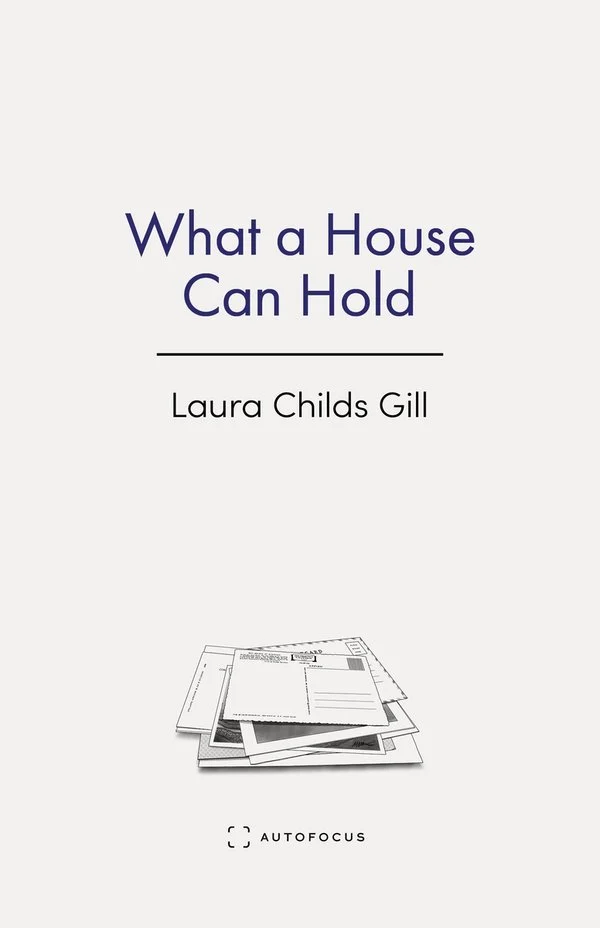 Dig if you will a picture. It’s a simple house, as if drawn by a child. That deceptively simple shape gives this literary pilgrimage in fragments its structure. It is pathless, as evidenced in the essay of the same name, but not directionless. The form reflects memory, which revisits rather than proceeds neatly and comes to us in fragments, as do these essays.
In What a House Can Hold (Oct. 2026; Autofocus Books), Laura Childs Gill sets a house that remains standing against a life that cannot remain as it was, tracing marriage and divorce, love and loss, writers and writing, and whether reinvention represents freedom, repetition, or both. This is not a simple story of leaving one relationship for another. It examines the impact of leaving on those around us and asks whether divorce, like writing, driving, and eating apples, might be hereditary.
“This is a love story that doesn’t have a clear beginning,” Gill writes, though not at the beginning of the first of three essays entitled “Beginnings, A Series of Attempts.” “Or if it does, it is the kind that stays hovering long before it knows where to land.” If that strikes you as confusingly beautiful or beautifully confusing, then this book is for you. Readers drawn to lyric essays, literary pilgrimage, architecture, memory, and associative form may easily fall in love with this quiet collection of beginnings, winding roads, and recurring apples.
What can a house hold? Houses appear to offer permanence, but they also contain marriages, memories, family stories, secrecy, departures, and the selves people eventually outgrow.
In “House Rules,” we spend time inside and around Emily Dickinson’s house. Gill writes, “Now I will go to many other [authors’] houses and write about how strange they are because authors and their homes and our attachments to them might just give me the solution to the problem I am having with wanting to be an author and struggling to be at home.” I loved this line because it contains the entire collection in miniature, both in what it says and in the way it moves.
Gill places herself in a paternal line of writers, and What a House Can Hold, her debut memoir-in-essays, makes clear that she belongs there. Rather than constructing a conventional chronological narrative, she moves associatively among houses, literary sites, memories, and inherited patterns. Her thoughtful, poetic prose works almost like a musical refrain, with chorus and verse. Images, places, family patterns, and questions recur, circling themes rather than escalating. The journey is not a linear one.
Her essays are a series of beginnings, both literal and figurative. Her writing returns to itself repeatedly, as though we are moving through a house by revisiting its rooms, reconsidering what can be seen through the windows and down the halls. Gill uses physical houses, thoughts of houses, and even a tattoo of a house to ask what happens when the structures meant to contain a life can no longer hold it.
The houses allow Gill to approach emotional material sideways, which is often when these essays are most moving. She invites us to consider the relationship between artistic creation and self-reinvention.
I found these essays especially captivating because I, too, struggle with the concepts of home and definition, and with living in the unsettled gray. In “After Apples,” Gill writes about what women are allowed to want. I took that as an invitation to want multiple things at once, and to believe that there can be many answers without one necessarily being wrong.
“Well, I don’t in a way, but I kind of do,” Gill says in the same essay when she is asked whether she has children. Gill is willing to say: I don’t know. Or maybe I do. Or both. Again and again, she lets two contradictory things be true at once.
A house is not necessarily a home, and vice versa, but I like to think of them both as containers of sorts. When is a house a home? Gill describes the new home she has created through many beginnings, deliberations, departures, transitions, reinventions, and acts of writing. By the collection’s end, a home is made from plants, fruit, mess, beloved people, and beginnings and endings cradled in both hands. In short, it contains a family, however that family is defined.
Aimee Seiff Christian writes memoir and creative nonfiction. Her writing has appeared in The New York Times, The Washington Post, Poets & Writers, The Rumpus, Pidgeonholes, Atticus Review, SmokeLong Quarterly, and more. She is a writing instructor and developmental editor, and is currently querying her memoir, Nobody’s Daughter, about adoption and identity. She is from New York City and currently lives in Massachusetts with her family. Find out more about Aimee at aimeechristian.net.