
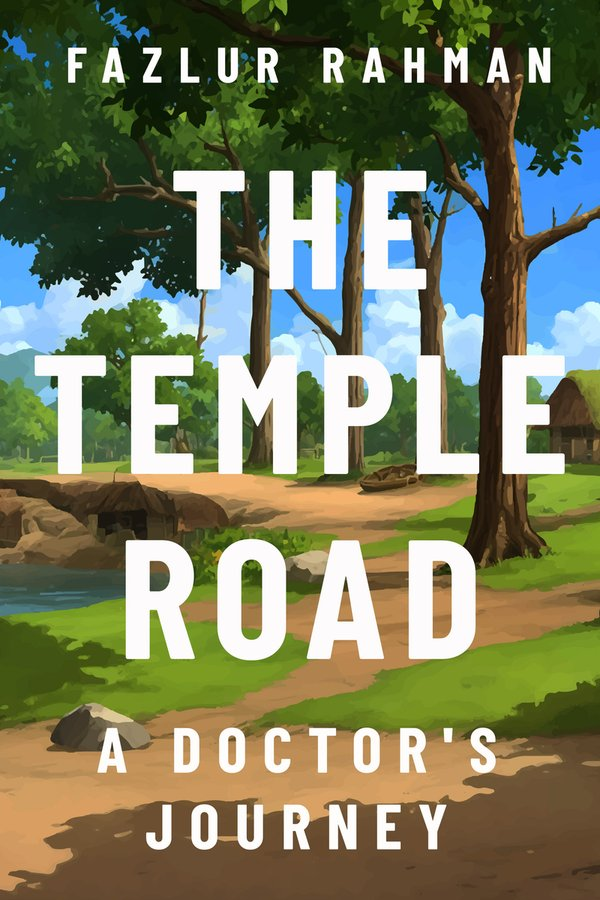
 In his memoir The Temple Road: A Doctor’s Journey (Texas Tech University Press; 2026), oncologist, educator, and medical ethicist Dr. Fazlur Rahman reflects on his remarkable journey from an early life in what is now Bangladesh to a career treating cancer patients in rural West Texas. As we follow along, we learn about the dreams, accidents, and tragedies that shaped his life over eight decades, and we come away with an appreciation for the determination and talent that allowed him to achieve success against difficult odds.
Rahman tells his tale largely autobiographically, and so, after a brief prologue, we return with him back to the beginning, back to the small Bengali village of Pora Bari in what was then British India. He describes the heartbreak of losing his mother at an early age, the challenge of overcoming a nearly fatal parasitic illness, and the difficulties of a competitive school environment. The sudden loss of his mother from unexpected complications during childbirth affects him particularly deeply, but her spirit, as well as her dream that her son would one day save lives as a physician, inspires the journey that occupies the rest of the book.
My interest as a reader was particularly piqued when Rahman turned his focus to the everyday village life of his childhood. He lovingly evokes that lost world — “The paths ran through the mango groves and bamboo thickets, along the banks of the ponds and under the canopies of the banyan trees, passing by the clay-walled houses of the farmers. How beautiful the villages were, with a profusion of wildflowers in the spring and summer!” It’s a setting that comes further alive in his stories of fending off roaming tigers, watching traveling theater troupes, and celebrating religious festivals with his family. His descriptions of Rajbari, the ruins of a nearby palace, were particularly evocative — “The ruins were shrouded in myths that I wholeheartedly believed. The king and his court were long gone, but their tragic stories survived. Myth and history came together to affect my boyhood.”
It’s a world separated from us by more than the passage of time. He describes a culture in which the separation between Hindu and Muslim communities wasn’t as rigid as it is today — for example, though born into an old Muslim clan, he prayed to Saraswati, the Hindu goddess of learning, to help him succeed in school, and his family openheartedly welcomed a passing Hindu traveler to their Eid celebration. It was also a largely agricultural society, the transformation that mass industrialization and unchecked capitalism would bring still years away. These attitudes slowly change as his village is first partitioned from India on religious lines and then, decades later, suffers the shocks of the civil war that cleaved Bangladesh from Pakistan.
But by then Rahman has already made his way to America. Though he’d finished in the top ten of his class at Dhaka Medical College, the professional and personal uncertainty brought on by the impending civil war led him to seek his fortunes across the ocean. He eventually ends up in Texas, where he finishes his training in hematology and oncology at Baylor College of Medicine in Houston, the same institution where I would complete my own training in cancer medicine over forty years later. Eventually, he moves to rural San Angelo, where he would raise a family and spend the rest of his career caring for patients.
As a hematologist and oncologist myself, I found his journey through medical education and early practice fascinating. Learning about the racism, both tacit and explicit, that marked his eventual move to practice in rural West Texas was sobering. And I left with an appreciation for the paths that pioneers like Dr. Rahman made possible for future South Asian physicians such as myself. I did finish wishing he’d slowed down into scene as frequently as he had during the earlier part of the book — I would have appreciated more of his patients’ stories as well as more interiority regarding his and his family’s struggle for acceptance in Texas. But I am hopeful that I’ll learn more about this when I read his previous book Our Connected Lives, which deals more explicitly with his 35 year oncology practice.
The “Temple Road” of the book’s title doesn’t just refer to the path Rahman took from his home to his childhood school, it symbolizes the winding route through the unknown most immigrants walk on their own journey across oceans. I’ve often regretted not asking my father more questions about his own childhood spent in India during the 1940s and 50s, and the struggles following his own immigration to America in the late 1960s. Though with his passing my opportunity to do that is now gone, books like The Temple Road help me understand more clearly what that journey gave and what that journey took. And I would recommend this book to anyone else hoping to learn more about that journey themselves.
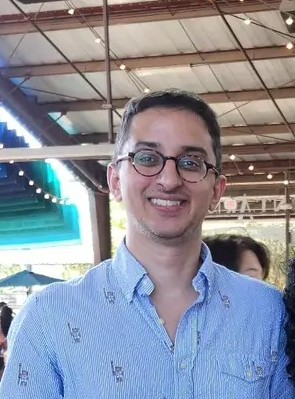 Born in small town Oklahoma, Indian-American writer Kirtan Nautiyal is now a practicing hematologist and oncologist near Houston, TX. His debut memoir-in-essays, We Are Not These Bodies: On Fathers, Sons, and Indian American Belonging, will be published in early 2027 with the University of North Carolina Press. His work has also appeared in The Guardian, Aeon, Electric Literature, Longreads and elsewhere. Visit his website at www.kirtannautiyal.com or find him on Instagram @pizzachampion to learn more about his upcoming work.