

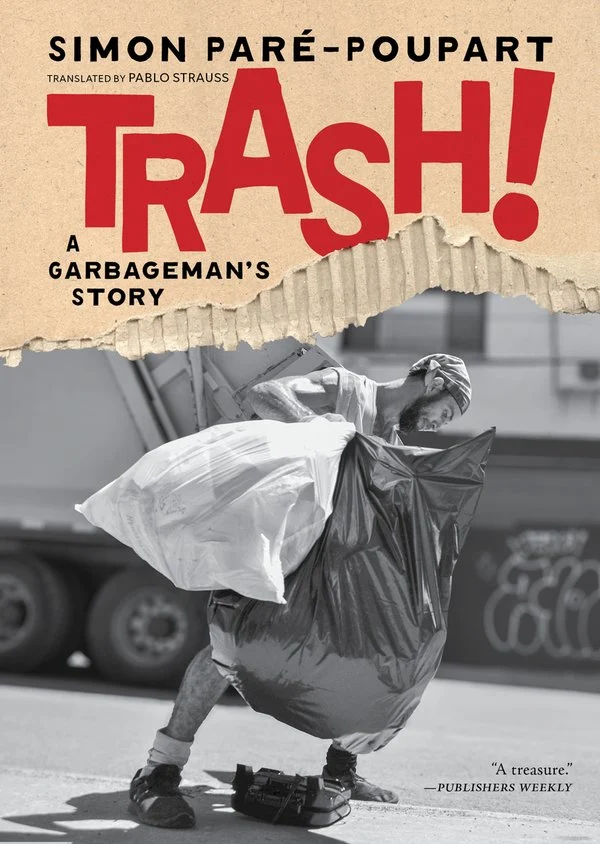
 The author of Trash! A Garbageman’s Story (Melville House; June 2026, translated from the French by Pablo Strauss) is a garbageman, and proud of it.
In this candid, revealing, and alternately comic and horrifying memoir, Simon Paré-Poupart delivers an up-close, unfiltered look at trash, the workers whose job it is to collect it, and what happens to our garbage once it leaves the curb. Paré has a passion for the topic. With over twenty years doing the job, he has a unique perspective on what it’s like to be one of the workers expected to take our trash away so that we don’t have to think about it. The opening paragraphs set the tone.
“I’m a garbageman. Day after day, I heave and haul the detritus of the most polluting civilization in human history. My fellow garbagemen and I scrub clean the stains of our consumer society. Our work behind the scenes keeps the whole edifice from crumbling down, at least for now.”
The memoir is a manifesto, the author on a mission to make clear what should be obvious — our garbage doesn’t magically disappear once it’s picked up. It’s dirty, smelly, it breeds maggots, it pollutes and much of it will remain on this earth for hundreds of years or more before it decomposes. Even with the advent of special containers for some recyclables and organics (green waste), the reality of what becomes of materials carefully sorted and even washed by the consumer is not what we might imagine.
Of the current stage of plastics recycling, Paré says, “We all want to live under the illusion that all the plastic we dispose of gets recycled, but the truth is that the real figure is just 10 percent. The rest is shipped out of our sight to poorer countries or ends up in the ocean, where we have literally created an entire new continent of plastic.” The author has equally eye-opening observations about the challenges and short-coming of organics separation and collection.
Aside from the realities of waste management, there’s a deeply personal aspect to the memoir’s message. Pare says, “. . . I feel solidarity with all the people working behind the scenes, whose anonymous labor lets all of us enjoy a better life.” He’s determined to prove that “no job
is lower” than another. With honest, no-holds barred, loving character sketches of some of the men he’s worked alongside, Paré shows us who these garbagemen are, where they came from, and the toll the job exacts on body and spirit. We meet men who are from poor backgrounds, largely uneducated and often struggling with addiction. The author says, “Our brotherhood is a gathering of marginal deviants, antisocial conspiracy theorists, eccentrics, and others who have a hard time fully integrating into the ‘straight world.’ This outsider status forges our identity as garbagemen.”
Pare is something of an anomaly among garbagemen. He began working on garbage trucks in Montreal to pay for his college education, eventually earning graduate degrees in sociology and international business. He now picks up trash part time, in addition to working as a journalist and social worker. His diverse background positions him to bring a historical and a societal and socio-economic perspective to garbage and to the stigma attached to those who do the dirty work most people would never dream of. Through portraits of his comrades we meet a class of worker that’s mostly invisible, often working through the night.
“Darkness and all that goes with it makes for perfect conditions for picking up trash—an activity you’d rather not see, carried out by people you’d prefer to ignore, whose purpose is to make the countless things you no longer want to see disappear.”
Paré is sometimes asked why he continues to pick up trash. People assume that since he’s educated, he could earn a living in cleaner and less physically demanding ways. He says he does it not because he has to but because he loves it, “. . . I’ll keep right on throwing trash, where the physical challenge, camaraderie, and steady income balance out the intellectual satisfactions of other jobs in journalism, research, and social services.” He also admits he’s addicted to the rush of running behind a garbage truck.
Scenes depicting the sheer physical demands of the job, are perhaps the aspect of Trash! that impressed me the most. The author likens a garbageman to an elite athlete. You may scoff, yet after reading these anecdotes, I get it. Garbagemen work every day of the year, without cease for holidays, blizzards or extreme heat (weather conditions that pose significant health and safety risks). The hours can be grueling; determined by the time it takes to complete a route, rather than a work schedule. Says Paré, “When I finish a shift, I’ve run fifteen miles. I’ve put my back under duress and taken considerable personal risks to keep your neighborhood clean and healthy. And pretty much no one cares.” (Automated trucks have reduced some of this; but not all routes or communities have them.)
Reducing the amount of garbage generated is not a simple or straight-forward matter. In the United States, city, county, and state governments have legislated, regulated and established or contracted with waste management companies in efforts to “solve” the problem. Virtually all of these efforts have dealt with the back end—the garbage.
In California, where I worked in the state legislature, landmark legislation (AB 939, 1989) mandated a 50% reduction in solid waste disposal by the year 2000; cities and counties that failed to reach the waste reduction goal were subject to fines of up to $10,000 a day. An industry was spawned around the ultimately impossible and pointless task of measuring and “counting” garbage. Many governments (including California) now acknowledge that without manufacturer responsibility and major lifestyle changes, we will never significantly reduce trash generation. The mantra “Reduce, Reuse, Recycle” is far easier said than done (as the author notes, the first one, reduce, often gets short shrift, in great part due to the lobbying power of manufacturers and the petro-chemical industry, among others).
Paré is a committed freegan. He says, “. . . after twenty years of filling garbage dumps, it’s the only [lifestyle] that makes sense to me.” Don’t buy new. Repair, mend, repurpose, scavenge. The author makes the point that there’s rarely, if ever, the need to buy new (other than to support and build economies). Some countries have a much better handle on this dilemma. He mentions Sweden where there’s a “shopping mall” near Stockholm, dedicated entirely to recycling, recovery, and the sharing economy. Simon Paré-Poupart is a self-described “cog in the wheels of the system. But I’m also, in my modest way, a grain of sand slowing the works, rebelling against a system whose premises I reject.”
Trash! is a memoir with a powerful and timely message. Perhaps it’s not a memoir you would typically be drawn to. Yet this garbage manifesto, while delivering hard truths from an author on a mission, is also a deeply human story, told with respect, compassion, humor and love—for the work and those who do it.
 Dorothy Rowena Rice is a writer, freelance editor, managing editor of the nonfiction and arts journal Under the Gum Tree, and a board member with the Sacramento-area youth literacy nonprofit 916 Ink. She is the author of The Reluctant Artist (Shanti Arts; 2015) and Gray Is the New Black (Otis Books; 2019), and editor of TWENTY TWENTY: 43 stories from a year like no other (A Stories on Stage Sacramento Anthology; 2021). At age 60, after retiring from a 35-year career in environmental protection and raising five children, Dorothy earned an MFA in creative writing from UC Riverside, Palm Desert. Learn more and find links to many of her published stories, essays, reviews, and interviews at www.dorothyriceauthor.com.