
Reviewed by Helene Kiser

 In the dark ages of the 1990s when I disappointed my father by jettisoning my law school acceptance in favor of a graduate degree in creative writing, my focus was poetry.
Now that I’m a recovering poet, writing almost exclusively in narrative nonfiction, a part of me wishes I’d been able to train as a multi-genre writer in the way that writing education is on offer in more commonplace fashion today. Nevertheless, I came to writing as a lover of language: semantics and semiotics, metaphor and meter. I adore prose written by poets.
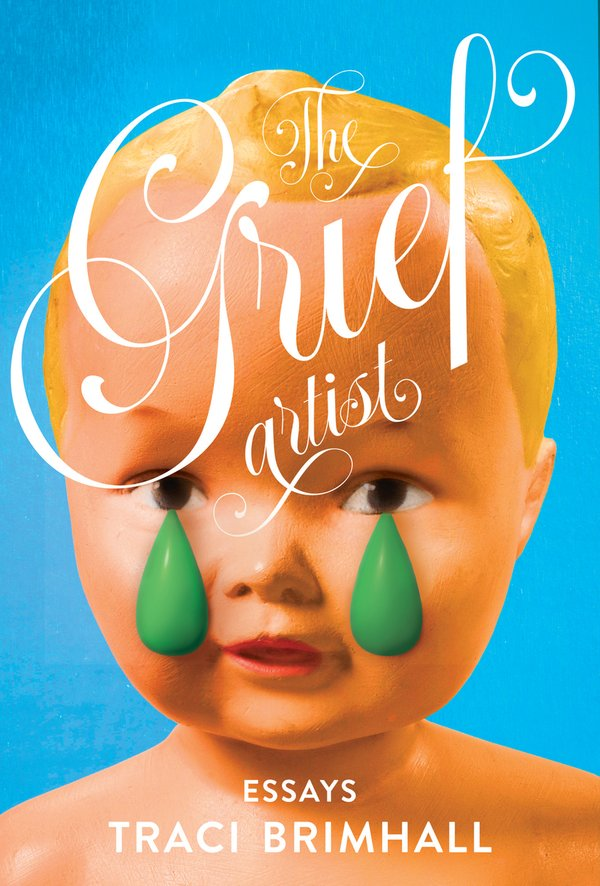
So poet Traci Brimhall’s new essay collection, The Grief Artist (Sarabande Books, October 2026), is my newest love. Taken together, the 18 essays in the collection serve as an investigation into the solitariness of contemporary grief by associative imagery, an exploration that searches in such unlikely territory as solar eclipses and papermaking next to haunted houses and dolls, a CPR-mannequin face and elephant mourning. Occasioned by the complex relationship with and death of Brimhall’s mother, the essays also span grief for a failed marriage, for innocence, art, religion, and the body, among many other griefs.
At its heart, the collection asks the question, is it possible to grieve together, publicly? Could we learn how? “Studies in Darkness” wonders on long-ago mourning customs, especially the symbols worn on the griever’s body from ancient Roman dark togas to Victorian hair necklaces. The contrast with today’s experience is stark: “We are no longer trying to outperform one another in grief, but to prove how quickly we move on, how easy happiness can still be.”
Brimhall’s essays are deceptively easy to read, with the depth and richness rising to attention on closer readings. As if the collection itself were a constraining poetic form, careful readers will find themselves assembling and interpreting each essay in light of what’s revealed from each new angle, while more casual readers will enjoy the tight storytelling and wry observations.
For example, three essays — “Hand,” “Heart,” and “Skin” — are identified as ghazals, originally a poetic form about love, loss, and longing, in which couplets end with a repeated word of phrase, giving the impression of separate thoughts circling back to a refrain. Brimhall’s poetic sensibilities are evident here, with two sentences per paragraph, each paragraph following an almost stream-of-consciousness association before ending with the name of the body part of its title. From “Hand Ghazal: An Essay:”
“The scar across my knuckle is the offspring of two empty wine bottles — perhaps cabernets or a favorite Beaujolais but greenly empty — that I broke against a garage floor, the ache reaching up to my elbow, though the pain didn’t announce itself until after I’d smashed a few coffee cups against the door. The person breaking bottles with me saw the new stains dotting the concrete like a manual for dance steps and called me beautifully fearless, or maybe it was beautifully foolish, but either way it changed my view of adverbs as they tore an old bed sheet into strips to bind my hand.”
Brimhall’s is a recursive approach that matches the way the brain works in grief, never linear, always spiral. Biblical references and fairy tales show up in abundance, but lest you get the impression that everything Brimhall’s holds up for inspection is heavy, so do pop culture references which prop up the television show Six Feet Under as a “mourning ritual.” If this sounds funny and weird or weirdly funny, you’re absolutely spot on. It’s no exaggeration to say I read and write about death and grief every day, and rarely has it been this much fun as with this collection.
In “Possession,” Brimhall remarks that, “The sheer number [of haunted dolls] should make me afraid, but the image loses its power and starts to feel like a history of girlhood pedagogies.” In the hermit crab essay “Death for Dinner,” the first ingredient is “12 black balloons, if you remember.” “The Devil’s Crown” begins, “The third time I go to meet the devil, I pay better attention to the legend and visit on Halloween.” Alongside the author’s attempts to make blankets for patients in hospice, the title essay includes a section on her “favorite bad scientist,” who attempted to prove the existence of souls.
The Grief Artist is chock full of wonder and wonderment as well, which is welcome given that death could not exist with life coming first. Brimhall arrives in each essay somewhere between pilgrim and skeptic. Honest about her desire for the supernatural, her humor never punches down. She is among other umbraphiles chasing an eclipse sighting in South America, enjoys “henbit with its lavender hyphens in the spring garden,” and mothers her young son with tenderness. The ordinary extraordinary of life.
Brimhall shows up in these essays where the grieving are, which is, of course, everywhere. Her observant eye and lyric prose take readers with her, urging us to follow her lead boldly into attentiveness and mystery, unabashed by grief, whether that within ourselves or others.
 Helene Kiser’s poetry and nonfiction has appeared in dozens of magazines and anthologies and was nominated twice for the Pushcart Prize. A recovering poet, she’s the author of “Topography” and “How to Live While Dying,” a grief memoir forthcoming in Fall 2028. Find her online at www.helenekiser.com.