Interviewed by Sayantani Roy

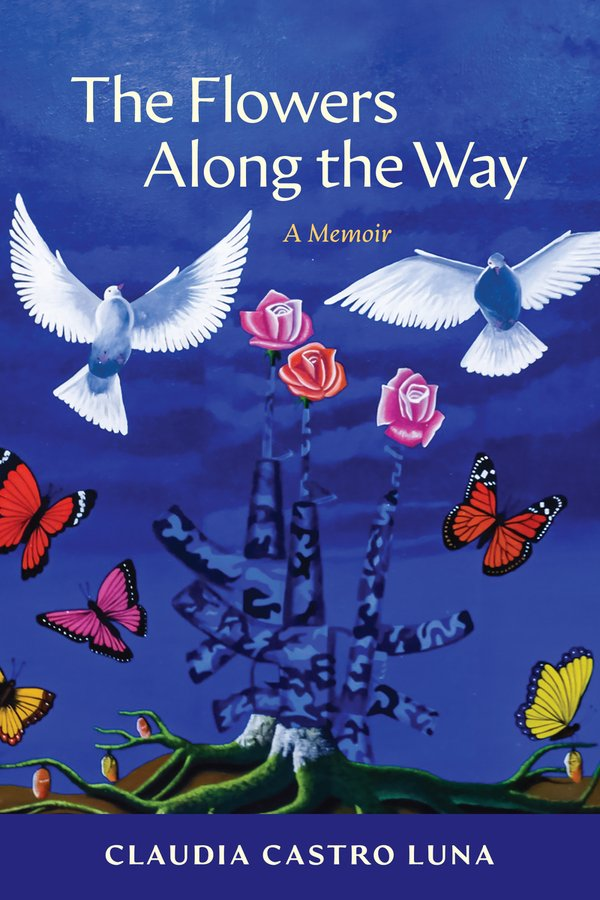 If you’re a writer in the Seattle area, chances are you’ve attended a reading or workshop conducted by poet and essayist Claudia Castro Luna, a pillar in the literary community.
She is a former Washington State Poet Laureate, a 2019 Academy of American Poets Laureate Fellow, and Seattle’s Inaugural Civic Poet. Her book Cipota under the Moon was a finalist for the 2023 Washington State Book Awards. During the pandemic I took her class titled “Arboreal Affinities” from the comfort and anonymity of a Zoom room, but her words about creating poetry through nurturing a relationship with trees have stayed with me. I am very fortunate to have crossed paths with her as a cohort member of the Jack Straw Writers Program, of which she is the curator this year. It is truly an honor to interview her about her new book, The Flowers Along the Way (Curbstone Press; Sept., 2026).
I was completely taken by the first paragraph, not only for its evocative quality, but also by how she bridges the past and the present through the juxtaposition of a terrible incident and a treasured childhood memory. The chapters go back and forth in time: she writes about El Salvador’s political unrest from the vantage point of a young girl and then looks back on life from her position as a U.S. immigrant, a new wife, a mother, and a blossoming writer.
But to say this book is about fleeing war would be reductive. It is a book about family, about life in El Salvador, about straddling continents, cultures, and languages, and about adapting to life in a new country while facing the hurt of exile. What comes through in these pages is not only Claudia’s astute political awareness, but her warm and captivating personality, her love for people and community, and above all, the tenderness with which she recounts the days of her girlhood, as lush and beautiful as El Salvador. On a sunny afternoon, Claudia joined me on Zoom from her home in Tacoma, Washington.
Sayantani Roy: Claudia, it is so good to be in conversation with you. We know you as a poet first. This is your first book of prose then?
Claudia Castro Luna: Yes, I have published essays, but not an entire book of prose.
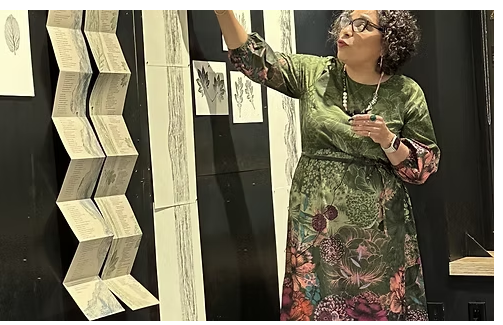
SR: Your prose is so lush and expressive. Your poems are more restrained in emotion. I must say here though, the accordion books of poetry that you have, Green, the World and One River, A Thousand Voices (both from Chin Music Press) are quite exuberant, but that’s perhaps because the form influences the content. When it comes to prose, I feel you are a maximalist. Is that a correct assumption?
CCL: I don’t think of myself as a maximalist, but I see your point, and yes, for the accordion books, exuberant would be the correct word — they are overflowing with expression owing to the shape of the book, the form. Normally I tend to compress a lot in my poems. The book of poems coming out this spring (Eleven Questions for a Tree from Skipstone), has poems that are very short and concise. For The Flowers Along the Way, I was trying to show how lush and beautiful El Salvador is. I wanted a feeling of expansiveness and not a feeling of constriction, of being afraid, which was real of course, but I wanted the lushness and beauty to prevail.
SR: You have written about your experience of growing up in a war-torn country through your poetry. Why did you want to write a memoir?
CCL: While working through the material of war I was writing in any which way it was coming to me. The memoir took twelve years to write. All through it, I was writing both poetry and prose. Some of the poems in my book Cipota under the Moon are long prose poems that address the civil war. I love these poems because they have a story arc and allow for historical material to show up. I kept playing with the story arc and was trying to tell the best story possible in whatever form it showed up.
SR: It’s a very organic process — you never know what’s going to show up—prose or poetry…
CCL: Yes, you are following your instinct so that the story finds its own form, the container. With multiple genres I was trying to get at the story I have been carrying around for so long.
SR: Your understanding was shaped by your direct and felt experiences and your rich memories. What about the gaps in those memories? Also, when you grew up and had new information, did you have to recalibrate some of the prior knowledge that you gained as a child? How did you navigate the gaps in memory and adjust your understanding, and how might other writers and memoirists do that?
CCL: That’s a great question. For a while, I was just writing down my memories as they came to me. They were often fragmented, and one of the luxuries of giving this book so much time was that filaments of memories would arrive later to fill those gaps. And of course, what helped to flesh out these fragments were conversations with family members, who remembered things slightly differently or added details I could no longer recall. Memory, especially memory associated with trauma, is by nature fragmented; you only remember a small detail or a fleeting feeling. You let it go and let something else come in its place.
Here’s an example. Two men came to our door during the insurgency seeking information about my mother and I blurted out details that could put all our lives in danger. My parents were teachers and teachers were persecuted. My father immediately decided that we would leave, and in preparation, he collected books around the house that could incriminate him and hid them behind a false ceiling. This is a complete memory for me. When we got to our last house, before leaving for the U.S., he hid them under the staircase there. This too I remember with clarity.
What I had forgotten was that before we left for the U.S., he dug graves in the backyard of that rented house and buried the books there. We talked about his burying of the books in the yard while I was driving him back to the airport on one of his visits to the U.S. He moved back to El Salvador in his later years after having lived in the U.S. for a long time. We speculated about what would happen if we exhumed those books — could we even call them books now? Anyway, I wrote the entire story in the memoir, but part of it was my father’s memory complementing mine.
For writers, my advice is to give it time. Books get stronger and better, and not just from the editing perspective; content-wise they become nuanced and richer. Live with the story. Let it sit. New information will come in. You’ll learn something that will stimulate something else in you.
SR: I imagine this is especially true for stories that are difficult to tell.
CCL: Yes, even the killing of my cousin, Lauro. Years after his death, on a trip to El Salvador, I listened to our aunt and his older sister recall the events of that day, which I had not witnessed because we had already moved to the city when it happened. Instead of telling Lauro’s story in a single narrative sequence, I chose to tell the story of his death from their perspective as they filled in the backstory for me. This added a richness to the narrative. Also, in that moment, when his sister was telling his story, sitting in my childhood home in Atiquizaya, with its dark interior and old tiled roof, the three of us held Lauro in our hearts. We were able to mourn him together as we had not done in real life because of the circumstances under which we lived then.
SR: After you came to the U.S. were you talking about the war at all?
CCL: Not at all…nothing.
SR: That’s the impression I got. Would you categorize your grief as disenfranchised then?
CCL: Oh, I love that title: disenfranchised. There weren’t many Salvadorans in the U.S. when we came here in the early 80s and very few outlets to be in community with other people who shared the experience. We never processed the grief and trauma — it was all in my head. Tia Maura, who helped us get to the U.S., went back and forth, but her life was in the States. My father’s sister, who lived in California, had not lived through the war either. My parents never talked about it. They were trying to survive, working long hours. As for myself, I dedicated all my energy to studies and became very active in several high school clubs — math, French, sports — they saved me from my fear and memories. My close friends were immigrants too, these brainy girls of Filipino and Chinese heritage, who loved me and invited me into their big families. But we didn’t talk about war — it was not their experience. I did not understand then that there was a complete thing inside of me that I had not processed.
SR: That’s why this book is so important. It is not an everyday story.
CCL: Yes, and we have so few stories of children who have lived through war and whose psychic processes are similar: the bottled fear, the terror, and how those show up later in life. It was very important for me to put my experience on the historical record, especially since it’s from the viewpoint of a girlchild.
SR: Cipota under the Moon focuses on the war experience through the eyes of a girlchild. Cipota — does that mean girl?
CCL: It’s a very Salvadoran word. In Náhuat, it means a girl child. Not many people know that word in the U.S. unless you are from a Salvadoran heritage. Once, in Texas, a woman came to my reading and was astonished to see the word “Cipota” on the cover of a book. She knew exactly what it meant, and in that moment, we both felt seen.
SR: In your book, the women in your family seem to have a huge influence on you. Your Abeula was a force of nature, but El Salvador isn’t a matriarchal society, is it?
CCL: El Salvador is hyper-patriarchal. It’s a Catholic society, which is by essence patriarchal. The society is also very sexist, machista. But it’s really the women who sustain daily life, and in my story, they come to the surface very naturally. By design, my grandmother is a throughline in this book because she was such a powerful personality. The angle of matriarchy versus patriarchy isn’t as deeply explored as other themes in the book, such as the search for home and war trauma, but the material very organically takes on the question of gender roles. Women take center stage in the book — it presents an on-the-ground reality of a child whose world was dominated by women.
SR: You and your family were deeply affected by the pacifist Archbishop Monseñor Romero’s assassination. And violence was unleashed upon the crowd of two hundred and fifty thousand people who attended his burial mass. “As an adult,” you say, “I have sat with the photograph of Monseñor’s burial mass many times.” Your reaction to the photo is the same every time : “Disbelief and awe.” Sitting with this image — is it a meditative practice? What does this practice do for you?
CCL: This is such a good question. Looking at those photographs is an act of remembrance for sure but it’s also about wanting to learn more about that time of which I was part. The practice deepens my understanding of what was going on, of my family’s history, and of the history of the country. So much of tragedy and bravery walk hand-in-hand in El Salvador. So much of disregard for life and deep faith go hand-in-hand. These understandings are layered for me based on lived experience, through sharing stories with others who were there, and by investigating the historical archive to which I’ve had access.
SR: You use the word “exile” so many times in your book. When did you start to think of the U.S. as home?
CCL: That didn’t happen until the birth of my second child. After twenty years of living in the U.S., I became a U.S. citizen. By then, I knew this was my world. My own family was growing here. I belonged here.
SR: How do you feel about the current political climate?
CCL: Silencing is a terrible form of violence. Disinformation and privileging state-approved media are insidious, and we must be very alert to that. I lived through media manipulation and silencing in El Salvador, and that’s the tragic thing.
SR: As a child you were influenced by your Abuela’s religiosity, her spirituality, and her veneration of the “unseen realm.” I was mesmerized by this paragraph: “The world of ritual, of reverence, the mystery of the unknown, the existence of God, being in a dark, quiet space with traces of incense was pure magic to me. The realm of spirit pulled me hard.” How has religion evolved for you?
CCL: What I most treasured, what I was after, even as a child, was the world of spirit. For my grandmother, a spiritual world did not exist outside of religion — for her it was all inside the Catholic church. I wanted to be like her. In El Salvador, daily life is marked by religion. Catholicism back then had such a hold on people’s bodies and imagination — even on their intellectual selves. But my parents were not religious, and I did not grow up in a religious household. Later in life I decided to become a Catholic to be in communion with my grandmother; it was one way to be close to her. Spirituality brings people together. Religion divides people.
SR: You mention that the shooting incident at the beginning of the book was also the jumping off point of your wanting to express yourself through writing. Do you want to talk a bit about your trajectory of becoming a writer?
CCL: I think my becoming a writer was responding to something deeper than that particular incident. I became a writer through poetry. Poetry came first—other writing came later.
SR: You had a professor who encouraged you to join the college open mic after he read your poetry.
CCL: You know what, Sayantani, he was at my reading in California last week and he was very touched by it. Over his years of teaching community college, he has influenced so many students. As a teacher you never know which of your students will end up writing a book or whose life is going to be transformed through writing.
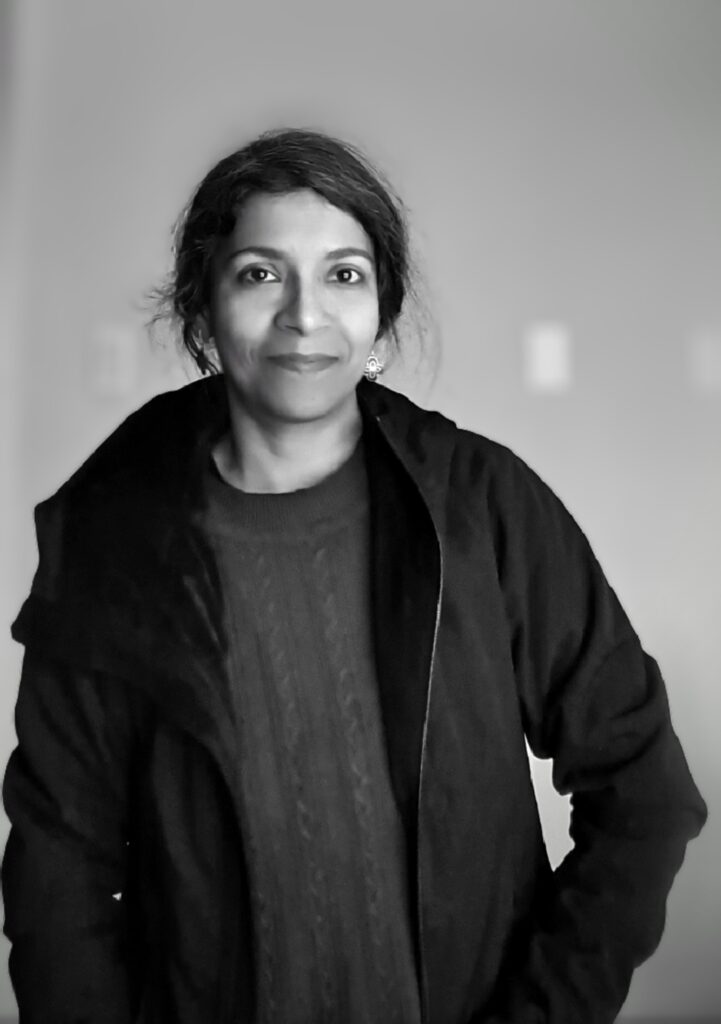 Sayantani Roy works out of the Seattle area and has placed work in Emerge Literary Journal, Heavy Feather, Grist, Mayday, Timber, West Trestle Review, and elsewhere. She is an MFA candidate at the Rainier Writing Workshop, and her work has been supported by AWP and the Jack Straw Cultural Center. See more at: https://linktr.ee/sayantaniroy.