Reviewed by Candace Cahill

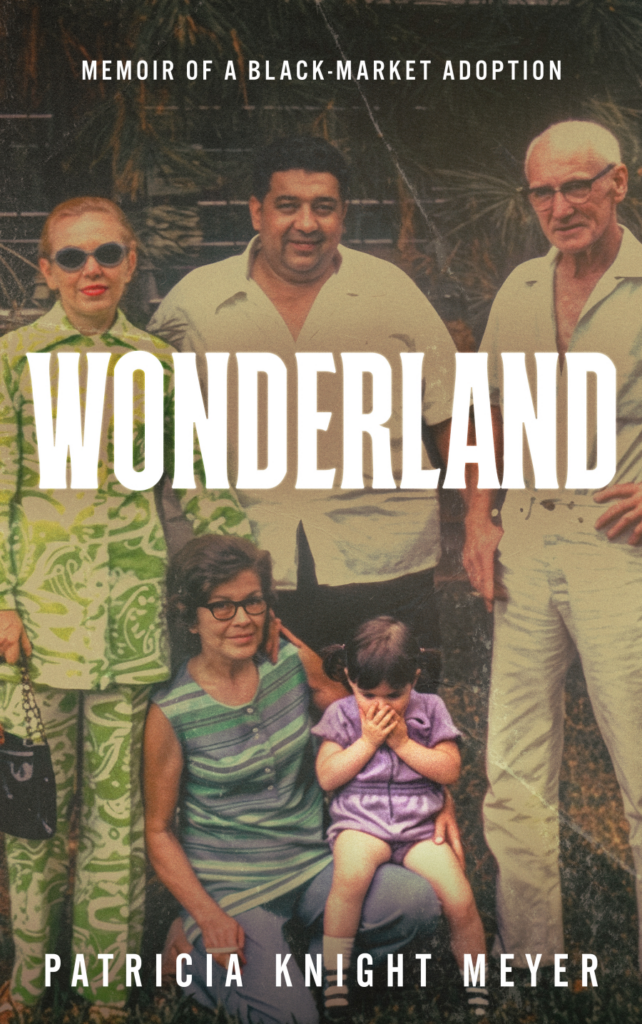 Imagine living in a house where every mirror is covered, and your family history is written in disappearing ink. That is the reality for many adopted people in the U.S., and as both a birth mother and an late-discovery adoptee (LDA), I know that world intimately.
I’m always searching for stories that reflect my experience, and while I’ve loved many adult adoptee memoirs of the heart, Patricia Knight Meyer’s Wonderland: Memoir of a Black Market Adoption (Unsolicited Press; July 2026) does something different: it tackles the system itself. It is a marriage of personal ache and systemic truth. Reading it felt like a jolt to my nervous system.
Wonderland reveals the cold, transactional machinery humming beneath that charitable veneer. Especially now, as adoption is increasingly presented as a tidy “solution” in a post-Roe landscape, Meyer’s story serves as a necessary reality check. By looking back on her “black-market” arrival, she offers a lens through which to view our current moment: a time when the ever-present risk of treating children as commodities is surging, threatening a significant increase in coerced adoptions and the continued erasure of adoptee identities by the state.
Meyer begins each chapter with quotes from Lewis Carroll’s Alice’s Adventures in Wonderland, a perfect reflection of the “upside-downness” of the adoptee experience. In chapter nine, she invokes the Dodo: “Let us get to the shore, and then I’ll tell you my history…” It’s the perfect metaphor for the struggle so many of us face: the feeling of constantly treading water, trying to reach a “shore” of truth while everyone else is writing the script. The Wonderland motif also highlights the sheer absurdity of the bureaucratic search. How does one secure a passport or prove their existence when their origin story has been lost in a sea of redacted, destroyed, or lost files?
The book’s “rabbit hole” structure is also reflected in its timeline. Meyer waits until the final third of the book to use the obvious Carroll quote: “Who in the world am I?” This choice hits on a hard truth I’ve lived: the identity crisis doesn’t stop once you find the “facts.” If anything, it deepens as you peel back the layers.
Part of that disorientation is the crushing pressure to manage everyone else’s feelings. Meyer describes the mandate to “save the saviors” with heartbreaking clarity: “I’d grow to feel worthy only when putting others’ needs before my own.” Seeing that internal tug-of-war articulated so clearly felt like a long-overdue validation.
What makes this a must-read for everyone, not just those in the adoption community, is Meyer’s political teeth. She warns of an impending “Baby Scoop Era 2.0,” arguing that restricted reproductive rights and thin social safety nets are recreating the exact conditions that allowed her own trafficking decades ago. She exposes a system that preys on both ends: coercing expectant parents with shame and treating hopeful adoptive parents like open checkbooks.
Meyer makes it clear that the shame, coercion, and extortion her parents faced decades ago are not historical artifacts; they are looming threats today. In a world where the demand for infants may once again override the rights of the families who bear them, Meyer’s history is a map of a territory we are currently treading with increased danger. She reveals a system that is often predatory on both ends of the transaction. On one side, expectant parents are met with a coordinated campaign of coercion: convinced through shame and a lack of resources that they are inherently “unworthy” or “incapable” of raising their own children. This systemic gaslighting strips them of their agency before they’ve even had a chance to breathe.
On the other side of the ledger, hopeful adoptive parents are often treated as open checkbooks, milked for astronomical fees by middlemen who prioritize profit over ethics. By framing adoption as a market-driven solution to a social “problem,” the industry transforms a profound human experience into a high-stakes financial deal. Meyer’s narrative proves that when a child becomes a commodity, the system doesn’t just fail the adoptee; it systematically takes advantage of the vulnerability of both biological and adoptive families, leaving a trail of trauma in its wake.
Ultimately, Wonderland is a demand for ethical storytelling. I recommend it to anyone who has ever felt like a ghost in their own story, and to anyone who still thinks adoption is a tidy solution to a social problem. Meyer’s work is a fierce reminder that the most dangerous stories are those in which the protagonists aren’t even allowed to own their own names..
 Candace Cahill is a writer, silversmith, and outdoor enthusiast. A first mother and late-discovery step-adoptee, she is the author of the memoir Goodbye Again, which explores the emotional complexities of relinquishment trauma. Her work has appeared in HuffPost, Newsweek, NBC Today, Severance, and The Citron Review. Based in Alaska, she works seasonally as a guide in Denali National Park & Preserve.