

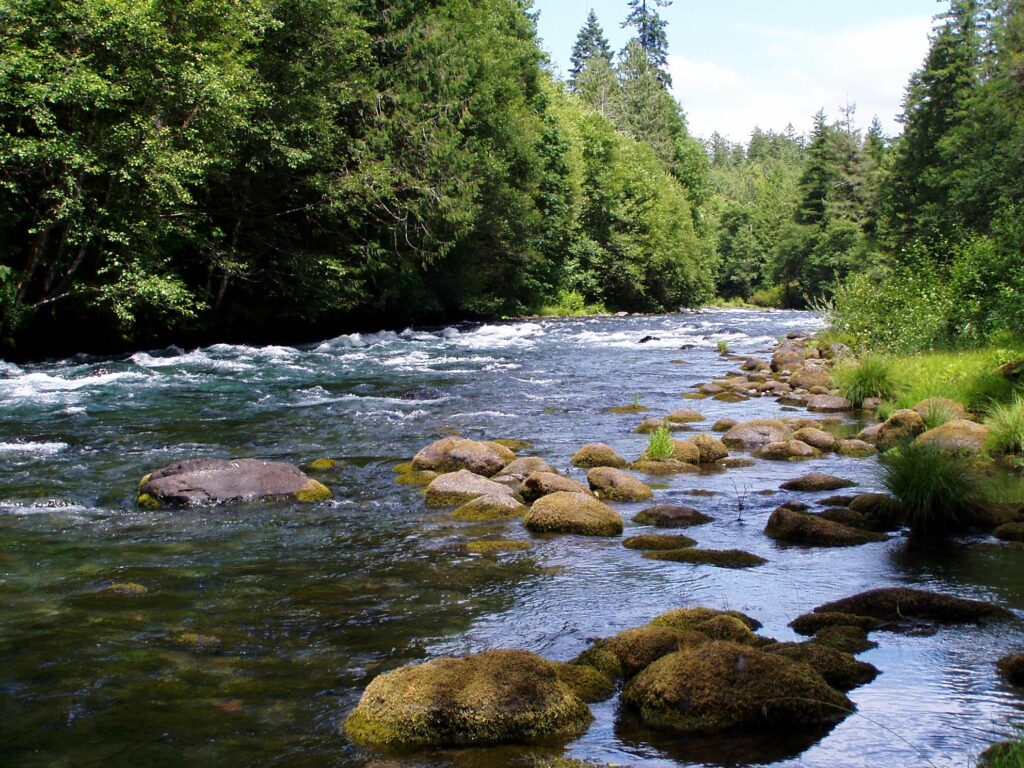
Mist hung over the green-blue water of the McKenzie, hiding the boat-ramp from the island of rocks near the bank where my eight-year-old brother and ten-year-old self cast our spinners into the pool. My aunt was upstream throwing long spools of line into the current where the willow-roots unfurled in a tangle, and her boyfriend Bill, who we’d only met the week before when we picked them up from the airport, stood watching us and smoking a Marlboro Red, his pole leaned against a tree. He’d cast and cast, complained about the fish not biting, and now seemed resigned to watching us boys try. He was not interested in pursuits that seemed doomed—which perhaps he should have considered before he tried dating my aunt.
My aunt even at forty was a beauty, petite and dark-haired, easy to laugh but impossible to get to commit (or so I’d heard my mother say). She’d always had a long queue of boyfriends we’d been asked to call Uncle each trip out to Oahu to visit our grandparents; Uncle Bill was the first one to get a name, the first haole, and certainly the first to come visit us out in Oregon. He was from the Midwest originally, tan, lanky, and tall, sporting a neat grey handlebar mustache that he liked to stroke with one hand. He wore denim and plaid and had a self-assurance that I imagined must come inevitably with being white and having money enough to spend freely on toys and treats and these new fishing poles. That he hadn’t otherwise had much to say to my brother and I did nothing to diminish his appeal—I was eager to have my love bought. Like the heroes I watched on television, he smoked and drank, two things my father despised. He was the hero I’d been waiting for my entire life.
“Look here!” Uncle Bill called, and so my brother and I took in our lines and turned back to look. Uncle Bill pointed the lit end of his cigarette into the mist and, out of it, in a huff of gears and blinking lights, a tall tanker-truck with a National Forest Service logo backed down the boat ramp to the edge of the water. Uncle Bill went to the window and chatted someone up, then let out a whoop of excitement. And then, as the tank tilted up and a great pipe extended downward, the truck released its cargo: a thousand stock trout, uniformly twelve inches, pouring quicksilver into the pool. An undeniable bounty of riches.
Uncle Bill threw his cigarette to the ground and stamped it out as he clapped my brother and I on the shoulders. “Now we’re fishing, boys!”
And so we were. The trout, still stunned from captivity and used to the tanks, stayed put in the slow water of the pool. They did not bite the spinners, but it was impossible not to snag them in the sides if you pulled your lure hard through the density of concentrated bodies. Uncle Bill showed us how to yank into them while my aunt watched disapprovingly. “You know, that’s really not—sporting,” said one of the brown-uniformed Forest Servicemen, a white-haired, paunchy old-timer who was reloading the truck.
“These are just kids,” Uncle Bill declared. “They deserve the fun.”
Soon we had a stringer full of trout bleeding in the shallows—Bill had to come and kill each of our catches, then pull the barbed hooks free from the fish’s sides and fins, which we weren’t strong enough to manage. We’d never caught so many fish. My brother, who’d never liked fishing much in the first place, grew tired, and went back into the trees to play. My aunt quit, mumbled something about this not really being fishing, and then walked along the bank to photograph trees or mist with her digital camera. I’d never really caught many fish, and so greed overtook me—I threw my line hard, pulled hard, desperate to show Uncle Bill my skill. He counted the still bodies. “Ok, Michael. One more is the limit. Let’s see what you’ve got!”
I took my pole to the edge of the ramp. The forest servicemen had finished and were taking a break, standing with arms crossed by the truck, which they’d pulled up the bank. I reared back my arms and threw my spinner—but missed the release button. The line swung forward and around and boomeranged back toward me, and I jumped back and felt a bite in my hand and then a rising pain. I looked down and there was my lure, stuck deep in the meat of my fourth finger. Uncle Bill hurried to me, grasped my hand, and then let out a gasp.
“Oh, lord,” he said.
My aunt hurried up, took one look at my hooked finger, and let out a scream.
I waited for Uncle Bill to pull the hook free, as he had from the fish, but his hands were shaking as he turned my hand this way and that, and then stepped away as if afraid of me. The old Forest Service man appeared now at my side. “Let me see, son,” he said.
He examined my hand and shook his head. “You’re good and hooked,” he said. He walked over to Uncle Bill and spoke a little under his breath.
“No fucking way,” Uncle Bill said.
“It’s the only way. And you better hold that boy’s hand.”
Uncle Bill went to my aunt, whispered something in her ear, and she gasped out something that sounded like “No,” or “Oh.” I wasn’t sure what.
Uncle Bill came back to me. “You’ve got to be brave,” he said, though he was looking off somewhere over the water, and didn’t seem to be speaking to me.
The Forest Serviceman came over, a pair of needle nose pliers in his hands. “You can do this, son. It’s going to hurt—we have to bring the hook back through, to clip the barb. Then we can pull it back out. You can’t move your hand.”
I looked over at Uncle Bill, and he nodded. I knew I could be strong—every day at recess, I fought bullies. In gym, I was a boy who could run until I puked, who could beat the other boys because pain was mere to me compared to losing. I’d always thought this was not enough, because it never seemed to be. But as that hook pushed back through my finger, I made no sound, though Uncle Bill had gone white, his hands shaking so bad that he shook me. The snap of the pliers clipped the barb, and again I made no sound as the curved hook was drawn back through both sides and Uncle Bill let out a moan.
I didn’t know then that if this was fishing, if this was living, then Uncle Bill wasn’t good at it—that he had nothing to teach me, no chance with my aunty. Instead, I spent years trying to be like him: plying all the wrong pools, nothing to take home but the ruin of what I touched.
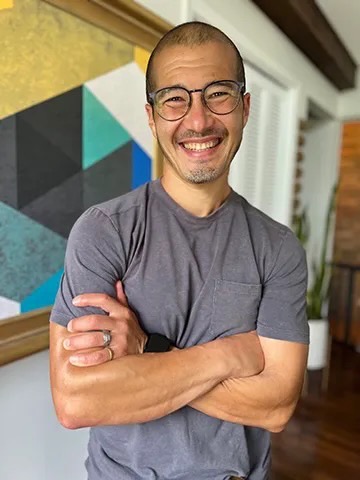 Michael Copperman is an assistant professor in the Department of Writing, Rhetoric and Cultures at Michigan State University. His memoir Teacher: Two Years in the Mississippi Delta (University Press of Mississippi 2017) was a finalist for the 2018 Oregon Book Award in CNF. He is the creative nonfiction editor for the Northwest Review.
His next book, Seeking Kenny, is about the extremes of the American subculture of wrestling as seen through the story of five-time national champion Kenny Cox’s pilgrimage deep into the wilderness of Kauai’s Na Pali Coast (University of Iowa Press 2026).

Very elegantly done, taking us moving through the action and then the last paragraph stretching us into time.
Really great piece, Michael. I mean damn good. Reminds me of “Communist,” by Richard Ford. You should check it out if you haven’t. I think you’d dig it.
I haven’t read, though I love Richard Ford. Thanks for reading!
I just LOVE this story. I laughed hysterically. I mean I couldn’t breathe. I had to send it, halfway through reading it, to my boyfriend so he could finish it, because I had so many laugh tears in my eyes. So perfectly put. Way to go.