Interviewed by Leslie Lindsay

 For her entire life, Emily Rapp Black has been answering awkward questions in elevators: “What’s wrong with you?” “What happened to your body?” which is what her first book, Poster Child: A Memoir (Bloomsbury; 2008) is about. In the case of her son’s terminal illness and death, which she explores in great depth in The Stillpoint of the Turning World (Penguin; 2014), she’s been told more times than she can count: “I would die if I were you.”
But this is not what we need. Instead, a healthy dose of community, story, authenticity, and empathy is what will survive.
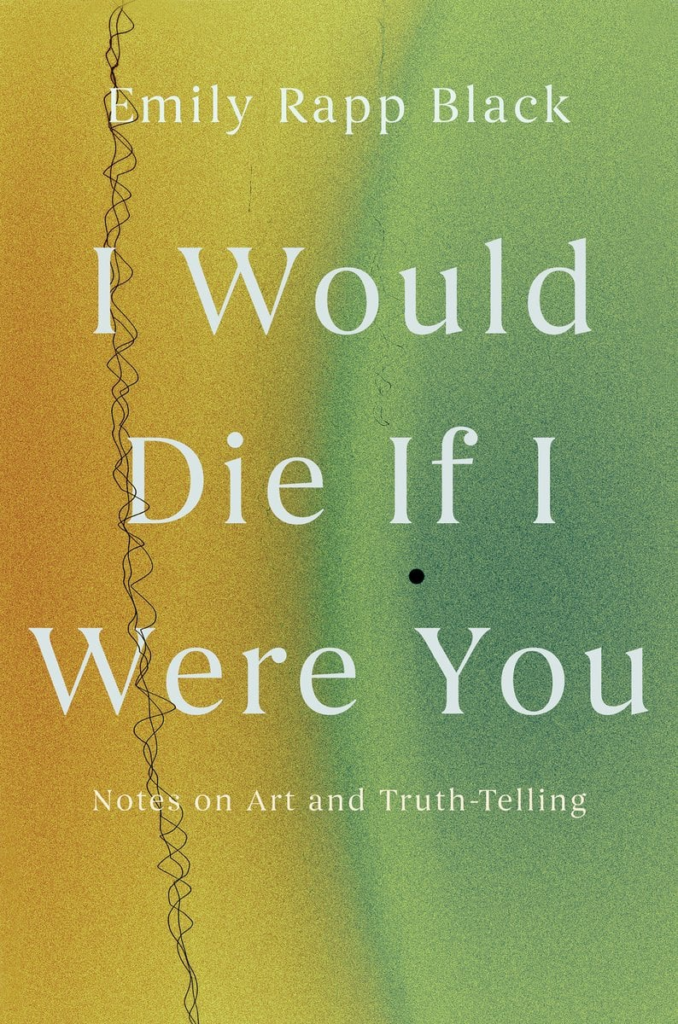
Drawing upon her previous work and over two decades of teaching, New York Times bestselling memoirist Emily Rapp Black explores how art can move us through moments of grief and loss while celebrating and making meaning from authenticity and creativity in her newest book, I Would Die If I Were You: Notes on Art and Truth-Telling (Counterpoint; May 2026).
As most artists and writers know, approaching “hard stories,” in a way that feels joyful and meaningful, can be darn near impossible. Who wants to write about unbearable loss, a traumatic event, or deep pain…at all? Who can do it with joy?
With I Would Die If I Were You, Emily Rapp Black has written a sharp and smart guide that will help creative people working in any medium make meaning out of loss.
I Would Die If I Were You is a field guide showing you how — it’s part memoir, part craft — and all wise.
Please join me in conversation with Emily Rapp Black.
Leslie Lindsay: Emily, it’s such a pleasure and honor to chat with you about your work. Thank you for taking the time. You open I Would Die If I Were You with a Rilke quote, “Love and death are great gifts that are given to us; mostly they are passed on unopened.” I love that. It’s beautiful and true. Why is it that these gifts are often ‘unopened?’ Why open the book with this quote?
Emily Rapp Black: Thanks for taking the time to ask questions about my book! Love and death, yes, those great gifts, and they are inextricably linked, totally baked into one another. You cannot love without fearing the beloved’s death. If you didn’t love, you wouldn’t grieve. So yes, love brings with it the necessary risk of loss, which is often death. I think what Rilke is getting at, or at least why I respond so deeply to this quote, is that love is often seen as the end goal, the final point, when actually, love can be challenging, chaotic, and not all about bunnies and rainbows.
Love can require a radical, unshockable witness, and that is not a gift people expect when they say, fall in love, but it’s part of the experience at some point. Death, too, is seen as something to avoid, to fear, to kick back against, but there is so much freedom in confronting that reality, and I have found that in doing that, I’m brought closer to life, to a feeling of joy and wonder. People don’t associate joy and wonder with death, and they may not associate struggle and sorrow with love, but those ARE gifts to experience and wrangle with, and I think that’s why Rilke is suggesting that we resist opening them fully.
L.L.: While I Would Die If I Were You is not exactly a self-help book, nor memoir, nor craft book, it embodies all these elements. It’s about narrative craft, consciousness, memory, loss, art, parenting, and so much more. It’s deep. All of these ideas intersect and cross, in life and in art. What I think you do so well here is fuse these wild and spiraling constructs into a cohesive whole, demystifying some of the process. But it’s still hard! This book is for every level of artist, but where might you suggest a beginner start, other than at the beginning?
E.R.B.: Thanks! My hope is that anyone can drop down into one of the chapters here and find something of value, or even something to argue or experiment with. Most of all, I want people to understand that there is no right or wrong way to begin, there’s just the desire to do it, and then the action of doing it. Even if you write three words on a page one day, that’s something. It doesn’t need to be dramatic, it doesn’t need to be seen by anyone but you, and nobody is judging what you do. I want this book to encourage readers to be playful with their ideas, and to live inside their minds in a generous and receptive way.

L.L.: “Are you ever going to stop writing about your son?” This is a question you get asked often. The answer is: “Never.” I get that. On a different plane, I have been writing about my mentally ill mother and her suicide for decades. Am I ever going to stop? Probably not. It’s interwoven into my DNA. Can you speak into that please? Is it about meaning-making? Transformation? Something else?
E.R.B.: There are only so many stories one gets to tell in a lifetime, in a body, at a particular time in this world. So yeah, I think that as we evolve, age, move in and out of stages and experience, our experience with grief is transformed, and our relationship with our beloveds shift and move as well. Our “grief city,” as it were, changes with season and time, or even moment to moment, and in that way, we are in an ongoing relationship with the person we long for. Memory is a form of imaginative ethics and companionship, and I believe it’s in that space that we continue to be in relationship with all the people we’ve lost, which may even include versions of ourselves.
L.L.: I want to turn back to Dorothea Lange. She was 7 years old when she contracted Polio and subsequently walked with a limp. She claims it was ‘one of the best things’ that happened to her and helped her be more intentional with her work. I was about 11 when my mother had her first psychotic break. You were 4 when your left foot was amputated and then later, your leg. All of these are pivotal moments of great loss. I am of the mind that my mother’s mental illness made me a better person and mother. My guess is this is how you’ve framed your non-typical body. Can you talk about that, please?
E.R.B.: Actually, no. I don’t think it’s made me a better person. I think it’s made me a different person. I think any outsider experience — any great moment of rupture — forces a person to reshape and relearn the boundaries of their body in space, in time, in community, in the world. Although I think this can be an expansive moment — increasing one’s empathy — but I resist the “better” label because “being nice” is often expected of people with disabilities, especially women with disabilities, which in my mind robs us of the ability to be full human people, with all our various potential flaws. I think the hardest part of being a person with a non-normative body is the way in which the world interacts with that difference, and that is very often irritating, harmful, and violent. And some of that leads a person to feel rage and disappointment, and I think it’s important to be able to express that, to be allowed the full range of human emotions.
L.L. Art making can reveal our deepest truths. It’s one of those magical places we can simultaneously escape and find ourselves, but we must do it. Whether it’s going to the studio or the writing desk or the stage, or wherever you make art; just do it. What might you advise someone who isn’t sure if others want to engage in their work about “hard things,” (grief, loss, disability, trauma, terminal illness, etc.)?
E.R.B.: I would say that nobody gets to tell anyone that a story is too hard or too sad or too odd to tell. It doesn’t mean that everyone must like it or engage with it, because readers or viewers or listeners don’t have to read or look or listen. We always have the choice to shut the book or turn off the television or take the needle off the record. But our right as human beings is to tell our stories. We are storytellers — it’s what makes us human, and nobody can take that from you. Nobody. I think we live in a time when we have such instant access to content, but that wasn’t always the case. Also, people didn’t live long enough or in a time when they were able to literally survive some of these experiences, so the range of experiences to write about has expanded. We are fully in our human-ness when we create. And that feeling, although difficult to quantify or qualify, is a FELT experience in the creator, and it’s a magical one.
L.L.: I want to talk about the fabulous writing prompts scattered throughout I Would Die If I Were You. So many good ones! Seriously, the appendix is worth the cost of admission. (But read the whole thing! Skipping in line is not allowed.) I’m most interested in your suggestion of giving your story ‘shape.’ This isn’t necessarily about structure or outlines, but more abstract, as in an actual shape. For example, you share that a banana came to you as the shape (or container) of your book. You didn’t understand it at first, but then you did. Whether letters or images, all art is made of symbols, so why not a shape to represent the whole? For me, the shape of my work-in-progress is elliptical, like a lemon, but I also relate to clocks and timepieces, which once might argue that time is elliptical.
E.R.B.: Thank you! Yes, my wild and wacky prompts! Ha! Shapes are helpful because they are an abstraction, but also a container. They allow the mind to focus but in an intuitive way, a way that taps into our subconscious mind where all the good stuff lives if we grant ourselves permission to release it. I like the lemons and the clocks! Or a lemon-shaped clock!
L.L.: I want to end with the fact that you’ve been writing I Would Die If I Were You for over a decade. Art takes time, heals you, but also heals others. It’s time-consuming, but it’s also service, a real labor of love. What sets it all apart? Is it worth it?
E.R.B.: Well, I think I’ve been writing it in my mind! Ha! It’s always worth it. When I was working on this book, I texted my bestie almost every day — “I’m so happy writing this book!” and believe me, that’s not a typical text from me! It’s so worth it. Writing — shaping experience — is the activity that brings me a very unique kind of joy. I wouldn’t trade it for anything.
Leslie Lindsay
Staff InterviewerLeslie A. Lindsay is the author of Speaking of Apraxia: A Parents’ Guide to Childhood Apraxia of Speech (Woodbine House, 2021 and PRH Audio, 2022). She has contributed to the anthology, BECOMING REAL: Women Reclaim the Power of the Imagined Through Speculative Nonfiction (Pact Press/Regal House, October 2024).
Leslie’s essays, reviews, poetry, photography, and interviews have appeared in The Millions, DIAGRAM, The Rumpus, LitHub, and On the Seawall, among others. She holds a BSN from the University of Missouri-Columbia, is a former Mayo Clinic child/adolescent psychiatric R.N., an alumna of Kenyon Writer’s Workshop. Her work has been supported by Ragdale and Vermont Studio Center and nominated for Best American Short Fiction.