Interviewed by Leslie Lindsay

 Years ago, and one month later, I am reflecting on my uncle’s death. He was found in his trailer home, unresponsive. Maybe an overdose. Maybe alcohol poisoning. Months prior, he had held my firstborn daughter. He grinned at her, a redheaded button-nosed baby with a squishy face. “You’re lucky,” he told us. “Take good care of her.” He lost his own son, not to death, but because of addiction.
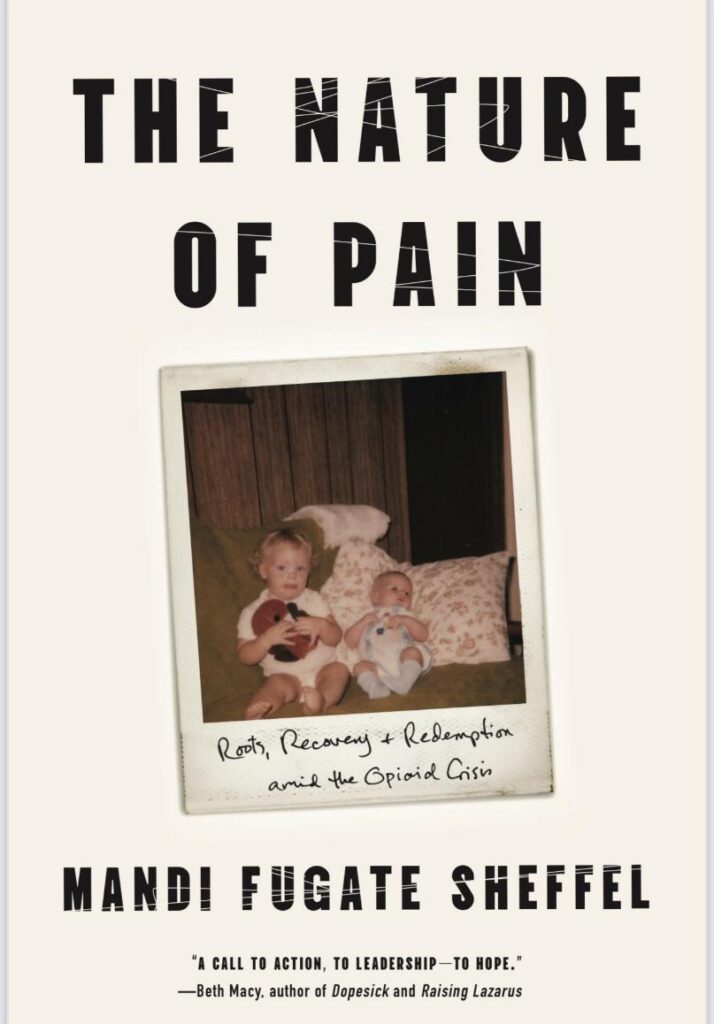
Mandi Fugate Sheffel leads us on a similar journey in The Nature of Pain: Roots, Recovery, & Redemption Amid the Opioid Crisis (UPK; Oct. 2025), a coming-of-age memoir which delves deep into the Appalachian epidemic of the late 1990s and early 2000s.
What Mandi Fugate Sheffel does so well in The Nature of Pain is presents the unvarnished truth of living with addiction, she tells it to us straight. This is an aching tale of empathy told in raw, honest prose that probes at the lifeblood connections of family and land, loss and grief.
The Nature of Pain looks at not just the nature of addiction, but the psychological and emotional reasons why it happens in the first place, the costs and benefits, how Purdue Pharma seemingly created the opioid epidemic in Appalachia by launching aggressive marketing campaigns. The land had been stripped of its resources, but so too had independence and personal agency. Still, a deep love for the place, family, and land persisted. We journey with Mandi through her childhood, her teen years, college, rehab and recovery, and the most excruciating loss of all, her dear friend and cousin, Eric.
Please join me in conversation with Mandi Fugate Sheffel.
Leslie Lindsay: Mandi, thank you so much for your candor and vulnerability. I read The Nature of Pain with a deep visceral ache, but also a strange sense of resonance (I think this comes from being about the same age). The first official chapter, aside from your introduction, is how you got your name. I love this topic because it always speaks to your family of origin. What can you tell us about your mom and dad? And feel free to share how you got your name, too!
Mandi Fugate Sheffel: In early drafts I shied away from writing about my parents. In particular my mom, because the majority of The Nature of Pain focuses on the paternal side of my family. But to understand how my childhood shaped who I became it was apparent that I would need to look at my entry into the world. Giving the back story of my name seemed like the most logical place to start. In eastern Kentucky a lot of our identity comes from our name. Connections and assumptions are made by our last names. I needed readers to understand that my parents were madly in love but also very young. Their time together was short lived; I was a product of that time. Talking about my name gave me an entry point to describe my parents and my crippling shyness. Introductions were hard for me at a young age and often a mishearing of Mandi when I introduced myself led to me not wanting to correct adults. That and the perpetual misspelling.
I’ve spent my whole life clarifying the spelling of my nickname. Amanda Danielle Fugate was my full name at birth — Amanda, thanks to Waylon Jennings, and Danielle for every woman’s love of Danielle Steel in the early eighties — but Mandi to everyone who knew me.

L.L.: Place is such a huge part of The Nature of Pain, like its own character. You grow up on dirt bikes chewing wild teaberry like gum. The creeks are ‘as clear and cold as nature would allow,’ and music from ZZ Top to Tom Petty and Bob Seeger filled your childhood. Your Pawpaw called Hale’s Branch, ‘God’s Country.’ Tell us a bit about the geography of Eastern Kentucky, how it felt like home and a bit about how music informed your experiences?
MFS: Eastern Kentucky is nestled in the foothills of the Appalachian Mountains in what’s referred to as the Cumberland Plateau. The mountains of eastern Kentucky are rich in coal and timber which makes our region susceptible to extractive industry. The topography is rugged with steep sided mountains where water carves out narrow valleys or what we call hollers. Growing up in “God’s Country” provided me with a deep love of place. A 150-year family history on one plot of land that’s been passed down to me literally and through my Pawpaw’s story telling. I think anyone who grows up in a rural area has a relationship with the natural world that’s hard to articulate. I once read the Appalachian Mountains have a gravitational pull, supposedly only measurable with sensitive instruments. But I’d argue that if you’re from here, this pull is something we all feel.
Mountain top removal changed the landscape of eastern Kentucky which I touch on a lot in the book. It is exactly what it sounds like. The removal of mountain tops to access seams of coal. What this left was large, flat, essentially toxic and unusable swaths of land. With the dirt on top, or what’s referred to as overburden, pushed into the valley land below. There’s literature available that explains this process in more detail than we have space for here, but I felt it was important to mention because it’s a critical part of our history and daily lives.
L.L.: I adore the renderings of maps as section breaks. Did you draw these yourself? How did they come about? What message were you hoping to send? For me, the maps really rooted me in place and your story.
MFS: The map idea first came about after a conversation with my editor, Abby Freeland at University Press of Kentucky. She thought it would be helpful for readers to get a lay of land because it really is a character in itself. My friend and fellow writer Robert Gipe drew the map. I asked him because he understands the importance of place particularly with my story. He was a reader for me throughout the life of the manuscript. That and he is an incredible and thoughtful artist. I hoped readers would reference the map when I’m talking about a particular place and see the roads and how they wind around mountains. Our communities can feel isolated but there isn’t much distance separating us as the crow flies. I was really happy with the way it turned out. It gets the picture in my mind on the page in a way words can’t.
L.L.: You have a good amount of photographs in the book, too, which also separate chapters. How I love this! I’m very intrigued with the idea of ekphrastic writing, if they informed your narrative? Or were they added after you wrote?
MFS: I love old photos almost as much as I love music. My mom was a diligent photo taker and photo organizer. I’m lucky in that way, my childhood is chronicled in albums. The photographs in the book were added after the fact. I selected them based on the chapter. One of the unintended outcomes is they get sporadic during the chapters where I write about my active addiction. I didn’t have a lot of photos from that time period. There was a time while working on the book when I struggled to get words on the page. I felt stuck and emotionally exhausted, so I leaned on ekphrastic writing to keep moving forward. Most of what I wrote during that time didn’t make the book, but it helped to transport me to a time and place I needed to access to keep writing. I viewed those photographs with new eyes focusing on the details of a room or landscape, things that often go unnoticed because our attention is typically on the main subject. This was a writing exercise ripe with material and photos have become my favorite writing prompt.
L.L.: As troubling as it is, I’m intrigued by OxyContin being ‘everywhere’ in Eastern Kentucky during the late 1990s and early 2000s. Much of this, I understand, is due to the high rates of cancer and chronic pain due to the physical demands of coal industry work. There’s a bit of irony here, too, because some years later, addicts return to the mines to make money for their next fix. Can you give us a brief explanation of how this all happened?
MFS: While we were in it, we didn’t know what was happening. I don’t remember anyone in the 90’s talking about why this pill was suddenly the answer. It was designed to treat patients with chronic or end of life pain, but it soon became the go to for all types of pain. Of course, we now know this was a targeted effort on Purdue Pharma’s part. States like Kentucky, West Virginia, and Virginia were selected because of the high cancer rates and industry that was physically taxing. Because Oxycontin was marketed as essentially non addictive and time released it replaced other commonly prescribed pain relief medications. Patients with chronic pain didn’t have to take medication as often and didn’t have to worry about becoming dependent. At least that’s what they wanted us to believe.
The amount of Oxycontin pills prescribed during that time period is astronomical compared to the population of rural central Appalachia. And soon pain management became a lucrative business with pain clinics and pharmacies popping up everywhere. Oxycontin was in high demand. It proved to be very effective for treating pain both physical and emotional. Because of the euphoric nature of opioids, it was also tempting for those who weren’t experiencing physical pain. It didn’t take long for people to become physically dependent and at that point it becomes necessary for survival. There are other texts that are far more comprehensive that I would recommend to readers to fully understand this was the inception of the current and on-going opioid epidemic. Beth Macy’s Dopestick is a great place to start.
L.L.: There is so much to unpack in The Nature of Pain, from using to rehab, staying clean, your friendship with your cousin Eric, and then, his tragic death. While your experiences are no doubt a summation of all of these events, was there one in particular that felt like you crossed a threshold, that changed the way you looked at everything?
MFS: Everything changed the day Eric went missing. I began to mark time as before and after his death. Losing him changed the way I looked at the world. For a long time, it was a little less bright and a lot less joyful. My time in active addiction and my stay in rehab no doubt impacted my future but I learned to cope with life without drugs. I can’t say that I’ve fully learned to cope with life without Eric.
L.L.: In the end, you write about finding writing as your solace. You even own a bookshop in Hazard, Kentucky (what a dream!), and found your passion for writing at the Hindman School. Can you tell us more about Hindman, and how writers can heal on and through the page?
MFS: The first time I attended the Appalachian Writers Workshop was the summer of 2019 on the recommendation of Kentucky writer Gurney Norman. At the time I wouldn’t have called myself a writer and I spent the week feeling like an imposter. But the beautiful thing about the Hindman Settlement School and the Appalachian Writers’ Workshop is they welcomed me exactly where I was. No books, essays, or published works, none of that was a requirement. I felt no sense of competition, only community and support. My writing flourished in this space. Everything that happened after that summer including the bookstore all goes back to Gurney Norman’s belief in my writing and the support of a writing community. Most of what made it into The Nature of Pain was workshopped at Hindman. I can say with confidence this book wouldn’t exist without the caring and generous feedback I received there.
Read Spotted Newt, my bookstore in Hazard, KY was for my community as much as it was for me. It felt like an amends to the region I had taken so much from during active addiction. Today it’s an honor to give space to all the writers of Appalachia. To highlight the diversity of a region that is often reduced to white and right leaning. I think one of the reasons we develop these lasting bonds of community at the Appalachian Writers’ Workshop is the deep love and fierce protection we feel when it comes to our stories. We all understand the damage created by extractive journalism in the region. As writers we have the opportunity to dig into the nuanced and complex narrative that is central Appalachia.
L.L.: Mandi, it’s been an absolute pleasure. Is there anything you would like to add that perhaps I forgot to mention?
MFS: I think it’s important for readers to understand that my journey of recovery is just that, mine. Recovery looks different for everyone. I was privileged to have a safe place to heal when I left treatment and not everyone gets that. bell hooks once said, “Rarely, if ever, are any of us healed in isolation. Healing is an act of communion” and “We cannot heal what we cannot feel.” I carry that with me every day. Substance use disorder is a disease of isolation. When I look back at the last twenty years I see the importance of community in my life. We must remember that drugs are the solution to something much greater. When we are able to connect and show empathy to those still suffering, we have the ability to make great change.
Thank you Leslie and Hippocampus Magazine for supporting my work. It’s been an honor and a pleasure to share with you.
Leslie Lindsay
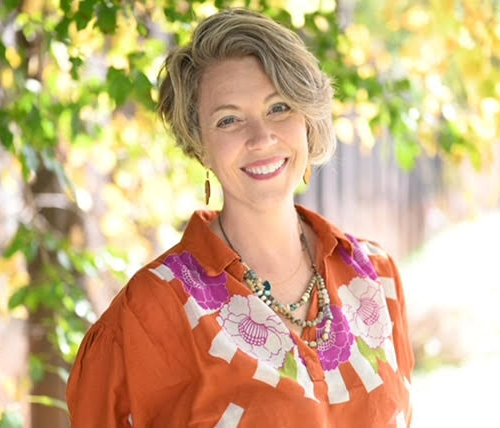
Staff InterviewerLeslie A. Lindsay is the author of Speaking of Apraxia: A Parents’ Guide to Childhood Apraxia of Speech (Woodbine House, 2021 and PRH Audio, 2022). She has contributed to the anthology, BECOMING REAL: Women Reclaim the Power of the Imagined Through Speculative Nonfiction (Pact Press/Regal House, October 2024).
Leslie’s essays, reviews, poetry, photography, and interviews have appeared in The Millions, DIAGRAM, The Rumpus, LitHub, and On the Seawall, among others. She holds a BSN from the University of Missouri-Columbia, is a former Mayo Clinic child/adolescent psychiatric R.N., an alumna of Kenyon Writer’s Workshop. Her work has been supported by Ragdale and Vermont Studio Center and nominated for Best American Short Fiction.