

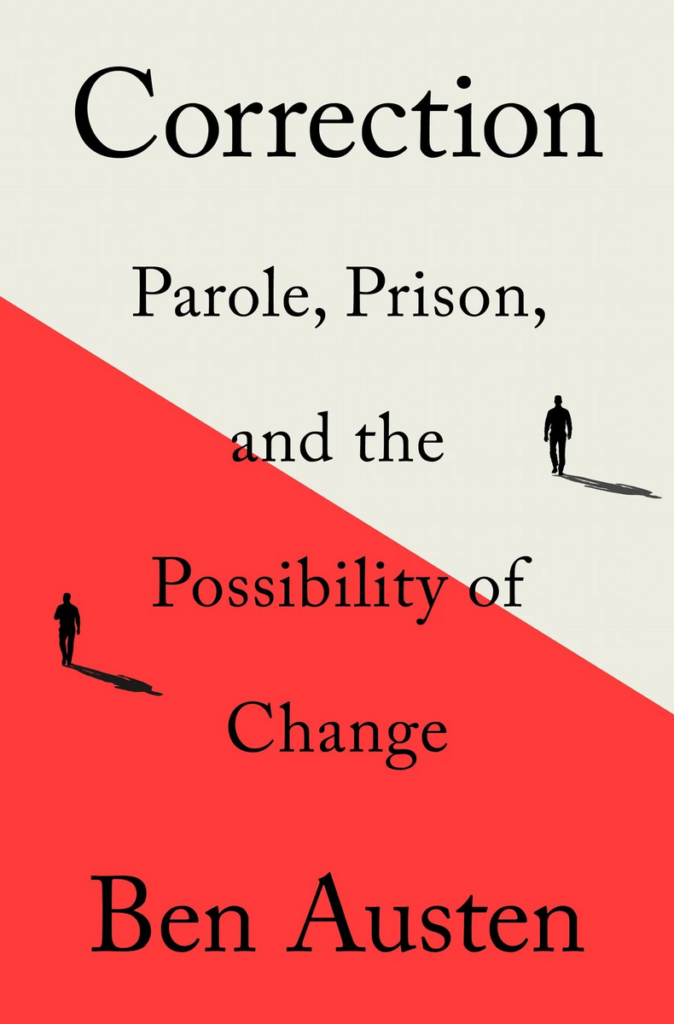
 Sometimes I miss hearing about a new, good book when it first comes out. We all do. When a colleague suggested I check out Ben Austen’s most recent work, Correction: Parole, Prison, and the Possibility of Change (Flatiron Books; Nov. 2023), I realized this was one such “missed” book.
Correction received plenty of praise when it was released (it was a New York Times Editor’s Choice and a Peabody Award finalist), and for good reason. I’m glad the paperback’s November 2025 release gave me an excuse to take a look.
A Chicago-based journalist, author Ben Austen, incorporates stunning statistics and thoughtful analysis to tell the story of America’s long, sordid infatuation with incarceration. To do so, Austen centers the Illinois criminal legal system, though examples drawn from other states (and countries) are peppered throughout the book. Austen is well-versed in many of the ingredients that feed the Illinois carceral system (and those elsewhere): economic inequality, racism, and politics prone to corruption. His prior book, High Risers: Cabrini-Green and the Fate of American Public Housing (Harper; 2019), is an oft-cited source on Chicago’s iconic public housing that explores many of the same themes.
Here, as in High Risers, Austen writes nonfiction in a wonderfully novelistic way. In another writer’s hands, the extensive, detailed reporting might have been a slog, but Austen avoids such pitfalls, manifesting meaning and creating a climate in which readers can connect with the human side of the big issues presented. By zooming in on two men’s journeys through the prison and parole systems, Austen transforms what might otherwise remain abstract into propulsive storytelling.
First, there’s Michael Henderson, who landed in the Illinois corrections system in 1971, when he was just eighteen years old. The crime committed by teenager Michael is the sort that many parents of teens—or someone who vividly remembers his own adolescence—can imagine happening when teenagers, alcohol, and a gun are combined. In an instant, Michael took the life of another young person. By the time Austen met him, more than forty years had passed since Michael was sentenced to 100-200 years in prison (with the possibility of parole). Whoever Michael was when he was locked up all those years ago, it becomes clear to the reader, bore little resemblance to the senior citizen who waited and wondered whether he would ever again live as a free man.
The significance of time (and aging) is crucial to the stories presented in Correction, as well as to the author’s conclusions. We need look no further than Austen’s other primary subject: Johnny Veal. Like Michael Henderson, Johnny went into the prison system when he was very young. At 17, Johnny and another young man were convicted in the killing of two police officers who were patrolling the Cabrini-Green housing development. Johnny insisted (and insists still) that he was innocent of the murders, but that did not stop him from being convicted and sentenced to 100-199 years (again, with the possibility of parole).
Both Michael and Johnny have been in Illinois prisons for most of their lives. And both hold out hope that, someday, they will be released. Austen dips in and out of the men’s stories as they prepare for parole hearings, get denied, and await their next opportunity. It is an emotional roller coaster that this reader found impossible not to feel invested in.
Woven throughout Correction is the historical and political backdrop against which men and women like Michael and Johnny become ensnared in the criminal legal system. Austen leaves no room for doubt that the criminal legal system is deeply flawed. Correction delivers an indictment of a broken corrections system in which thousands of Americans languish. The guiding question for him is whether the use of parole can and should be part of reforming that larger system.
There are no quick fixes here, and Austen does not pretend to have all the answers. Still, highlighting relevant factors—like the role of age in predicting recidivism or the political nature of seats on a parole board—situate the stories of stakeholders within a complex web of a system that is badly in need of reform.
Still, as Austen details the experience of the incarcerated, as well as their advocates, friends, and family, he demonstrates the importance of hope and perseverance, qualities that many of us feel hard to come by these days. So, while much of the material here is hard and uncomfortable, inspiration and motivation can be counted among the emotional souvenirs that readers will leave with. Those who are drawn to nonfiction that grapples with injustice and inequality are sure to devour Correction. However, Austen’s style and structure mean that even readers with a bias towards fiction will likely find Correction as gripping as any novel.
 Lindsay has always been moved by people’s stories. For many years, in her capacity as a death penalty lawyer, Lindsay worked to tell her clients’ stories. Fueled by her love of great storytelling, she went back to school in her 40s, obtaining her master’s in creative writing and literature from Harvard Extension School, where she was awarded the Dean’s Prize for Outstanding Capstone Project. Lindsay’s work has been featured in Ms. Magazine, Herstry, and The Memoirist, among other publications.
In all endeavors, Lindsay is guided by her belief in the transformative power of stories well told. She is working on her first book, a work of narrative nonfiction. Read more at www.lindsay-bennett.com.